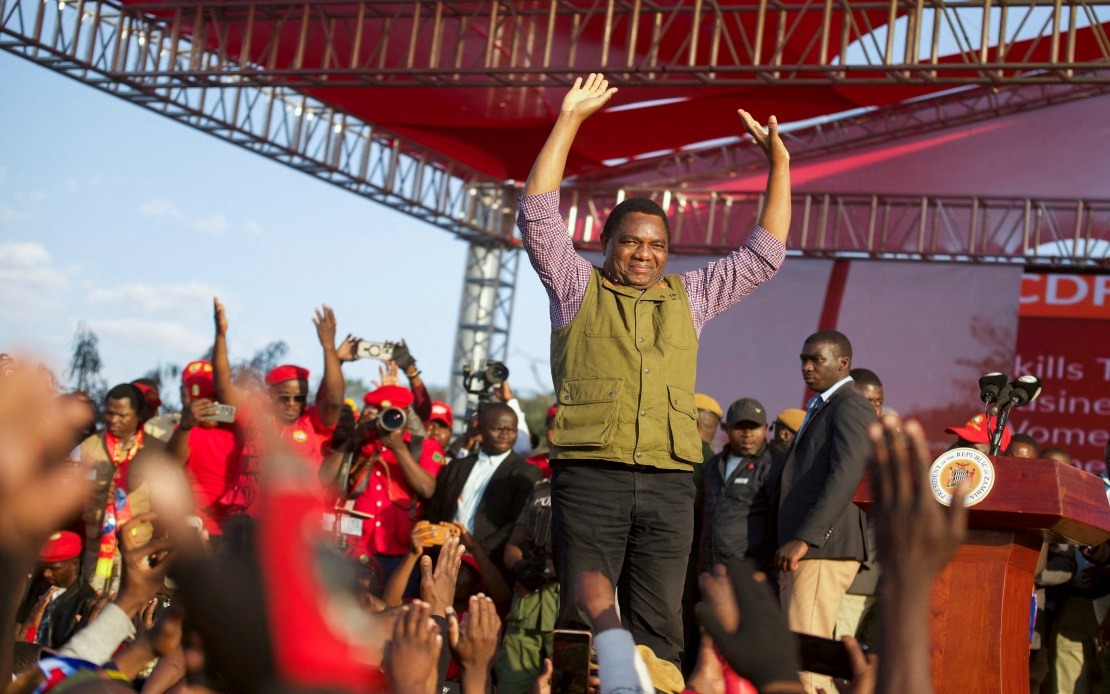
Hakainde Hichilema has been declared the winner of Zambia's presidential election, securing a fresh five-year mandate after polling more than 2.9 million votes in balloting held on Thursday. The 64-year-old incumbent, who heads the ruling United Party for National Development (UPND), surpassed the constitutionally mandated threshold of 50 per cent plus one vote by a substantial margin, as announced by the Electoral Commission of Zambia early Tuesday in the nation's capital, Lusaka.
The scale of Hichilema's victory represents a significant endorsement of his administration's policies and direction over the past five years. His nearest competitor, Brian Mundubile of the National Restoration Party for Unity and Progress (NRPUP), accumulated 1.8 million votes, placing him far behind the incumbent. Electoral Commission chairperson Mwanagala Zaloumis indicated that the margin was sufficiently large that outstanding tallies from selected polling stations across five of Zambia's 226 constituencies would not alter the final outcome, allowing officials to declare the result with confidence despite incomplete formal certification.
The victory carries particular significance within the Southern African context, where political transitions and electoral legitimacy remain closely watched by regional observers and international partners. Hichilema's re-election demonstrates voter confidence in his administration's handling of economic challenges and governance priorities that have defined his first term. For neighbouring nations and regional trading blocs including the Southern African Development Community (SADC), the outcome signals continuity in Zambian leadership and policy frameworks that shape regional commerce and diplomatic relations.
Celebrations erupted spontaneously across Lusaka as news of the result spread, with residents from diverse social backgrounds gathering in streets despite the early morning hour and cold weather. The public displays of enthusiasm reflected broader satisfaction with the electoral process and the outcome among segments of the population that turned out to vote. Such scenes underscore the importance citizens place on participatory democracy and transparent electoral procedures in a region where contested elections have occasionally triggered tension.
In a statement posted to Facebook shortly after Zaloumis's announcement, Hichilema expressed gratitude to voters and pledged continued commitment to public service. His language emphasised humility and stewardship, framing his second mandate as a renewed responsibility to serve national interests rather than personal political advancement. This rhetorical positioning reflects international best practice in democratic transitions and seeks to build broad national consensus around his agenda going forward.
Collins Maoma, national chairperson of the UPND, reinforced these themes in remarks to journalists at the election centre. Maoma urged Hichilema to sustain the qualities of leadership that voters had endorsed, while celebrating Zambian citizens' demonstrated commitment to democratic participation. Such statements from party officials aim to consolidate support and establish a governing narrative that extends beyond electoral victory to encompass the substantive work of administration.
The competitive environment in which Hichilema prevailed reflects Zambia's maturing democratic institutions. The existence of organised opposition capable of mounting credible campaigns, combined with a functional electoral administration able to oversee complex logistics across 226 constituencies and report results transparently, demonstrates institutional capacity. For Malaysian observers, Zambia's experience offers perspective on democratic evolution across diverse African contexts and the varying trajectories nations follow in establishing durable electoral systems.
The economic context surrounding Hichilema's re-election warrants consideration. Zambia has faced significant macroeconomic challenges including debt distress and currency pressures, circumstances that typically create electoral headwinds for incumbent administrations. That voters nonetheless returned Hichilema to office suggests they either credited his government with constructive responses to inherited difficulties or believed continuity preferable to untested alternatives. This pattern resonates with electoral dynamics observed in several Southeast Asian democracies where voters have similarly chosen continuity during periods of economic strain.
Hichilema's second term will likely prioritise economic recovery and fiscal stabilisation, particularly given Zambia's ongoing engagement with international creditors and multilateral institutions. His administration's capacity to deliver on development priorities while managing external obligations will determine whether the electoral confidence expressed this week translates into tangible improvements in living standards. For regional observers monitoring economic governance in Southern Africa, this performance will offer insights into policy effectiveness and institutional resilience.
The election result also carries implications for intra-regional dynamics within SADC, where differing governance models and political trajectories create both partnership opportunities and competitive tensions. Hichilema's continuation in office preserves an administration that has positioned itself as a champion of democratic governance and rule of law within regional forums. This positioning influences how Zambia engages with fellow members on questions ranging from election observation to economic policy coordination.
Looking forward, Hichilema faces the immediate challenge of translating electoral victory into effective governance. The mandate voters have granted provides political space to pursue substantive reforms and policy initiatives, but only if the administration successfully communicates progress and maintains public confidence. International observers, including those from neighbouring countries and distant democracies, will monitor his second term as a barometer of democratic consolidation in the region and the durability of institutional frameworks for managing power transitions.

