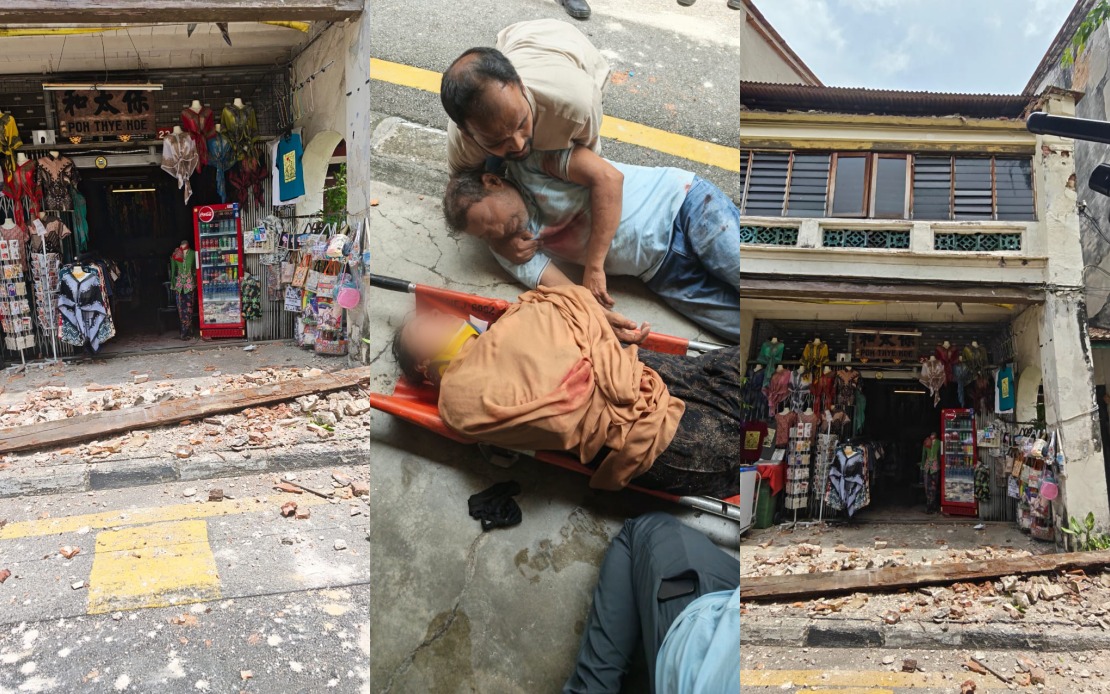
A structural failure at a heritage property in George Town's Armenian Street has prompted urgent safety concerns across Penang's historic precinct, with two visiting tourists from Sri Lanka injured after stones and timber from an upper-floor beam collapsed without warning. The incident, occurring on August 4, highlights the vulnerability of aging buildings in the state's prized World Heritage Zone and has triggered a coordinated government response to prevent similar accidents.
The two casualties, identified as Mohamad Ammtar, 66, and Fatimah, 55, were caught directly beneath the falling debris while navigating the popular Armenian Street thoroughfare. According to Penang Fire and Rescue Department assistant director of operations John Sagun Francis, emergency responders reached the scene at 1.11 pm following calls reporting the collapse. Firefighters from the nearby Lebuh Pantai station found that the debris comprised substantial pieces of stone and timber from what appeared to be a load-bearing first-floor structure. Medical personnel from the Health Ministry provided immediate treatment before transporting both victims to Penang Hospital, where they remained under observation for injuries sustained in the accident.
The timing of the incident proved particularly unfortunate, as the injured couple had arranged to depart Malaysia the following day to return home to Sri Lanka. Initial investigation revealed that the building involved housed a grocery operation on its ground floor, with the upper storey appearing largely unoccupied at the time of the collapse. This configuration may have delayed discovery of the structural weakness that ultimately led to the accident.
State Tourism and Creative Economy Committee chairman Wong Hon Wai visited the scene and immediately elevated the incident beyond a simple accident response, framing it as a broader challenge for Penang's heritage preservation efforts. He disclosed that both George Town World Heritage Incorporated (GTWHI) and the Penang City Council (MBPP) had been instructed to distribute safety advisories to all heritage building proprietors throughout the state. Wong's intervention reflected the government's recognition that one damaged structure could indicate systemic vulnerabilities affecting multiple properties across the heritage zone.
The official response emphasised that inspection protocols must extend far beyond the single building where the accident occurred. Wong stressed in comments to journalists that the structural integrity of all historic and aged properties deserves equal attention, given their potential to endanger both the regular public and the substantial tourist populations that traverse these areas daily. His remarks suggested that building maintenance standards in heritage zones may have fallen below acceptable levels across multiple properties, requiring comprehensive remedial action rather than isolated repairs.
The incident carries particular resonance for Penang's economy and international reputation, given that George Town attracts visitors from across the globe who value its architectural heritage and historical significance. The fact that tourists themselves became victims of poor building maintenance threatens to undermine confidence in the state's stewardship of its protected areas. Wong acknowledged this dimension explicitly, noting that the government took the matter seriously precisely because it involved both visitor safety and the integrity of a designated heritage precinct.
Penang authorities indicated they were still gathering information to establish the precise cause of the structural failure. Wong confirmed that the state government awaited comprehensive reports from investigative authorities before determining what factors contributed to the collapse. This cautious approach suggests officials recognise the need to understand whether the incident resulted from deferred maintenance, design flaws, prior damage, or other causative elements that might affect similar buildings throughout the zone.
In a diplomatic dimension reflecting the international nature of the incident, Wong disclosed that the Penang state government had already contacted the Sri Lankan High Commission in Kuala Lumpur to coordinate assistance for the injured visitors. This coordination mechanism, whilst routine in cases involving foreign nationals, underscores the significance attached to the accident by state leadership and their commitment to ensuring the visitors received appropriate support during their recovery and departure from Malaysia.
The debris collapse raises questions about the adequacy of current inspection regimes for heritage properties in Penang. The state's designation as a UNESCO World Heritage Site in 2008 emphasised architectural preservation, yet the incident suggests that structural safety assessments may not have kept pace with the ageing of these buildings. Many heritage properties in George Town date from the 18th and 19th centuries, and whilst their cultural value is undisputed, their physical integrity requires continuous professional evaluation and timely remedial work.
For Malaysian property owners more broadly, the incident serves as a stark reminder that heritage status, whilst conferring cultural and potentially economic benefits through tourism attraction, also creates heightened safety responsibilities. Buildings of historical significance cannot simply be maintained cosmetically for appearance—their structural systems demand the same rigorous oversight as any modern structure, perhaps even more so given the age and material composition of these properties. The Penang government's rapid mobilisation of advisory mechanisms suggests recognition that proactive communication and enforcement will be necessary to ensure compliance across the diverse ownership landscape in the heritage zone.

