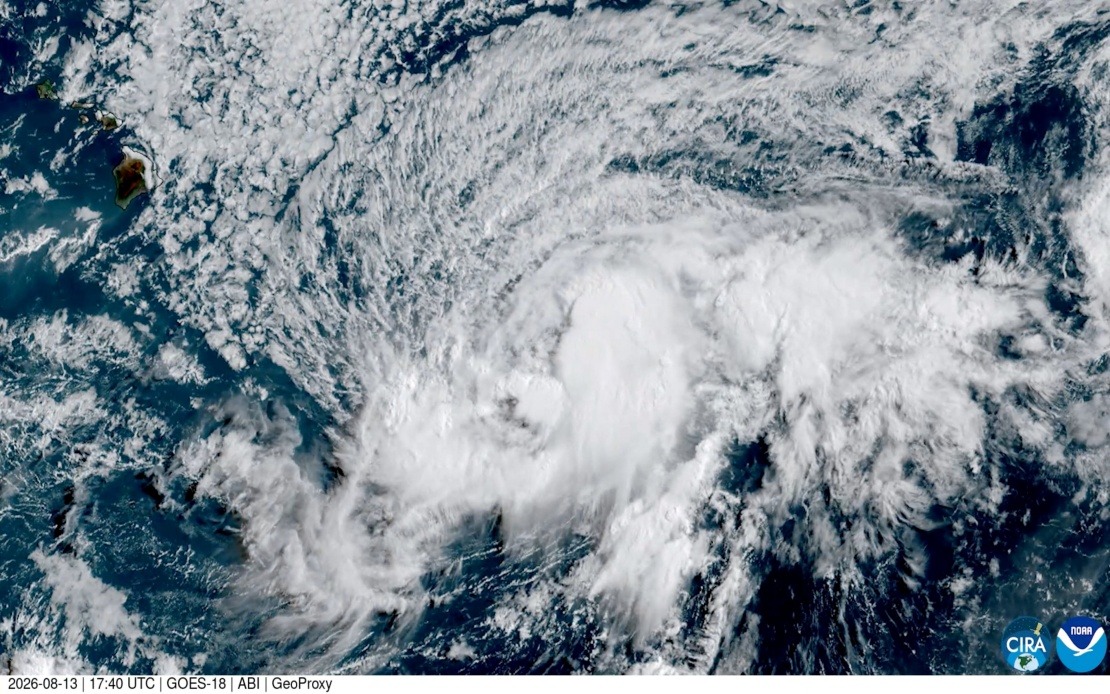
Hawaii's Big Island is preparing for an exceptionally rare weather event this weekend as Tropical Storm Lala gathers strength in the Pacific and moves toward landfall, with meteorologists warning that it will likely achieve hurricane status before reaching the island. The National Hurricane Centre has issued forecasts indicating the system should reach hurricane-force winds by the time it approaches the Big Island on Saturday, making it a potentially historic event for the region if it makes direct contact with land.
The significance of this threat cannot be overstated in the context of Hawaiian weather history. A direct hurricane landfall on the Big Island would represent the first such occurrence since 1871—a gap of more than 150 years. Research conducted by atmospheric scientists at the University of Hawaii, drawing from archival newspaper records from that era, documents that the last hurricane to strike the island was a Category 3 system that affected the northeast corner of the Big Island in the nineteenth century. This historical rarity underscores just how unusual tropical cyclone landfalls are for the Hawaiian archipelago, despite the islands' location in the Pacific hurricane belt.
Vanessa Almanza, a meteorologist with the National Weather Service in Honolulu, emphasized the unprecedented nature of the current threat, noting that no hurricane has made landfall on the Big Island during the satellite era, which began in the 1960s. Her assessment of the latest forecasting models places Lala's projected track extremely close to the southern tip of the Big Island, raising the probability of a direct impact. This proximity to land, combined with the storm's anticipated strengthening, has prompted authorities to issue hurricane warnings specifically for the Big Island while extending tropical storm warnings to Maui County, encompassing Maui, Molokai, Lanai, and Kahoolawe.
The hazards posed by Lala extend well beyond powerful winds. Forecasters have highlighted the substantial risk of destructive flooding from torrential rainfall, a concern that carries particular weight given Hawaii's terrain and drainage patterns. The concentrated nature of tropical cyclone precipitation can rapidly overwhelm local water management systems and create dangerous runoff conditions, especially in areas with significant topographic relief such as the Big Island's volcanic landscape. Additionally, the strong winds associated with hurricane-force systems present secondary dangers through their ability to ignite or accelerate wildfires, a concern that echoes recent fire incidents that have devastated parts of Hawaii in recent years.
The issuance of formal hurricane and tropical storm warnings reflects the gravity with which meteorological agencies are treating this system. A hurricane warning indicates that hurricane-force winds are expected within a specified area within 48 hours, signaling an immediate and severe threat requiring comprehensive emergency preparedness. For the Big Island, this means residents and businesses must take active measures to secure their properties, prepare emergency supplies, and be ready to shelter in place if necessary. The tropical storm warning for Maui County conveys a somewhat lower but still serious risk, as tropical storm-force winds can cause substantial damage and disruption even without reaching full hurricane intensity.
For Malaysia and Southeast Asian readers, this developing situation offers perspective on the weather challenges that Pacific island nations regularly confront and the preparedness mechanisms they employ. While Malaysia itself benefits from its equatorial location and does not face Atlantic or Pacific hurricane threats comparable to those affecting Hawaii, understanding how advanced meteorological systems and early warning protocols function in other regions provides valuable context for global weather phenomenon literacy. The Hawaiian islands, despite their remote location and relatively small population, maintain sophisticated forecasting infrastructure that allows meteorologists to provide several days' advance notice, enabling crucial preparation time.
The contrast between the current threat and historical patterns also highlights how climate systems operate on decadal and longer timescales. The fact that 150 years elapsed between major hurricane landfalls on the Big Island does not negate the islands' vulnerability to such events; rather, it underscores the variability of tropical cyclone activity and the importance of maintaining readiness despite the rarity of specific impact scenarios. This principle applies broadly across the tropical Pacific region, where Southeast Asian nations and island communities must maintain preparedness even for meteorological events that occur infrequently.
Emerging as this situation develops, the response from Hawaiian authorities and communities will provide instructive examples of disaster management and resilience in action. The mobilization of resources, coordination between agencies, and public communication strategies deployed over the coming days represent practical demonstrations of how societies respond to imminent natural hazards. For a region as geographically dispersed and vulnerable as the Pacific island realm, such real-world applications of preparedness protocols carry significance extending well beyond Hawaii's shores, offering lessons applicable to island nations throughout the region facing similar meteorological risks.

