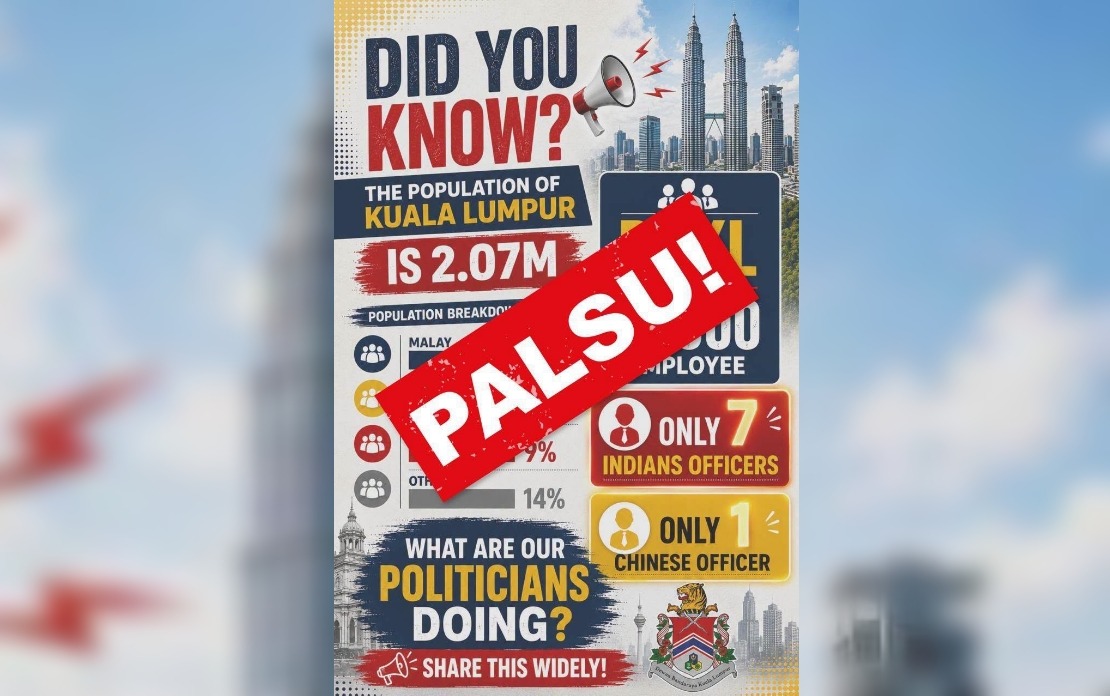
Minister in the Prime Minister's Department (Federal Territories) Hannah Yeoh has moved to counteract misleading information circulating online regarding the ethnic composition of Kuala Lumpur City Hall's workforce, warning the public against being swayed by unsubstantiated claims that have gained traction during the election campaign. The clarification addresses a widespread WhatsApp poster alleging severe underrepresentation of minority communities at the municipal authority, claims that Yeoh characterised as fundamentally inaccurate and disconnected from verifiable personnel records.
According to official data released by Yeoh's office, the actual employment profile of DBKL as of July 1, 2026, presents a markedly different picture from the viral claims. The local authority currently employs 9,131 staff across its operations, encompassing a workforce that includes 490 Indian employees and 22 Chinese staff members—figures substantially higher than the single-digit allegations circulating on social platforms. Within DBKL's more senior Management and Professional Group, representation includes 10 Indian officers and two Chinese officers, demonstrating a degree of diversity in mid-level administrative positions, though the overall percentages warrant ongoing examination.
The emergence of such claims during an election period raises concerns about the deliberate weaponisation of workplace diversity statistics for political gain. Yeoh emphasised in a Facebook statement that all stakeholders should resist the temptation to exploit employment composition as a vehicle for sowing racial division. Instead, she advocated for a constructive approach focused on correcting verifiable misinformation while simultaneously addressing any legitimate gaps that may exist within DBKL's human resources framework. This dual message reflects a delicate balance between defending the institution against unfounded accusations and acknowledging room for improvement.
Recognising that even accurate employment data may mask systemic imbalances, Yeoh has taken the proactive step of instructing DBKL to undertake a comprehensive review of its human resources practices. This directive encompasses multiple dimensions of the employment lifecycle, including initial recruitment strategies, hiring decision-making processes, and the mechanisms through which advancement opportunities are allocated. Additionally, the review extends to job advertisement distribution channels, an often-overlooked area that can inadvertently limit applicant pools and perpetuate historical imbalances if not scrutinised closely.
The announced review signals an administrative commitment to identifying structural barriers that may discourage applications from underrepresented groups or create subtle obstacles to career progression. Such gaps are frequently embedded in institutional practices rather than arising from explicit discriminatory intent, making them difficult to detect without deliberate examination. By committing to transparency and merit-based processes, Yeoh has framed the initiative as an opportunity to strengthen DBKL's legitimacy as a representative public institution that reflects the demographics and aspirations of Kuala Lumpur's diverse population.
For Malaysian readers concerned with governance quality and institutional integrity, the episode illustrates the ongoing vulnerability of public sector agencies to electoral manipulation through demographic narratives. During campaign periods, false claims about government institutions can spread rapidly through messaging applications, where limited fact-checking and high emotional resonance create fertile ground for misinformation. The swift rebuttal from Yeoh's office, backed by specific employment figures, demonstrates one approach to combating such claims, though questions remain about how effectively official corrections reach audiences already exposed to misleading content.
The broader context involves Malaysia's complex relationship with ethnic representation in the civil service. Historical patterns reflect the preferences established during the postcolonial period, and subsequent governments have grappled with whether existing demographics represent merit-based outcomes or residual structural advantages. Yeoh's acknowledgement that representation can still improve suggests an acceptance of this underlying tension, implying that current levels, while higher than the false claims alleged, may not yet reflect proportional workforce participation across all ethnic communities in Kuala Lumpur.
The commitment to reviewing recruitment and promotion practices carries significance beyond DBKL itself. As the capital city's primary municipal authority, DBKL's employment policies influence not only the livelihoods of thousands of individuals but also set precedents for human resources management across other local authorities and government departments. A successful demonstration of transparent, merit-based advancement could provide a replicable model for other institutions navigating similar pressures to improve representation while maintaining institutional effectiveness.
Yeoh's appeal for all parties to refrain from exploiting the issue for political advantage underscores the responsibility borne by both government officials and opposition actors during electoral periods. While criticism of institutional practices remains legitimate and necessary for accountability, framing concerns through deliberately false claims undermines constructive dialogue and invites counter-narratives that may dismiss even valid concerns about diversity and inclusion. The distinction between legitimate advocacy for improved representation and the spread of fabricated statistics carries real consequences for democratic discourse.
Looking forward, the review findings and any subsequent reforms will merit close scrutiny from civil society, opposition politicians, and the media. Transparency in publishing both the review's conclusions and the concrete steps taken in response will be essential for maintaining public confidence in DBKL's commitment to fair employment practices. Whether this episode catalyses genuine institutional change or remains a one-off response to electoral pressure will likely shape public perception of whether serious concerns about representation in public institutions are being adequately addressed.

