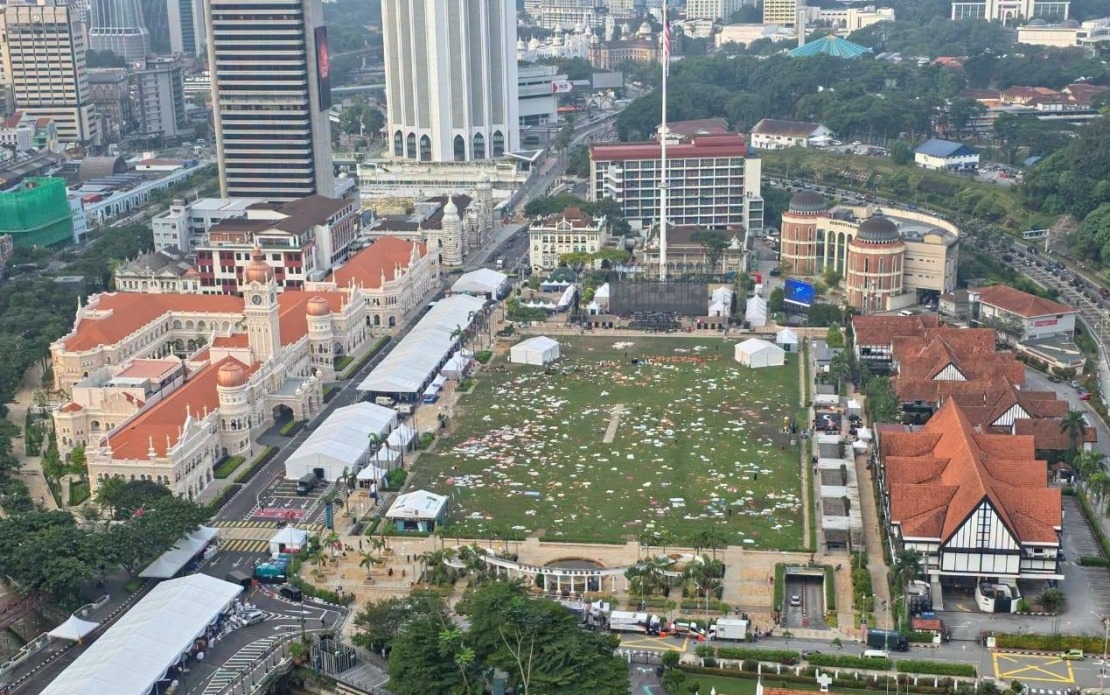
Federal Territories Minister Hannah Yeoh has praised the dedication of Kuala Lumpur City Hall (DBKL) staff who undertook a comprehensive cleanup of Dataran Merdeka after the area accumulated significant litter during a public screening of the 2026 FIFA World Cup final. In acknowledging the workers' efforts, the minister has simultaneously launched a broader appeal to the Malaysian public, stressing that maintaining the cleanliness and dignity of national spaces remains a collective responsibility that cannot rest solely on government workers and their agencies.
The incident underscores a recurring tension in urban management across Southeast Asian capitals, where high-profile public events frequently generate substantial waste that strains municipal resources. Dataran Merdeka, as Malaysia's most symbolically significant public plaza and the site of Independence Day celebrations, carries particular cultural weight that extends beyond its function as a venue for gatherings and screenings. The contrast between the historic importance of the space and the aftermath of the event prompted the minister to reframe the discussion around civic duty and national pride rather than merely criticizing attendees' behaviour.
Hannah's intervention reflects a deliberate policy approach within the Malaysia MADANI framework, which positions governmental progress not solely through infrastructure development or service delivery, but through cultivating a culture of mutual responsibility between state institutions and citizens. This philosophical stance acknowledges that while DBKL must maintain professional standards in public space management—a core government obligation—the quality of shared urban environments ultimately depends on individual choices made by millions of residents and visitors. The minister's remarks suggest that relying exclusively on enforcement and cleanup operations represents an incomplete solution to maintaining public dignity.
The minister explicitly challenged the notion that taxpayer status automatically transfers all maintenance obligations to government bodies. While recognizing that every Malaysian legitimately expects quality public services in exchange for tax contributions, Hannah articulated the distinction between service provision and personal responsibility. Disposing of litter properly, she argued, represents a fundamental civic action that should not require municipal intervention. This framing positions waste disposal as a matter of individual conscience rather than regulatory compliance, appealing to intrinsic values rather than external enforcement mechanisms.
The context of a FIFA World Cup screening carries additional significance for Malaysia's international standing. As the nation aspires to host major sporting events and position itself as a modern, organized capital within Southeast Asia, the visual appearance of its premier public spaces carries diplomatic implications. International visitors and media coverage of such events shape perceptions of Malaysian governance and social discipline. The accumulation of rubbish at Dataran Merdeka, therefore, extends beyond a local sanitation issue to reflect on broader national competence and civic culture in the eyes of external observers.
Hannah's invocation of Prime Minister Datuk Seri Anwar Ibrahim's perspective on measuring national progress adds executive-level weight to the civic responsibility argument. By connecting cleanliness and respect for public spaces to the broader definition of national advancement, the government signals that development encompasses social and behavioural dimensions alongside economic and infrastructural metrics. This represents a strategic reorientation in how progress is discussed in Malaysian politics, potentially shifting public discourse toward questions of individual conduct and collective stewardship.
The symbolic significance of Dataran Merdeka as a heritage space—the location where Malaysia declared independence and where national celebrations occur annually—elevates the cleanup discussion beyond routine municipal management. The minister framed the plaza not merely as a functional event venue but as a repository of national history and identity requiring protection by all Malaysians. This heritage-conscious approach may resonate particularly among citizens who view public spaces through the lens of national patrimony rather than simply utilitarian functions.
For DBKL specifically, the minister's praise provides institutional validation while setting clear boundaries around organizational responsibility. The acknowledgment that the city hall has fulfilled its obligations establishes accountability expectations going forward, while the simultaneous call for public participation suggests that government capacity alone cannot sustainably manage cleanliness outcomes. This balanced approach avoids scapegoating either the municipality or the public, instead positioning them as interdependent stakeholders in urban quality.
The timing and framing of Hannah's statement reflect emerging concerns in Malaysian governance about social discipline and environmental stewardship during large public gatherings. Recent years have witnessed high-profile events where crowds generated substantial waste, raising questions about whether current civic education adequately instils environmental consciousness. The minister's intervention suggests that policymakers increasingly view public cleanliness as an indicator of social health and cultural values rather than a purely technical municipal challenge requiring only better equipment or more workers.
For Malaysian residents and those planning major public events, the minister's remarks carry practical implications. The expectation that attendees at large gatherings should actively dispose of their own rubbish in designated bins, rather than assuming cleanup crews will manage debris, represents a normative shift in how public events operate. Event organizers may need to combine improved waste infrastructure with education campaigns emphasizing individual responsibility, recognizing that infrastructure improvements alone have demonstrably insufficient impact.
The broader Southeast Asian context reveals similar struggles with maintaining public space standards during high-attendance events across Bangkok, Jakarta, and Singapore. Hannah's approach of framing cleanliness as a citizenship issue—connected to dignity, national identity, and shared pride—offers an alternative to purely technical or punitive solutions. This philosophical angle may prove more culturally resonant than enforcement-heavy approaches, though implementation success will depend on whether the message translates into sustained behavioural change among diverse urban populations.
Looking forward, the challenge for Malaysian authorities involves sustaining this conversation beyond the immediate incident. Single appeals from ministers, however well-articulated, historically produce temporary shifts in public consciousness. Embedding responsibility for public space cleanliness into broader national narratives about identity, progress, and shared citizenship may require sustained reinforcement through multiple institutional and educational channels. The effectiveness of Hannah's message will ultimately be measured not by the cleanup itself—which DBKL competently completed—but by whether attendance at future public events in Dataran Merdeka and similar spaces demonstrates internalized norms about environmental stewardship.

