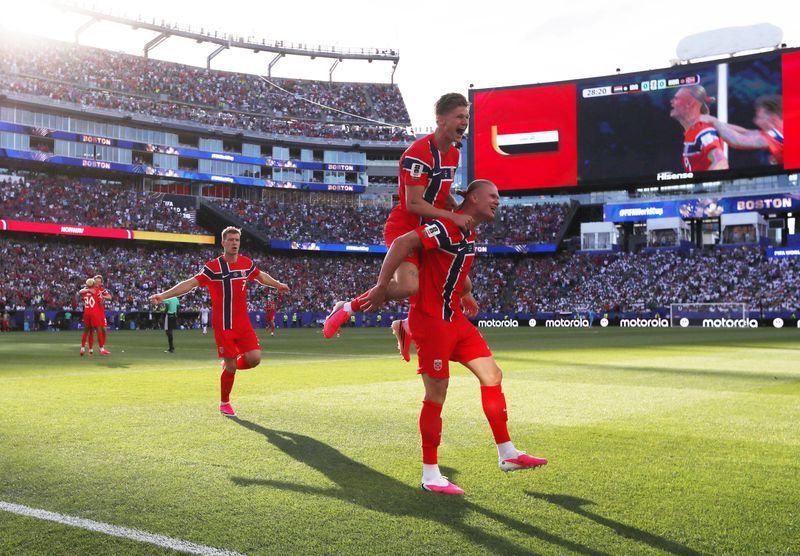
Bearing the weight of Norwegian expectations, striker Erling Haaland made an unmistakable statement at the World Cup with a commanding two-goal performance that carried his nation to a 4-1 demolition of Iraq on Tuesday. The prolific forward, who has built a reputation for decisive moments in high-pressure environments, proved he belongs among the tournament's elite talents with a masterclass in clinical finishing that overshadowed a patchy overall display from his teammates.
Haaland's first-half brace represents another milestone in an extraordinary trajectory through European football's most prestigious stages. The 22-year-old has now registered goals on his competitive debut for every major platform he has graced—the German Bundesliga, the English Premier League, the UEFA Champions League, and now the World Cup finals. Few observers had harboured doubts that he would rise to this occasion, yet the speed and efficiency with which he delivered silenced any remaining sceptics about whether youth and inexperience might hinder his impact at this level.
Norway's path to victory, however, revealed vulnerabilities that could prove troublesome in subsequent group matches. Despite the emphatic scoreline, the Scandinavian side failed to impose a sustained rhythm on proceedings, committing a series of passes to poorly chosen recipients and allowing Iraq to orchestrate moments of genuine attacking threat. Haaland's individual brilliance papered over the cracks in a team performance that lacked cohesion and composure in midfield and defensive positions for stretches of the encounter.
When asked about his contributions, Haaland—known for his taciturn approach to media engagement—allowed his performances to provide the primary commentary. Irrespective of Iraq's defensive configurations and tactical adjustments, the Norwegian forward found space and time to influence the match decisively. His first strike exemplified textbook positioning, capitalizing on a pinpoint cross from David Moller Wolfe delivered across the face of the goal. His second goal arrived through a different pathway: aggressive pressing forced the Iraqi defence into a careless backwards pass, which Haaland seized upon, blocking the goalkeeper's clearance attempt and redirecting the ball goalward.
The philosophy underpinning Norway's approach, as outlined by Prime Minister Jonas Gahr Stoere in his pre-match remarks, centres on a simple but effective principle—while individual players score, teams claim victories. Manager Stale Solbakken's tactical framework essentially revolved around creating opportunities for Haaland to exploit, trusting his finishing prowess to convert half-chances into goals. This strategy bore fruit, yet it also exposed a concerning dependency on one player's brilliance rather than a more balanced attacking structure.
Norway's midfield and defensive setup showed concerning lapses, most notably the lapse in concentration that allowed Iraq to equalize through Aymen Hussein. Captain and playmaker Martin Odegaard, typically influential in orchestrating attacking play, produced an uncharacteristically muted contribution from his midfield berth. The defence, preoccupied with monitoring threats elsewhere, momentarily lost focus and conceded a goal that ought to have been preventable through better positional discipline.
The victory places Norway atop their group with three points, though this commanding position relies more on mathematical advantage than on the quality of their performance. France, who defeated Senegal 3-1 earlier in the day, sit just behind on goal difference—a reminder that group-stage football offers little margin for complacency. Haaland himself acknowledged this reality, cautioning that his side must substantially elevate their standards in upcoming fixtures if they harbour ambitions of progressing beyond the group stage.
For Norwegian supporters and the nation itself, the result carries deeper resonance beyond its immediate sporting significance. This represents Norway's return to the World Cup stage after an absence stretching back 28 years, a drought that has tested the patience of a football-loving public. Haaland's explosive entrance into the tournament provided an ideal narrative through which the country could reacquaint itself with World Cup football at its most thrilling.
The striker's post-match demeanor reflected the broader mood of celebration and relief. When asked about the occasion, Haaland spoke with evident satisfaction about meeting expectations and steering clear of potential early embarrassments. His reference to the time in Norway and hopes that people were celebrating underscored the personal and national significance of the moment—a young talent delivering immediately when the stakes were highest, and a country rediscovering the joy of World Cup participation after decades in the wilderness.