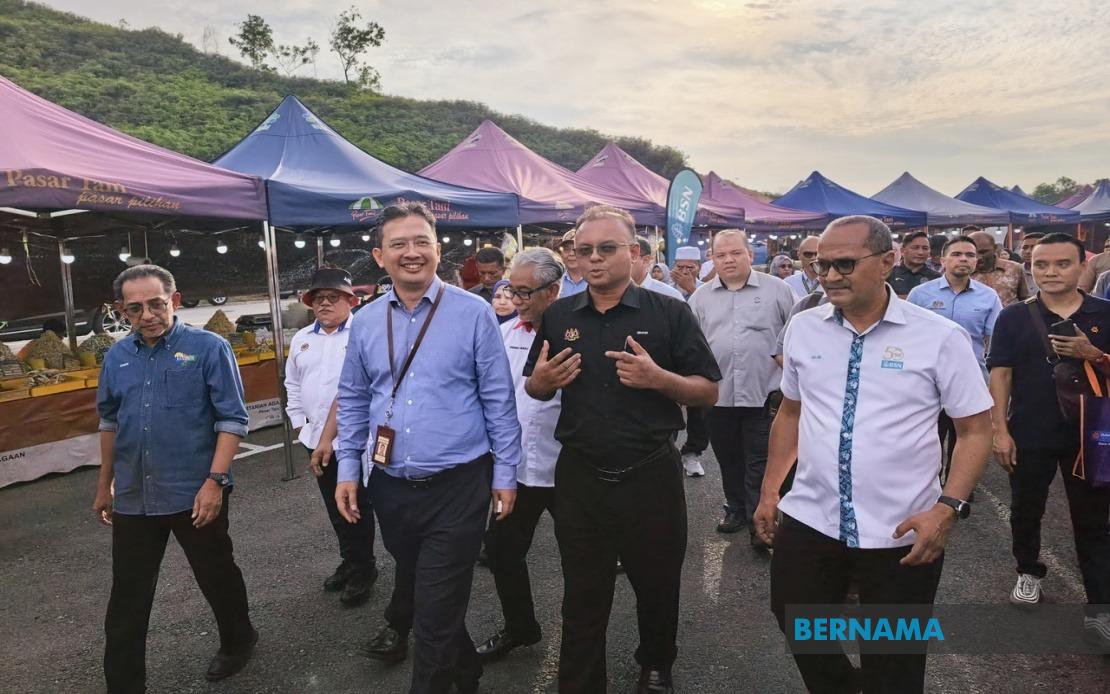
The Malaysian government is stepping up its drive to educate small business owners and traders about access to micro-financing schemes worth over RM5 billion, recognising that widespread lack of awareness is preventing many eligible entrepreneurs from obtaining crucial financial support.
Treasury secretary-general Tan Sri Johan Mahmood Merican identified limited public knowledge about the range of micro-credit facilities as a persistent challenge, prompting coordinated ground-level engagement by all participating agencies. Speaking after attending an outreach event at Putrajaya Pasar Tani, he emphasised that the administration intends to place officers directly within trading communities, particularly focusing on small-scale retailers and informal sector businesses who often operate without exposure to formal banking channels.
The RM5 billion micro-financing initiative, announced by Prime Minister Datuk Seri Anwar Ibrahim, is being delivered through six major institutions: Agrobank, Bank Simpanan Nasional, Bank Rakyat, TEKUN Nasional, Amanah Ikhtiar Malaysia, and Majlis Amanah Rakyat. Together, these entities represent a substantial portion of the government's strategy to democratise financial access and strengthen the backbone of Malaysia's informal economy. The participation of institutions ranging from agricultural-focused lenders to cooperative organisations reflects the breadth of the programme's design.
During his engagement with over 124 traders at the Putrajaya farmers market, Johan discovered encouraging results when conversing directly with business owners. The majority indicated they had previously successfully obtained financing from participating government agencies, with numerous traders having accessed multiple rounds of funding. This pattern suggests that once entrepreneurs become aware of the facilities and complete the application process, they tend to return for additional financing as their businesses grow or require working capital replenishment, indicating genuine utility of the schemes.
Agrobank, one of the core delivery partners, has reported tangible momentum from its farmers' market engagement programme. To date, the bank has processed more than 160 applications generating approximately RM6.4 million in approved micro-financing, demonstrating that when outreach occurs in accessible community spaces rather than formal banking environments, application volumes rise substantially. This success rate suggests that traditional banking infrastructure may inadvertently create barriers for informal traders unfamiliar with institutional procedures, and that meeting entrepreneurs in their natural business environments significantly reduces friction in accessing capital.
Agrobank president and chief executive officer Datuk Tengku Ahmad Badli Shah Raja Hussin characterised the positive response as validation that hawkers and micro-entrepreneurs are receptive to financing products positioned as convenient, geographically accessible, and contextually relevant to their operational realities. Rather than generic loan products designed for corporate borrowers, the micro-financing schemes acknowledged that small traders operate on constrained timelines, require rapid capital deployment, and need financial solutions integrated with their daily commercial rhythms. The receptiveness indicated by application volumes suggests this tailored approach resonates with target beneficiaries.
Beyond provision of raw capital, participating agencies are complementing financing with ancillary support services designed to strengthen long-term business viability. Financial advisory services, takaful insurance protection, business digitalisation assistance, and financial literacy programmes represent a holistic ecosystem recognising that capital alone is insufficient for sustainable entrepreneurship. By bundling these supports, the scheme addresses structural vulnerabilities affecting informal traders, including limited financial planning capacity, inadequate insurance coverage, and slow technology adoption—factors that frequently impede business expansion even when capital is available.
The farmers' market engagement strategy represents a deliberate administrative shift toward proactive outreach rather than passive availability. Traditional banking assumes potential borrowers will independently seek financial services through established channels; the new approach recognises this assumption fails for informal sector traders who may lack time, confidence, or awareness to navigate formal institutions. By stationing lending officers in high-traffic trading locations, the government removes practical obstacles while simultaneously gathering intelligence about trader needs, preferences, and constraints that can inform programme refinement.
For Malaysian policymakers focused on inclusive economic growth, the RM5 billion micro-financing initiative addresses a critical gap in the country's financial ecosystem. Southeast Asia's informal economy employs millions of workers whose economic contributions remain substantial despite operating outside formal regulatory frameworks. Malaysia's recognition that financial inclusion requires deliberate infrastructure dedicated to informal traders positions the country as a regional leader in addressing persistent disparities in capital access between formal and informal sectors.
The initiative carries particular relevance for states with large informal trading populations and agricultural workers who historically faced barriers when approaching mainstream financial institutions. Rural entrepreneurs and agricultural traders, who lack conventional collateral or formal credit histories that banks traditionally require, benefit from the specialised approach adopted by agencies like Agrobank and TEKUN Nasional, which have developed assessment methodologies appropriate for businesses operating without conventional accounting systems.
Government commitment to amplifying awareness through intensified ground-level engagement suggests recognition that programme success depends not merely on making capital available but ensuring information reaches intended beneficiaries through trusted, accessible channels. The continuation of farmers' market visits and similar community-based engagement formats should yield sustained increases in application volumes and disbursements, while simultaneously gathering feedback that helps agencies refine eligibility criteria, documentation requirements, and product features to better serve target populations.
Ministry of Agriculture and Food Security secretary-general Datuk Seri Isham Ishak complemented the financing initiative by highlighting the SISDA portal operated by the Federal Agricultural Marketing Authority, which enables price transparency across supply chains. This complementary infrastructure allows traders to access market information alongside financing, creating conditions where capital can be deployed informed by real-time price signals and supply dynamics, thereby reducing speculative risk associated with inventory investment decisions. The integrated approach—combining financial access with market intelligence—demonstrates sophisticated understanding that comprehensive trader support requires coordination across multiple government functions.

