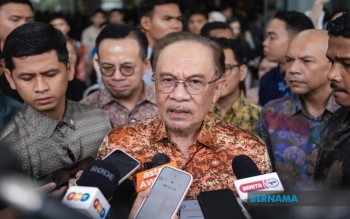
Prime Minister Datuk Seri Anwar Ibrahim has definitively ruled out returning to a Goods and Services Tax framework despite mounting fiscal pressures, drawing a clear distinction between rejecting the levy's foundational structure and remaining flexible on modifying the existing Sales and Service Tax regime. Speaking after opening the TikTok Shop Summit 2026 in Kuala Lumpur on Tuesday, Anwar, who also holds the Finance Ministry portfolio, stressed that the government's commitment to protecting lower-income Malaysians remains non-negotiable even as policymakers explore ways to strengthen the country's consumption tax base.
The pronouncement comes as the administration grapples with balancing revenue imperatives against political sensitivities surrounding taxation. Malaysia's transition away from GST in 2018 reflected public anger over cost-of-living pressures during that period, making any reversion politically fraught. Anwar's remarks indicate the government recognises this historical context and has chosen to frame its tax strategy around the MADANI governance philosophy, which prioritises protecting vulnerable populations. By explicitly rejecting GST's core principle—which applies levy universally across economic activity—the Prime Minister is signalling that future tax adjustments will operate within narrower parameters.
However, Anwar's position should not be interpreted as rejection of all tax reform. The government has been quietly canvassing options to improve revenue collection, including proposals for electronic payment transaction taxes and selective modifications to how SST operates across different sectors. These discussions reflect a pragmatic acknowledgment that the current consumption tax framework may not generate sufficient revenue for infrastructure development, social programmes, and debt management that the government deems necessary. The distinction Anwar drew between considering "some components of GST" while rejecting the "basic essence" suggests room for targeted revenue-raising measures that avoid imposing fresh burdens on Malaysia's poorest households.
The SST system, introduced in September 2018 as a replacement for GST, applies a six percent levy on goods and a six percent service tax on select services. While simpler to administer than GST, the system generates lower revenue and leaves numerous service categories untaxed, creating gaps in the tax base. Experts have long noted that SST's design is less efficient than a properly structured broad-based consumption tax, partly because it requires determining goods versus services classifications and involves exemptions that complicate compliance. Anwar's openness to "adjustments in the way to improve the implementation of the SST" likely refers to addressing these technical inefficiencies without fundamentally restructuring the levy or expanding its reach to previously untaxed groups.
The timing of this clarification matters for Malaysia's regional standing and investment climate. Neighbouring economies like Singapore and Australia operate sophisticated GST or goods and services tax systems that contribute substantially to government revenue while maintaining progressive elements through exemptions and reduced rates on essentials. Investors and credit rating agencies monitor Malaysia's fiscal trajectory carefully, and the government's inability to broaden its tax base constrains its ability to fund development and service debt comfortably. By keeping the door open to selective SST improvements, Anwar is attempting to signal fiscal responsibility to international observers while managing domestic political constraints.
The government's position also reflects internal debates within the MADANI coalition about the proper balance between fiscal consolidation and social protection. The phrase "core principle of the MADANI government" appears carefully chosen to embed tax policy within the administration's broader ideological framework rather than purely technical or economic considerations. This framing allows ministers to pursue incremental revenue measures—such as broadening SST coverage to previously exempt services or adjusting sectoral tax rates—without being accused of abandoning pro-poor commitments. It also provides cover for unpopular decisions by tethering them to the MADANI philosophy rather than presenting them as reversals of campaign promises.
Regional observers will note that Malaysia's tax debate occurs against a backdrop of rising fiscal deficits across Southeast Asia and global discussions about minimum tax standards. The OECD's recent work on pillar two minimum tax arrangements and Base Erosion and Profit Shifting initiatives creates international pressure on governments to expand revenue bases. Malaysia's rejection of broad-based GST means the government must find alternative revenue sources—through corporate tax increases, wealth taxes, or targeted consumption tax adjustments—to maintain fiscal sustainability. The emphasis on SST refinement suggests officials are exploring the path of least political resistance while still addressing revenue shortfalls.
Industry and business groups will likely interpret Anwar's remarks as authorising technical discussions about SST implementation without fear of sudden structural overhaul. Retailers, hospitality operators, and service providers have invested heavily in systems and processes adapted to the current SST framework. The government's commitment to retaining that structure, with modifications rather than replacement, reduces business uncertainty about compliance costs and system redesign. However, companies should anticipate that specific sectors or service categories might face expanded SST coverage as the government pursues "adjustments" to improve efficiency and revenue yield.
For ordinary Malaysians, particularly those in lower income brackets, the Prime Minister's statement provides reassurance that any future tax changes will not impose the across-the-board burden that GST represented. The 2018 election's anti-GST sentiment demonstrated that voters will punish governments perceived as increasing the tax burden on ordinary citizens. By cementing the "do not increase taxes on the very poor" principle as non-negotiable, Anwar is signalling that fiscal adjustment will not rely on regressive consumption taxation. This positioning helps the government maintain political credibility on living cost issues even as it pursues other revenue-raising measures that might affect middle-income and higher-income groups more substantially.
The distinction between rejecting GST in principle while remaining open to SST evolution also has implications for Malaysia's tax base in coming years. Selective sectoral expansion of SST, combined with possible taxes on digital transactions or financial services, could gradually broaden the consumption tax base without formally reintroducing GST. This incremental approach allows the government to improve fiscal health while claiming consistency with its MADANI commitments. Whether such an approach ultimately generates sufficient revenue without harming growth or competitiveness will determine whether future administrations revisit the GST question or pursue alternative fiscal strategies.

