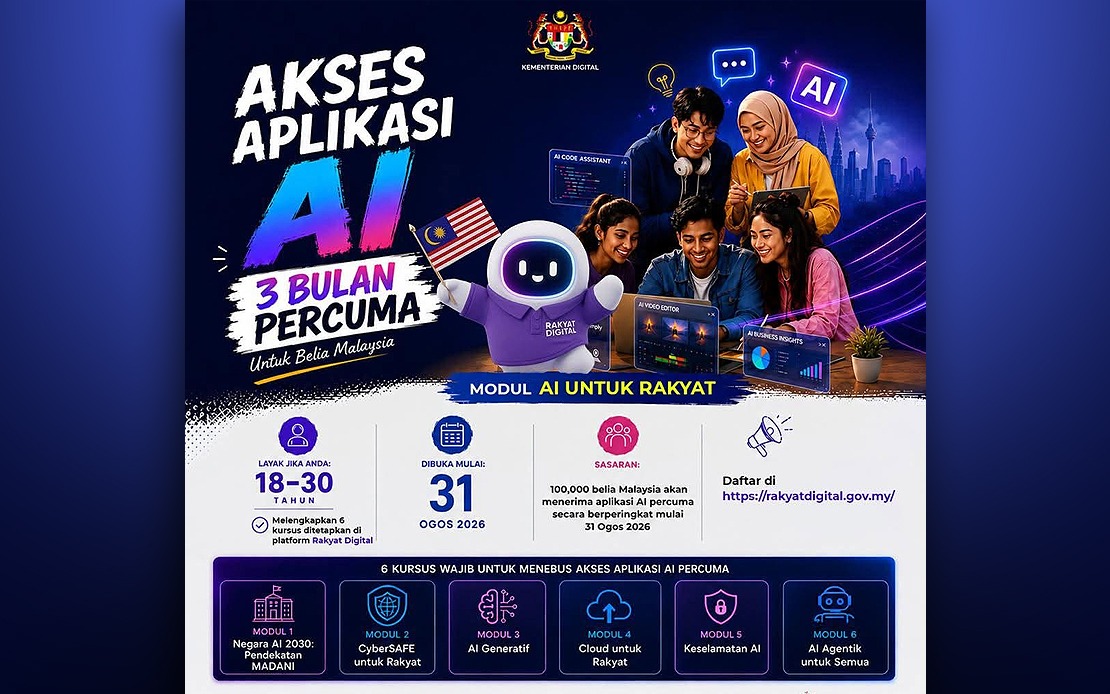
The Malaysian government has launched an ambitious initiative to democratise access to artificial intelligence technology among young citizens, announcing the AI for the People (AI Untuk Rakyat) programme that will provide free training and software subscriptions to 100,000 Malaysians between the ages of 18 and 30 until 2027. Prime Minister Datuk Seri Anwar Ibrahim unveiled the scheme at the Putrajaya International Convention Centre during the 2026 National Day Premier Address, positioning it as a cornerstone of the government's broader effort to expand digital opportunities for the nation's youth.
The programme operates through a structured learning pathway in which participants must successfully complete and pass six modular courses before becoming eligible for three months of complimentary access to artificial intelligence applications and software. Enrollments commenced immediately through the Rakyat Digital portal at rakyatdigital.gov.my, with the Digital Ministry managing the rollout in phases to accommodate the anticipated demand from interested young Malaysians seeking to deepen their understanding of contemporary technology. The portal, operated by MyDIGITAL Corporation as a national digital learning initiative, will serve as the central hub for registrations and course delivery.
The curriculum comprises six substantive modules designed to build comprehensive competency in artificial intelligence across multiple dimensions. The offerings include AI Nation 2030: The MADANI Approach, which frames AI development within Malaysia's broader development philosophy; CYBERSAFE for the People, addressing security and responsible usage; Generative AI, covering the most commercially prevalent AI applications; AI Security, focusing on protective measures and risk mitigation; Agentic AI for All, exploring autonomous intelligent systems; and Cloud for the People, introducing cloud infrastructure foundations. This structured approach ensures that participants gain both conceptual understanding and practical technical literacy necessary for leveraging AI tools effectively in professional and personal contexts.
Participants who successfully navigate the entire course sequence will receive privileged access to a curated selection of artificial intelligence tools from both established local and multinational technology providers. The initial partnerships include YTL AI Labs offering IlmuChat, Alibaba providing Wonderclip and MuleRun, and Google delivering Gemini Enterprise—representing a blend of Malaysian and global technological resources. The Digital Ministry has signaled that this roster will expand progressively as additional software providers join the initiative, gradually enriching the ecosystem available to programme participants and ensuring that the offering remains current with emerging technological developments.
The initiative addresses a critical gap in Malaysia's digital preparedness by providing hands-on exposure to advanced technology tools that would otherwise remain inaccessible to many young Malaysians, particularly those from lower-income backgrounds or outside major urban centres. By removing financial and educational barriers, the programme enables broader participation in the artificial intelligence economy, potentially cultivating a more diverse pool of talent capable of developing, deploying, and governing AI systems within Malaysia. This grassroots approach to technological capability-building contrasts with conventional models that tend to concentrate AI skills within elite educational institutions and corporate environments.
Digital Ministry secretary-general Datuk Fabian Bigar underscored the strategic importance of the initiative, emphasizing that access to technology represents only half the equation—meaningful engagement with AI tools requires both conceptual knowledge and practical experience. The programme deliberately combines theoretical instruction with immediate access to production-grade software, allowing participants to move seamlessly from learning to application. This integration between education and practical deployment significantly enhances the relevance of the training for participants contemplating careers in technology sectors or seeking to leverage AI for entrepreneurial ventures and creative projects.
The programme aligns with Malaysia's Digital 2030 aspirations and the broader national vision to establish an inclusive AI Nation by 2030—a policy framework emphasizing that technological advancement must distribute benefits across society rather than concentrating them among privileged segments. The government's positioning of this initiative as integral to national development strategy reflects recognition that artificial intelligence will fundamentally reshape employment, productivity, and economic competitiveness across virtually all sectors. By building foundational AI literacy among 100,000 citizens during their economically productive decades, the nation aims to cultivate a workforce equipped to navigate the technological transitions ahead.
For Malaysian youths, the programme offers tangible value extending beyond simple digital skill acquisition. Participants gain exposure to tools employed by professionals and entrepreneurs globally, enabling them to understand the capabilities and limitations of contemporary artificial intelligence systems. This practical knowledge proves invaluable whether individuals pursue careers in technology directly or apply AI to challenges within other professional domains such as healthcare, agriculture, education, and manufacturing. The three-month subscription period provides sufficient duration for meaningful exploration and skill development while establishing familiarity with interfaces and workflows that participants might encounter in professional environments.
The regional implications of Malaysia's initiative warrant consideration as well. Southeast Asia broadly lags developed nations in artificial intelligence adoption and workforce development, creating structural disadvantages in an increasingly AI-driven global economy. Malaysia's proactive stance in providing subsidized access to AI training and tools positions the nation as a regional leader in democratizing technology and could establish a template for other Southeast Asian governments grappling with similar capability gaps. Should the programme successfully reach its target of 100,000 participants and demonstrate measurable improvements in digital competency, neighbouring countries may adopt comparable approaches, collectively raising the region's technological preparedness.
The programme also signals the government's confidence in private sector partnerships for delivering public digital benefits. By enlisting technology providers ranging from homegrown enterprises like YTL AI Labs to multinational corporations including Google and Alibaba, the initiative leverages commercial innovation and resources to advance public objectives. This collaborative model allows the government to extend programme reach beyond what domestic budgets alone could accomplish while giving technology companies early access to a large cohort of trained users who might later become customers, employees, or partners.

