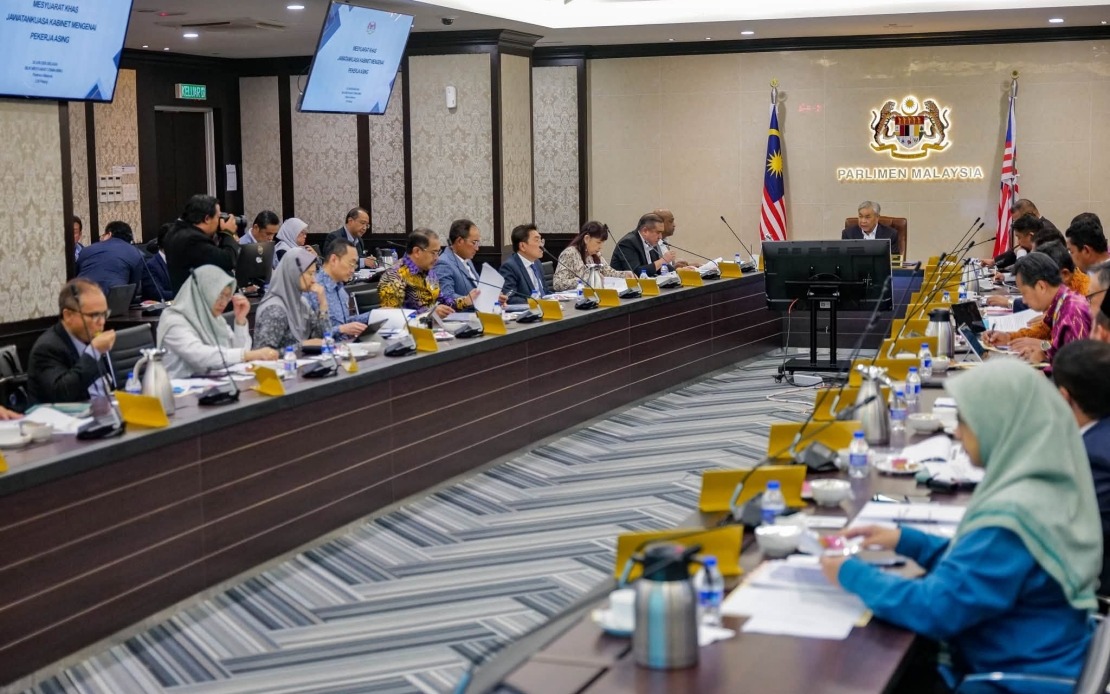
Malaysia's government is embarking on a comprehensive restructuring of how it manages foreign workers, with Deputy Prime Minister Datuk Seri Dr Ahmad Zahid Hamidi announcing the initiative following a special Cabinet Committee meeting held at Parliament on June 30. The overhaul aims to create a more streamlined, coordinated and efficient framework that responds to industry requirements while upholding national interests and protecting Malaysian employment opportunities.
The restructuring emerged from deliberations by the Cabinet Committee on Foreign Workers, which Ahmad Zahid chaired during the session. The committee finalised several significant operational changes, including modifications to the committee's own membership structure and its terms of reference, signalling a broader recalibration of how government bodies oversee migrant labour. Among the most notable decisions is the relocation of the One Stop Centre for Foreign Worker Management to the Ministry of Human Resources, consolidating responsibility and establishing clearer lines of accountability for the system.
Ahmad Zahid framed the initiative as addressing a persistent tension in Malaysia's labour market: balancing genuine industry staffing needs against the imperative to create meaningful employment for citizens. Speaking through a Facebook post, he emphasised that the restructured system would enhance efficiency while maintaining integrity standards across the foreign worker ecosystem. This language reflects growing scrutiny of Malaysia's migrant labour arrangements, which have faced criticisms regarding worker exploitation, irregular employment patterns, and inadequate compliance enforcement.
The government's approach signals a shift toward more data-driven labour planning. Rather than responding reactively to employer requests, the system will conduct strategic reviews of foreign labour requirements based on empirical assessments of actual industry needs. This represents a departure from historical ad-hoc arrangements and suggests the administration recognises that controlling migrant worker inflows requires better forecasting and alignment with genuine economic demand, not merely employer preferences seeking cost advantages.
Parallel to managing current foreign worker populations, Ahmad Zahid outlined a multi-pronged strategy for reducing Malaysia's structural dependence on migrant labour. The government intends to prioritise expanding local workforce participation through targeted employment initiatives. This includes investing in skills development programmes that enhance Malaysian workers' competitiveness, particularly in sectors where foreign workers currently predominate. Additionally, the administration plans to accelerate industrial automation, recognising that mechanisation and technology adoption offer longer-term solutions to labour shortages without requiring expanded migrant populations.
The timing of this restructuring reflects deeper concerns within Malaysian policymaking circles. The country hosts nearly 1.9 million foreign workers, representing roughly 5 percent of the total workforce, with concentrations in construction, manufacturing, domestic work, and agriculture. Managing this large migrant labour force presents challenges ranging from worker welfare protection to preventing irregular employment arrangements and ensuring tax compliance. A more coordinated governmental approach through the consolidated One Stop Centre theoretically enables better monitoring and enforcement.
For Malaysian employers, the restructuring carries mixed implications. While improved coordination may streamline legitimate foreign worker recruitment processes, more stringent strategic assessments of labour requirements could make it harder for businesses to justify requests for additional migrant workers. Companies accustomed to obtaining foreign workers relatively easily may encounter increased scrutiny and documentation requirements. However, businesses can adapt by investing in workforce development and automation, aligning with government priorities.
The move also reflects Malaysia's positioning within regional labour market dynamics. Neighbouring countries including Singapore, Thailand, and Indonesia similarly grapple with foreign worker management, each pursuing different policy trajectories. Malaysia's emphasis on reducing reliance through upskilling and automation suggests a bid to move away from labour-intensive, low-wage manufacturing models toward higher-value production requiring fewer but more skilled workers. This strategic orientation has implications for regional labour migration patterns and potentially affects how Malaysian wages and working conditions evolve.
From a governance perspective, consolidating foreign worker administration under the Human Resources Ministry creates institutional clarity where previously responsibility was scattered across multiple agencies. This ministry-led approach enables policy consistency and facilitates monitoring of labour standards. However, success depends on the ministry receiving adequate resources and enforcement capacity. Historical experiences with Malaysian regulatory agencies suggest that institutional restructuring alone proves insufficient without corresponding investments in staffing, technology systems, and inspectorate capabilities.
The government's emphasis on "integrity" in the restructured system addresses longstanding complaints regarding corruption and inefficiency in foreign worker processing. Agents, employers, and even government officials have been implicated in irregular arrangements, documentation fraud, and worker fee exploitation. A modernised One Stop Centre operating under ministry supervision could theoretically reduce opportunities for malfeasance, though only if transparency mechanisms and accountability structures are genuinely implemented.
For Malaysian workers, the government's commitment to expanding local employment participation offers potential benefits, particularly if skills development programmes actually equip citizens for available positions. However, the transition from foreign-worker-dependent sectors toward automation-driven or higher-skill operations will necessarily involve displacement and retraining challenges. Policymakers must ensure that workers displaced from roles previously held by migrants receive adequate support during this structural transformation.
The restructuring also carries implications for Malaysia's international standing on labour rights. Enhanced government oversight of foreign worker management, coupled with stricter compliance enforcement, could improve conditions for vulnerable migrant populations. Conversely, if restructuring primarily serves to restrict migrant worker access while failing to address exploitation within existing arrangements, it may draw criticism from international labour rights organisations and regional counterparts.
Moving forward, the success of this foreign worker management overhaul will depend on implementation rigour. Ahmad Zahid's announcement establishes the policy direction, but translating these principles into effective operational changes requires sustained commitment, adequate resourcing, inter-agency coordination, and demonstrated willingness to enforce standards even against politically connected employers. Malaysian observers and international stakeholders will watch closely to assess whether restructuring delivers substantive improvements to worker protection, labour market efficiency, and compliance.

