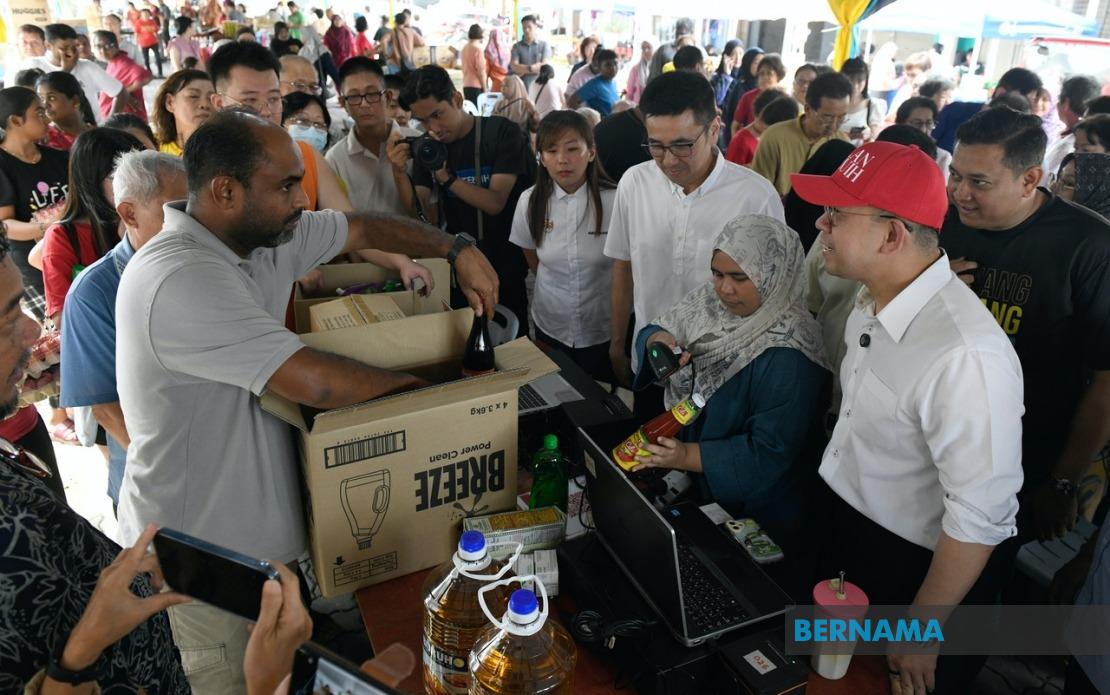
Malaysia's Ministry of Entrepreneur and Cooperatives Development (KUSKOP) is doubling down on efforts to empower local small businesses and cooperative organizations, recognizing them as vital engines for broader economic participation across the wholesale and retail trade sectors. The push represents a deliberate strategy to ensure that gains from expanding commerce are distributed beyond large corporations, reaching entrepreneurs and trading organizations operating at the grassroots level throughout the country.
Minister Steven Sim Chee Keong outlined the government's vision during the Jualan MADANI KUSKOP (JMK) initiative launch in the Jawi state constituency, emphasizing that a series of coordinated programmes targeting MSMEs and cooperatives would unlock opportunities for domestic businesses seeking to capture market share in the thriving trade sector. The programmes are designed as practical vehicles through which smaller players can navigate an increasingly complex commercial landscape and establish stronger footholds in growing markets.
Recent economic data provides compelling evidence for optimism about sector prospects. According to figures from the Department of Statistics Malaysia (DOSM), the wholesale and retail trade sector generated sales valued at nearly RM175 billion during April 2026, reflecting a year-on-year expansion of 15.3 per cent. This sustained growth trajectory underscores the sector's resilience and its continuing capacity to absorb new market entrants and generate employment opportunities across supply chains.
Simplicit in the government's approach is recognition that this sectoral expansion stems from confluence of factors: joint action by public and private sectors in managing consumer costs, price stabilization initiatives for essential goods, and wage increases that have supported household purchasing power. These policies have collectively sustained the domestic demand environment that continues to drive wholesale and retail activity, creating conditions under which smaller enterprises can thrive alongside established players.
Yet the operating environment for Malaysian businesses remains complex. As an open economy heavily integrated into global trade networks, Malaysia faces exposure to international headwinds including tariff escalations, trade disputes between major economies, and geopolitical tensions that create uncertainty about future market conditions. Despite these external pressures, the government has maintained steady focus on local economic development through coordinated public and private sector initiatives that have kept domestic trading momentum positive.
The expansion occurring in wholesale and retail spaces represents far more than aggregate sales figures. For cooperatives and small entrepreneurs operating across Malaysia, the growth trajectory creates concrete possibilities for market expansion, development of fresh customer relationships, and deeper entrenchment within local value chains. These opportunities address a persistent challenge facing small enterprises: the difficulty of scaling beyond initial market foothold without institutional support.
KUSKOP's grassroots approach reflects understanding that meaningful economic transformation requires engagement with business organizations operating at community level, not merely with large corporations or state-linked enterprises. Through programmes targeting MSMEs and cooperatives specifically, the ministry acknowledges that small enterprises face distinct operational constraints, from access to capital and market information to supply chain integration, that differ substantially from challenges facing larger firms.
The minister's emphasis on ensuring comprehensive distribution of growth benefits signals awareness that unchecked concentration of economic gains can breed social discontent and limit long-term macroeconomic resilience. By supporting local entrepreneurs' participation in the expanding wholesale and retail sectors, the government advances both equity objectives and economic efficiency, recognizing that healthy MSME ecosystems contribute to employment, income generation, and consumer spending across the broader economy.
Looking ahead, the success of KUSKOP initiatives will depend heavily on implementation effectiveness and sustained resource commitment. Small businesses require not only programme access but also ongoing technical assistance, market intelligence, regulatory clarity, and financing mechanisms tailored to their cash flow constraints. The government's stated commitment to supporting local entrepreneurs indicates recognition that the nation's economic future rests significantly on whether thousands of smaller trading organizations and cooperatives can compete successfully and grow.
For Malaysian entrepreneurs operating in or considering entry into wholesale and retail spaces, the expanded government backing through KUSKOP represents meaningful encouragement. The combination of strong underlying sector demand, demonstrated commitment to MSME development, and recognition that economic growth must benefit participants across firm-size spectrum creates an environment where smaller enterprises can plan expansion with greater confidence. However, competitive pressures remain intense, and success will ultimately depend on individual enterprise capability alongside the supportive institutional environment that the government is working to strengthen.

