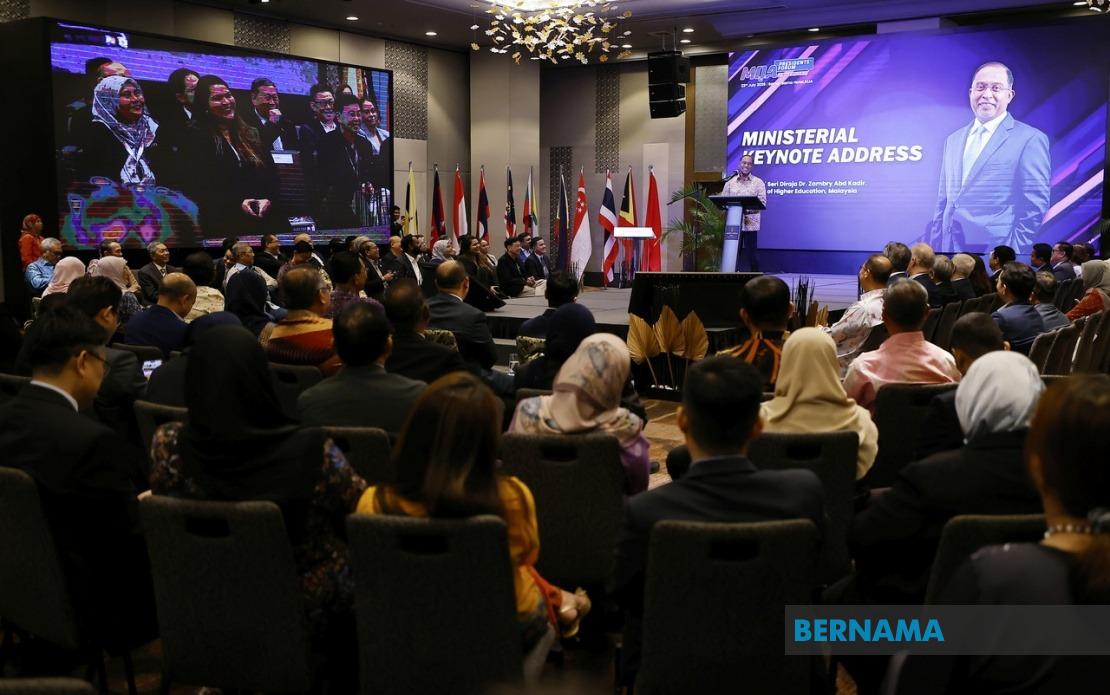
Datuk Seri Dr Zambry Abd Kadir, Malaysia's Higher Education Minister, has restated the government's unwavering commitment to preserving academic freedom while fostering constructive intellectual discourse within the country's universities. Speaking at a public lecture in Putrajaya on July 23, Zambry emphasised that institutions of higher learning must continue functioning as environments where competing perspectives can be explored openly, courteously and with responsibility. He underscored that through such dialogue spanning different disciplines, borders and viewpoints, the advancement of knowledge remains achievable and beneficial for society.
The minister's remarks came during an address at a lecture titled Muslim Identity in a Globalised World, delivered by Columbia University's Prof Dr Joseph A. Massad. In his welcoming comments, Zambry characterised academic freedom as inseparable from intellectual responsibility. He stressed that while the ministry encourages vigorous and substantive debate on pressing issues, such discussions must be conducted with civility, grounded in evidence and characterised by genuine respect for opposing viewpoints. This formulation seeks to balance the openness essential to academic enquiry with the standards of rigour and decorum that distinguish scholarly exchange from mere polemic.
Malaysia's distinct social composition provided particular reason for prioritising informed dialogue and mutual understanding through academic channels, according to Zambry. The nation's plural society, encompassing diverse ethnic communities, religions and cultural traditions, stands to benefit significantly when scholars engage substantively with complex issues affecting multicultural populations. Scholarly discourse conducted at universities can model the kind of respectful engagement necessary for societies with deep diversity to function cohesively and progress. Universities thus serve not merely as repositories of knowledge but as laboratories where democratic deliberation can flourish.
Zambry acknowledged that disagreements among citizens are inevitable, especially in contemporary contexts characterised by rapid technological change, artificial intelligence proliferation and the dominant role of social media in shaping public discourse. Rather than viewing such differences as threats to social harmony, he positioned them as natural features of plural societies. He noted that Malaysians have historically recognised the value of respecting divergent perspectives even when fundamental disagreements persist on substantive matters.
The minister articulated this principle through a memorable formulation: "We agree to disagree. We disagree on many things, but we also agree on many things." This statement captures an approach to managing diversity that neither demands uniformity of opinion nor treats disagreement as inherently corrosive. Instead, it suggests that societies can maintain cohesion and mutual respect while entertaining genuine intellectual differences. Such an orientation proves particularly relevant for Malaysia as it navigates questions of national identity, religious expression, governance and development in an increasingly complex geopolitical environment.
Zambry's remarks reflected a conscious effort to position Malaysia's higher education sector as open to international scholarly engagement and global intellectual currents. The ministry intends to continue extending invitations to prominent academics from around the world to contribute their expertise and perspectives to Malaysian university communities. This openness serves multiple objectives: it exposes Malaysian students and scholars to cutting-edge research and diverse intellectual traditions, enhances the reputation of local institutions within international academic networks, and demonstrates Malaysia's confidence in its capacity to engage with ideas from across the globe without defensiveness or restriction.
The hosting of Prof Massad's lecture exemplifies this approach. Columbia University stands among the world's most prestigious research institutions, and Massad's work on Middle Eastern studies and identity questions brings sophisticated analytical frameworks to bear on issues of global significance. By welcoming such distinguished visitors, Malaysia signals that its universities serve as venues for substantive intellectual exchange on topics that matter internationally, rather than as insular institutions narrowly focused on local concerns. This positioning enhances the quality of higher education available to Malaysian students whilst strengthening academic connections between Malaysia and leading international research centres.
The minister's emphasis on intellectual responsibility alongside academic freedom represents an important clarification of what academic freedom entails. Rather than portraying it as an unrestricted right to say anything without consequence, Zambry grounded it in standards of rigour, respect and evidence-based reasoning. This understanding acknowledges that academic freedom exists within a framework of scholarly norms and ethical expectations. Researchers and teachers remain accountable to professional standards and to the broader communities they serve, even as they enjoy protection from censorship or sanction for unpopular ideas.
The Higher Education Ministry's stance addresses ongoing debates about the proper relationship between institutional autonomy and social responsibility. As universities expand their role in addressing complex societal challenges—from climate change to social inequality to technological disruption—questions inevitably arise about the limits of unfettered intellectual exploration. Zambry's formulation suggests that the answer lies not in restricting inquiry but in conducting it within frameworks emphasising civility, evidence and genuine engagement with opposing perspectives. This approach trusts in the capacity of reason and empirical evidence to contribute to human understanding, whilst maintaining that how we reason together matters as much as what we discover.
For Malaysia, reinforcing academic freedom carries particular significance at a moment when universities worldwide face scrutiny regarding their independence from political and commercial pressures. Authoritarian regimes have increasingly constrained academic autonomy, whilst democracies grapple with questions about how to balance competing values within academic institutions. Zambry's public reaffirmation of the government's commitment to academic freedom sends a signal that Malaysia intends to maintain universities as spaces where intellectual inquiry can proceed without fear of state censorship, whilst also advancing the notion that such freedom carries corresponding obligations to communities and standards of scholarly practice.
The minister's invocation of Malaysia's multicultural heritage as a foundation for valuing academic freedom and intellectual diversity points toward a distinctive vision of Malaysian higher education. Rather than viewing pluralism as a challenge that universities must manage or minimise, this perspective treats it as a resource for deepening knowledge and improving scholarly understanding. When students and faculty from different backgrounds engage rigorously with ideas and evidence, the resulting intellectual ferment can yield insights that homogeneous academic communities might never achieve. In this sense, Malaysia's diversity becomes not an impediment to academic excellence but a potential advantage, provided institutions commit genuinely to fostering the kind of respectful, evidence-based discourse that Zambry described.
Moving forward, the substantive challenge for Malaysia's higher education sector involves translating these high-minded principles into institutional practices that genuinely protect academic freedom whilst maintaining scholarly standards. Universities must attract and retain faculty members who can engage international intellectual currents, support student researchers investigating sensitive topics, and create spaces where controversial ideas can be discussed rigorously. They must also resist pressures—whether from government, commercial interests or social movements—that would subordinate academic integrity to external agendas. Zambry's public commitment to these principles establishes a benchmark against which the ministry's actual policies and institutional practices can be evaluated.

