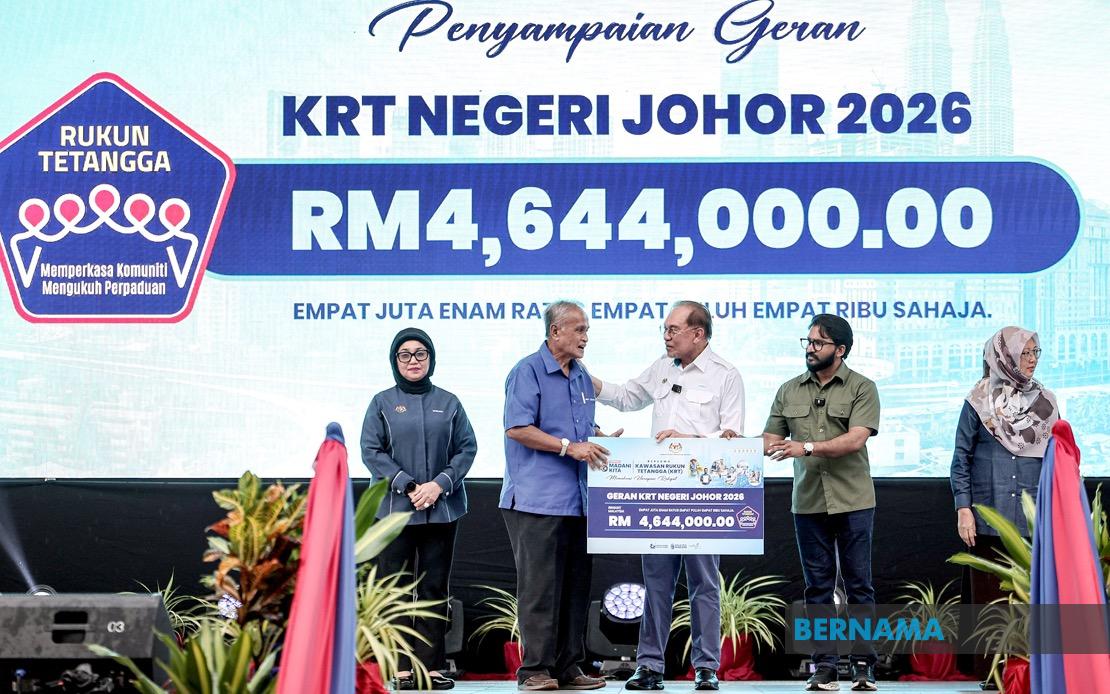
Prime Minister Datuk Seri Anwar Ibrahim has announced a significant financial boost for the nation's Neighbourhood Watch Areas, approving an increase in their annual grants to RM10,000, a substantial jump from the RM6,000 allocation that has remained unchanged for the past decade. The enhanced funding will take effect from January 1, 2027, and applies to all KRTs that actively report their development and activities to the government.
The announcement came during the MADANI KITA Programme held at Dataran Segamat, where the Prime Minister reflected on the long-overdue nature of this adjustment. During his address, Anwar noted that the KRT grant had been frozen at RM6,000 since the mid-2010s despite the organization's expanding responsibilities and the rising cost of operations over that period. The 67 percent increase reflects the government's acknowledgment that these grassroots institutions deserve financial recognition commensurate with their contributions to maintaining social stability and community welfare at the local level.
According to the Prime Minister, KRTs play a fundamental role in reinforcing Malaysia's foundational values of consensus, democratic participation, and national unity. These neighbourhood-based organizations serve as crucial intermediaries between government agencies, security personnel, and residents, facilitating the resolution of community issues ranging from public safety concerns to welfare support. By strengthening KRT operations through increased funding, the government signals its commitment to decentralizing governance and empowering local communities to address their own challenges with adequate resources.
Anwar emphasized that Malaysia's greatest asset lies in its ability to maintain harmony across its diverse racial, cultural, and religious landscape since independence in 1957. He cautioned against weaponizing these differences as tools for division, positioning instead a vision where Malaysia's pluralism represents strength rather than fragmentation. This statement carries particular resonance given ongoing discussions about social cohesion and community integration across Southeast Asia, where demographic diversity requires active investment in institutional structures that foster inter-group understanding and cooperation.
During the same event, the government committed substantial funds to complementary grassroots priorities. An immediate allocation of RM3.205 million was announced for basic infrastructure repair projects at 16 Islamic educational institutions across Johor, encompassing religious schools, madrasahs, study centres, and tahfiz institutions in districts including Batu Pahat, Muar, and Segamat. This investment underscores the broader MADANI administration's philosophy of strengthening foundational institutions that support community development and youth formation across Malaysia's diverse constituencies.
The infrastructure investment in Islamic educational facilities reflects recognition that comfortable, well-maintained learning environments directly impact educational outcomes and student engagement. By dedicating resources to upgrading these institutions, the government addresses a long-standing gap in facility standards that has affected the quality of religious education delivery. This approach mirrors regional trends where Southeast Asian governments increasingly recognize that investment in educational infrastructure, particularly in underserved or marginalized communities, yields dividends in social stability and economic participation.
Simultaneously, the Prime Minister approved an immediate allocation of RM1.0 million for critical and urgent repair work at Royal Malaysian Police quarters in Johor. This facility upgrade initiative recognizes that adequate living conditions for security personnel directly correlate with their morale, retention, and performance in maintaining public order. The investment reflects the government's philosophy that maintaining national peace requires corresponding investment in the welfare infrastructure of those responsible for security provision.
The timing of these announcements during a grassroots engagement programme demonstrates the MADANI Government's strategic emphasis on direct community interaction and responsiveness to local needs. By bundling the KRT grant increase with infrastructure allocations for religious institutions and security personnel facilities, the Prime Minister presented a coherent narrative of governmental commitment across multiple layers of society. This approach seeks to build legitimacy and public confidence by demonstrating tangible resource allocation to visible community priorities.
For KRT coordinators and members across Malaysia, the enhanced annual grant represents practical relief, allowing greater investment in community programmes, security initiatives, and administrative operations. The RM4,000 increase, while significant, also implicitly acknowledges the inflation that has occurred since 2016, suggesting the government has accepted that cost adjustments merit priority in budget deliberations. Moreover, by timing the implementation for January 2027, the government provides adequate planning horizons for KRT leadership to incorporate the additional funding into their operational strategies and community development initiatives.
The policy change carries broader implications for how Malaysia approaches community-based governance in an era of increasing social complexity. KRTs have traditionally functioned as voluntary neighbourhood watch and community welfare organizations, bridging formal government structures and informal neighbourhood networks. By enhancing their financial capacity, the government effectively invests in social capital and institutional resilience at the grassroots level. This approach offers lessons for other Southeast Asian societies grappling with questions about how to maintain social cohesion while devolving governance responsibilities to community organizations.
For policymakers in the region, the KRT funding decision illustrates a recognition that voluntary community organizations require financial sustainability to function effectively. Across Southeast Asia, similar neighbourhood and community associations often struggle with limited budgets that constrain their capacity to deliver services or maintain facilities. Malaysia's experience suggests that strategic government investment in these institutions, even at modest levels, can yield significant returns in terms of social stability, local problem-solving capacity, and citizens' sense of agency in addressing collective challenges.
The announcement also reflects Malaysia's continuing effort to position itself as a multiethnic and multireligious nation that actively invests in social cohesion mechanisms. In a regional context where ethnic tensions and communal conflicts periodically destabilize societies, Malaysia's emphasis on institutions like KRTs that bring diverse communities together carries strategic importance. By adequately funding these organizations, the government reinforces its commitment to the institutional infrastructure that undergirds pluralistic coexistence.