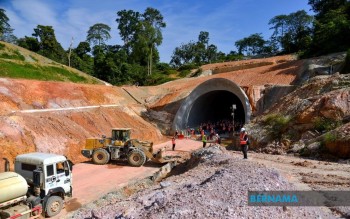
Malaysia's cabinet has endorsed a substantial development agenda for Pasir Puteh parliamentary constituency in Kelantan, allocating RM207.2 million across 46 separate initiatives scheduled for 2026. The funding package reflects a strategic pivot towards leveraging the newly operational East Coast Rail Link as an economic multiplier for the largely rural eastern corridor, with particular emphasis on establishing integrated industrial and logistics capacity around the ECRL's cargo and passenger facilities in the constituency.
Deputy Economy Minister Datuk Mohd Shahar Abdullah outlined the government's vision during parliamentary question time, emphasising that the projects extend well beyond conventional infrastructure spending. The Pasir Puteh development agenda centres on methodical land preparation and infrastructure engineering for a dedicated downstream industrial zone positioned to capitalise on ECRL connectivity. This targeted approach reflects lessons from recent transport infrastructure rollouts, where economic gains concentrate around strategic hubs rather than distributing evenly across broader regions.
The ECRL Integrated Land Use Master Plan, or PGTA-ECRL, provides the architectural blueprint for this transformation. Pasir Puteh's ECRL station has been designated as a dual-function facility serving both passenger and cargo operations, with the latter viewed as the primary engine for attracting manufacturing, processing, and warehousing enterprises. The geographical advantage is tangible: the station's proximity to the Tok Bali Supply Base creates a natural clustering opportunity for businesses seeking integrated logistics networks that combine rail, maritime, and terrestrial transport nodes.
For Malaysian policymakers and development observers, the Pasir Puteh allocation represents a significant commitment to translating megaproject investments into real regional economic transformation. The ECRL, which cost tens of billions of ringgit, has faced scrutiny regarding its contribution to peripheral economies. This concentrated investment in downstream industrial capacity around specific stations demonstrates attempts to maximise the rail link's multiplier effects rather than treating it as a transportation amenity disconnected from local value creation.
The logistics and industrial hub strategy carries substantial implications for Kelantan's economic trajectory. Historically, the state has lagged in manufacturing and export-oriented industrial activity compared to more developed western seaboard states. Pasir Puteh's positioning as a logistics nexus could catalyse investments in food processing, agricultural value-addition, petrochemical derivatives, and e-commerce fulfillment centres—sectors aligned with both regional comparative advantages and national economic priorities. Deputy Minister Mohd Shahar explicitly highlighted that government allocation strategy now emphasises leveraging each locality's inherent strengths rather than applying uniform development templates.
Job creation emerges as a critical variable in evaluating the initiative's success. The Pasir Puteh constituency and surrounding districts face youth unemployment and skilled talent outmigration, with younger residents historically seeking opportunities in Klang Valley and Penang manufacturing hubs. A functioning logistics cluster would generate diverse employment pathways spanning warehousing operations, supply chain management, port logistics, and specialised manufacturing roles. The salary levels and career progression in emerging logistics hubs typically exceed agricultural and service sector alternatives prevalent in rural Kelantan, potentially reversing demographic patterns that have weakened rural communities.
The integration of ECRL operations with existing port infrastructure at Tok Bali represents a critical multiplier. Ports and rail terminals function as economic anchors only when complementary facilities and services develop around them. The government's allocation toward industrial land preparation and utilities indicates recognition that facilities alone attract minimal investment without operational ecosystems. This systemic approach contrasts with infrastructure-only investments that frequently generate disappointing economic returns in developing economies.
The 13th Malaysia Plan framework provides the overarching policy rationale, extending through 2030. Mohd Shahar's parliamentary statement clarified that implementation timelines stretch beyond 2026, with projects commencing this year and continuing across the five-year planning horizon. This extended timeline reflects realistic construction phasing and market absorption rates for industrial real estate. The MyRMK monitoring system, referenced by the Deputy Minister, theoretically enables transparent progress tracking, though Malaysian observers note that public accountability for infrastructure spending outcomes often remains inconsistent.
Regional implications extend beyond Kelantan's boundaries. The Pasir Puteh model potentially establishes precedent for similar ECRL station areas in Terengganu, Pahang, and Perak, where comparable economic development challenges persist. However, successful replication depends on each locality's unique infrastructure endowments, transport connectivity, and existing industrial bases. A mechanistic application of the Pasir Puteh template to less favourably positioned ECRL stations risks generating costly infrastructure with limited economic uptake.
The announcement also reflects broader policy evolution regarding regional equity and development gap reduction. Malaysian policymakers increasingly recognise that infrastructure spending alone fails to narrow development disparities without complementary private investment attraction and skill development. The Pasir Puteh allocation toward downstream industrial infrastructure attempts to address this challenge through targeted demand-side interventions that make specific locations attractive to private capital. Whether market responses align with government expectations remains contingent on global logistics demand, commodity price cycles, and competitive positioning relative to established regional hubs in Thailand, Vietnam, and Indonesia.
Stakeholder responses will prove instructive. Kelantan's state government coordination with federal authorities, private sector enthusiasm for industrial plot acquisition, and workforce training programme development will collectively determine whether the RM207.2 million investment generates sustainable economic multipliers or represents well-intentioned capital spending with limited systemic impact. Initial indicators will emerge as specific projects advance through tender and construction phases across the coming 18 months.

