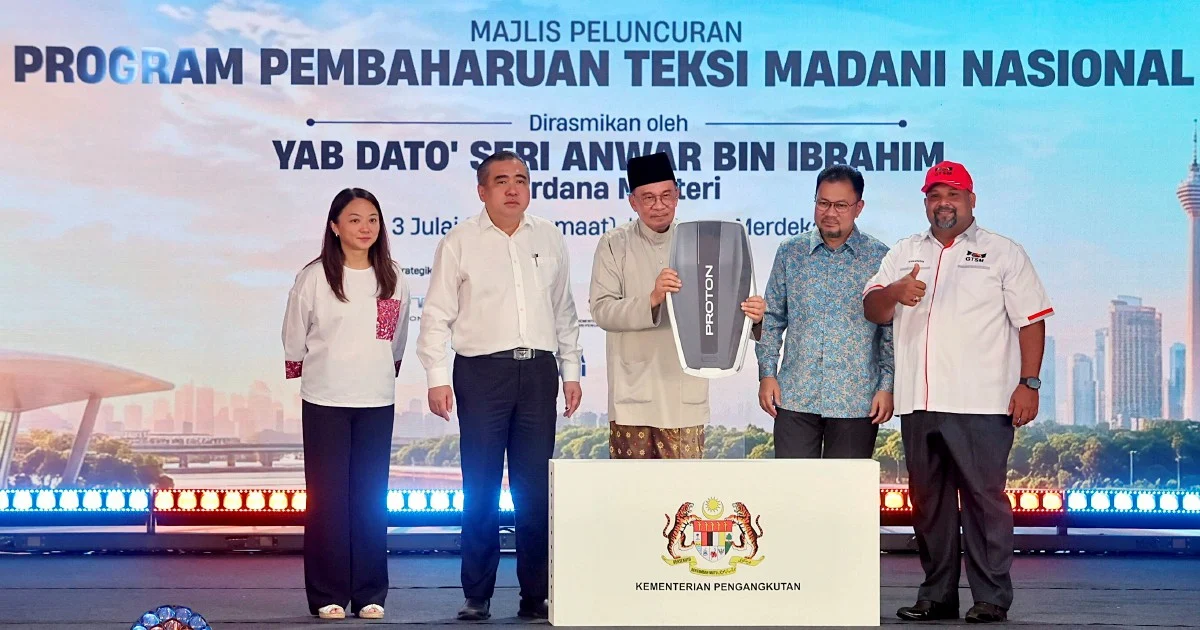
Prime Minister Datuk Seri Anwar Ibrahim has announced a fresh RM10 million injection into the government's matching grant programme designed to facilitate the replacement of aged taxis, marking an important development in the ongoing effort to rejuvenate Malaysia's road transport sector. The allocation underscores the administration's recognition of the challenges facing traditional taxi operators in an increasingly competitive mobility landscape dominated by ride-hailing applications and evolving consumer preferences.
The matching grant initiative represents a shared-cost approach where the government contributes funds that operators must match through their own resources or financing arrangements. This structure ensures that participating taxi operators maintain a stake in the modernisation process while receiving tangible financial support from the public sector. The RM10 million supplement builds on previous tranches allocated to the scheme, though the total lifetime budget and number of vehicles targeted under the entire programme remain subjects of broader transport policy discussion.
Aging taxi fleets present multifaceted challenges across Malaysia's urban centres. Older vehicles typically exhibit higher emission profiles, contributing to air quality concerns in cities like Kuala Lumpur and George Town. Simultaneously, passengers increasingly expect modern amenities and reliable conditions—cleanliness, functioning air conditioning, and vehicle safety features—that older models struggle to provide consistently. The replacement programme directly addresses these passenger expectations while advancing environmental objectives aligned with Malaysia's commitments under international climate frameworks.
The timing of this announcement carries significance within Malaysia's transport ecosystem. Ride-hailing services have fundamentally disrupted conventional taxi operations, compelling the government to actively support the sector's transition rather than permit gradual obsolescence. By providing direct financial assistance, authorities acknowledge that market forces alone cannot sustain viable competition for traditional taxi operators, many of whom operate as independent proprietors or small consortiums lacking substantial capital reserves for vehicle renewal.
Operators utilising the matching grant scheme gain access to modern vehicles equipped with contemporary safety and connectivity features, potentially improving their competitive positioning against app-based alternatives. Newer taxis can be better maintained, require fewer repairs, and often qualify for improved insurance premiums. The fleet modernisation also creates indirect benefits for vehicle maintenance sectors, as new models generate demand for specialised servicing and spare parts through authorised dealers.
For Malaysian consumers, the programme's cumulative effect should manifest as improved service quality. Modern taxis operated through refurbished fleets reduce wait times attributable to mechanical failures, enhance passenger comfort during journeys, and provide greater confidence in vehicle safety standards. Additionally, newer taxis equipped with GPS and digital payment systems can facilitate improved booking transparency and transaction security, narrowing the experiential gap between traditional taxis and ride-hailing platforms.
Regional perspectives offer instructive context for Malaysia's approach. Several Southeast Asian governments have similarly invested in taxi modernisation, recognising that protecting incumbent operators against technological disruption requires active intervention. Indonesia, Thailand, and the Philippines have implemented various subsidy and incentive programmes, though results have varied based on implementation rigour and the depth of financial support relative to vehicle costs. Malaysia's incremental approach through matching grants allows for measured deployment while maintaining fiscal discipline.
The matching grant mechanism also embeds accountability mechanisms absent from direct subsidies. Operators must demonstrate capacity to secure co-financing, implying a baseline viability assessment. Banks and finance companies participating in such schemes effectively conduct due diligence on borrowers, reducing the likelihood that government funds support fundamentally unviable operations. This approach preserves programme integrity while extending support to operators with genuine business fundamentals.
State-level coordination will prove essential for effective implementation. Transport regulation in Malaysia remains partially devolved, with vehicle licensing and route franchising managed through state authorities. The RM10 million allocation's impact will depend on how state transport departments integrate the matching grant scheme within existing licensing frameworks and how transparent they render the application process for taxi operators. Seamless coordination between federal allocations and state administrative procedures can dramatically accelerate uptake rates.
Longer-term sustainability questions warrant consideration beyond immediate fund deployment. As vehicle fleets modernise through this programme, operators must sustain new maintenance standards and operational practices that justify continued competitiveness. The government may need to consider complementary support through driving standards programmes and digital technology training to ensure participating operators extract full competitive advantage from their renewed vehicle assets.
The announcement also indirectly signals government acknowledgment that Malaysia's transport transition cannot proceed through market forces alone. While authorities have progressively liberalised urban mobility through ride-hailing licensing, protecting worker livelihoods and maintaining viable alternatives to monopolistic platforms requires targeted intervention. This RM10 million represents not merely a subsidy but a policy statement that traditional taxi operations remain valued components of Malaysia's transport architecture worth preserving through strategic investment.

