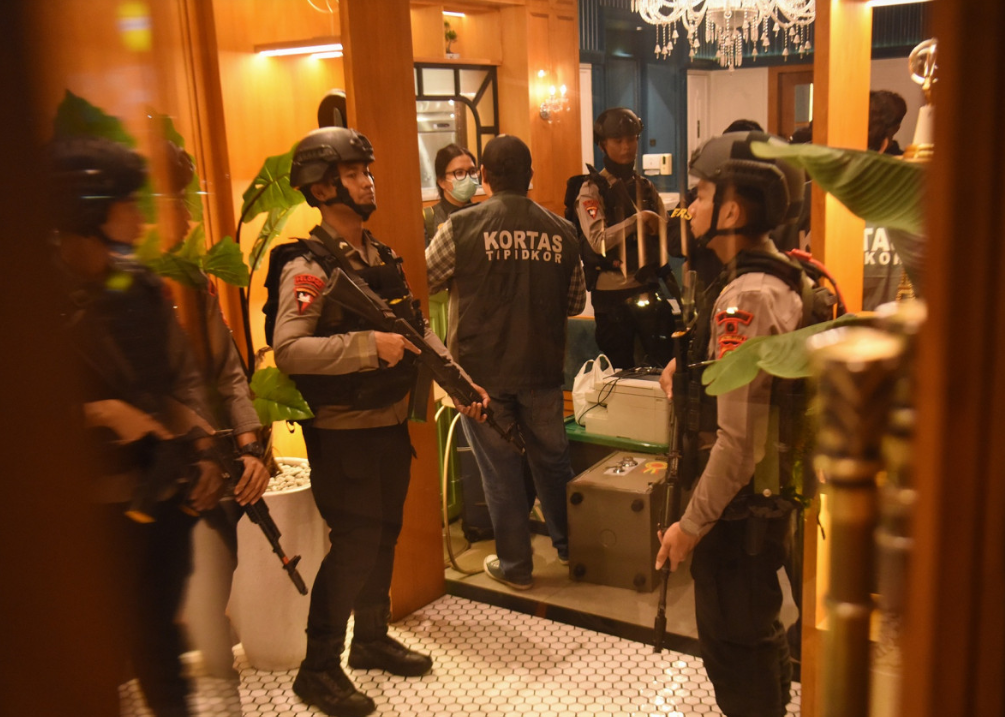
A dramatic series of police raids across Jakarta and surrounding areas last week exposed one of Indonesia's most significant law-enforcement scandals in recent years when authorities discovered millions of dollars in gold bars and cash hidden in properties linked to a senior government official. The operations, which swept through upscale restaurants, money-changers and residential compounds from Wednesday into Thursday morning, revealed the extent of alleged financial impropriety at the highest levels of Indonesia's justice system and have forced uncomfortable questions about the independence and effectiveness of the country's anti-corruption infrastructure.
The operation began at de'Clan Signature, an upmarket restaurant located in the Cipete neighbourhood of South Jakarta, where heavily armed police units descended with tactical precision. Officers from both Jakarta's metropolitan police and the National Police's specialised corruption investigations division, supported by combat-equipped Mobile Brigade personnel carrying high-powered firearms, methodically forced open a two-metre-tall safe concealed behind cabinetry. Inside lay documentation and cash denominated in multiple currencies totalling millions of dollars, an unexpected trove that signalled the scope of what was to unfold. The raid immediately adjacent to the restaurant proved equally productive: at the adjoining Koin Money Changer, authorities seized another safe containing hundreds of thousands of dollars in rupiah-denominated notes, suggesting a coordinated system for managing illicit funds.
These discoveries, however, paled beside what police uncovered at a high-end residence in Sentul, an affluent hillside community approximately one hour south of Jakarta. At this private residence, officers recovered seven suitcases packed with seventy-four kilograms of gold bullion alongside additional cash reserves in various currencies. When authorities inventoried the seized assets, the total valuation reached US$26.3 million—a staggering sum that underscored the scale of alleged financial misconduct. The property belonged to Febrie Adriansyah, who until his recent resignation had occupied the position of deputy attorney general for special crimes, a role he had held for more than four years. The explosive timing of his departure and the subsequent raids painted a picture of institutional crisis at the heart of Indonesia's prosecutorial apparatus.
Febrie's response to the allegations provided little clarity or reassurance. Though named as a suspect in corruption and money-laundering investigations, he has not been detained. He confirmed his ownership of the Sentul residence but disputed claims regarding the seized assets, asserting they belonged to other parties. He offered no concrete explanation for the gold and currency found on his property, instead indicating that answers would emerge through legal proceedings—a statement that struck many observers as an evasion rather than an exoneration. The stark images of gleaming gold bars and stacks of banknotes displayed by police to assembled media became instantly emblematic of the scandal, circulating widely through Indonesian news outlets and social platforms as tangible evidence of systematic wrongdoing.
The investigation extended well beyond the initial locations. Police executed searches at more than ten additional sites throughout Jakarta and its periphery, including a unit at Pacific Place, a prestigious apartment tower near the nation's stock exchange, as well as various commercial offices scattered across the city. Authorities also raided residential properties in the Gandaria district of South Jakarta with connections to Don Ritto, a lawyer implicated in the case alongside Febrie. Corporate records revealed that Ritto maintained business interests in entities connected to both the raided restaurant and money-changing operation, suggesting a network of individuals orchestrating the financial schemes. Unlike Febrie, Ritto was detained following his identification as a suspect, indicating police assessed him as a greater flight risk or more culpable party.
The scale and coordination of the raids pointed to an investigation that had been developing methodically before its public eruption. The simultaneous searches across multiple locations suggested authorities had built a comprehensive case architecture prior to executing the warrants, targeting not merely individual assets but attempting to capture a broader pattern of financial misconduct and institutional complicity. The involvement of specialised corruption investigators alongside regular police units indicated this was treated as a matter of significant institutional concern, not a routine investigation.
As Jakarta's legal and political establishment assessed the implications of these discoveries, debate intensified regarding the fundamental adequacy of Indonesia's corruption-fighting institutions. The prominent constitutional scholar Mahfud MD, who previously served as Indonesia's chief justice and as coordinating minister for political, legal and security affairs, publicly intervened in the controversy through his YouTube platform. Mahfud raised serious procedural objections to the decision to transfer investigative responsibility from the police to the Attorney General's Office—the very institution in which Febrie held senior rank. This jurisdictional shift, he argued, lacked any statutory foundation within Indonesia's criminal procedure code and created vulnerability to pretrial legal challenges that could ultimately undermine prosecution efforts. His intervention reflected broader concern that the case could collapse on technical grounds, allowing the accused to escape justice through procedural technicalities.
Mahfud's alternative proposal—that Indonesia's Corruption Eradication Commission, an independent state institution insulated from the Attorney General's hierarchical structure, assume investigative control—addressed fundamental questions about institutional independence. The commission's autonomous status would theoretically provide greater protection against political interference and institutional self-protection, concerns that seemed directly relevant given Febrie's prominent prosecutorial rank. The constitutional law specialist's public critique represented an unusual intervention from a respected elder statesman, suggesting the scandal had triggered alarm among institutional guardians about whether the justice system could investigate itself credibly.
For Malaysian and Southeast Asian observers, the Jakarta sting operation illuminates recurring patterns of elite financial misconduct that periodically destabilise even nominally robust institutional frameworks. Indonesia's experience demonstrates that sophisticated anti-corruption infrastructure—including specialist police units, dedicated investigation protocols, and prosecutorial resources—can detect major wrongdoing but may struggle to ensure consequences if jurisdictional and institutional arrangements are misaligned. The concentration of authority within the Attorney General's Office, an institution potentially compromised by the suspect's senior position within its ranks, exemplifies how structural vulnerability can persist despite surface-level corruption-fighting apparatus. The controversy also highlights the critical importance of independent institutions specifically designed to operate outside compromised hierarchies, a lesson increasingly relevant across Southeast Asia as countries confront similar patterns of high-level financial concealment and institutional capture by powerful individuals.
The immediate question facing Indonesian authorities involved determining whether the prosecutorial apparatus would prove sufficiently independent and determined to pursue cases implicating its own senior leadership. The resolution would significantly influence public confidence in whether Indonesia's much-publicised anti-corruption commitments represent genuine institutional transformation or merely rhetorical commitment. For regional governance observers, the case would serve as a crucial test of whether modern Southeast Asian democracies could construct investigative frameworks capable of transcending political loyalty and institutional self-interest when senior officials faced serious allegations.

