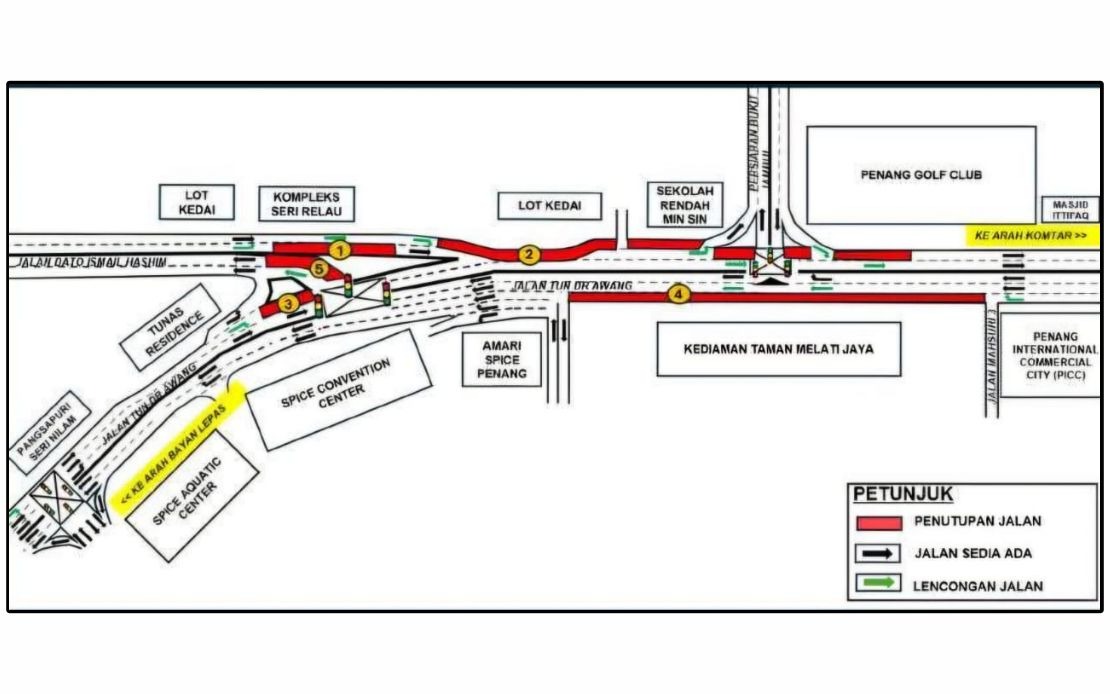
Penang motorists will navigate restricted traffic conditions across central George Town for the next two months as the Mutiara Line Light Rail Transit project enters its initial construction phase. Beginning August 20 and running through October 31, Malaysia Rapid Transit Corporation Sdn Bhd (MRT Corp) will implement intermittent partial lane closures along Jalan Tun Dr Awang and Jalan Dato Ismail Hashim, spanning the corridor from Sri Relau Complex to Penang Golf Club. The 72-day undertaking, confined to daytime hours between 8:30 am and 4:30 pm, aims to make room for critical drainage infrastructure and road widening activities essential to the project's initial phase.
The closure strategy reflects a phased approach to managing the competing demands of maintaining traffic flow while enabling essential preparatory work. MRT Corp has identified four specific lane restrictions within the affected corridor. The right lane along Jalan Dato Ismail Hashim immediately in front of the Sri Relau Complex, proceeding toward Komtar, will be unavailable to traffic. Additionally, the left lane on the same street, beginning near shop lots adjacent to SJK (C) Min Sin and extending to the Penang Golf Club vicinity also heading toward Komtar, will face closure. At the intersection of Jalan Dato Ismail Hashim and Jalan Tun Dr Awang, the left turning lane toward Komtar will be blocked, and on Jalan Tun Dr Awang near the Taman Melati Jaya residential development, the leftmost lane proceeding toward Bayan Lepas will be inaccessible. Other lanes throughout the affected sections will remain operational to maintain baseline connectivity.
The closure falls under Package CMC1 of the broader Mutiara Line development, marking a tangible step toward realizing Penang's expanded rapid transit network. These preliminary works constitute foundational engineering activities that precede actual rail infrastructure installation, making them critical milestones for maintaining the project's construction timeline. For George Town residents and workers accustomed to direct routes through this busy commercial district, the restrictions will necessitate adjusted commuting patterns and potentially longer journey times, though the segmented approach attempts to preserve single-direction traffic capability on most affected corridors.
MRT Corp has deployed comprehensive traffic management measures to mitigate disruption and enhance safety. Directional signboards, traffic cones, and on-site flagmen will be strategically positioned throughout the closure zones to guide drivers and maintain orderly movement. The corporation emphasizes that motorists should remain vigilant in these areas, follow posted directional guidance meticulously, and anticipate variable traffic conditions compared to normal operations. The visible management infrastructure serves a dual purpose: protecting workers engaged in drainage and road widening activities while communicating clear instructions to the traveling public.
The timing of these works during August through October represents a deliberate scheduling choice with implications for local commerce and commuting patterns. August marks the end of the school holiday period, while September through October encompasses the start of the new academic term and the approach of year-end activity surges. George Town's commercial sector, concentrated particularly in the Komtar area and surrounding downtown zones, will experience modified accessibility during peak commercial seasons, potentially affecting foot traffic to retail establishments and service providers in the affected zones. Businesses and service providers operating within or near the closure corridor may need to communicate revised access information to customers.
The Mutiara Line represents a strategic expansion of Penang's public transportation infrastructure, intended to complement existing rapid transit options and reduce congestion on increasingly saturated roads. As Malaysia's states pursue infrastructure modernization and sustainable urban mobility solutions, Penang's LRT initiative sits within a broader national movement toward rail-based transportation. The preliminary construction phase underway through these road closures represents the tangible beginning of this expansion, transitioning the project from planning and design phases into physical construction. Successful execution of these early-stage works establishes the foundation upon which subsequent and more intensive construction phases will build.
For the general public, MRT Corp has established communication channels to address specific concerns or obtain clarification regarding the closure program. The corporation operates a dedicated Careline at 1-800-88-6782 and maintains an email contact point at [email protected] for inquiries related to these disruptions. These channels allow affected residents, business operators, and commuters to seek specific routing guidance or report problems encountered during the closure period. The availability of responsive communication mechanisms signals MRT Corp's intent to maintain dialogue with stakeholders throughout the construction process.
The drainage and road widening works scheduled for this period reflect essential engineering preparatory activity. Modern light rail infrastructure requires sophisticated underground drainage systems to manage stormwater and prevent flooding around station areas and track segments. Simultaneously, widening portions of the existing road network creates space for later installation of rail infrastructure, station facilities, and ancillary systems. These works, though preliminary in the overall project sequence, represent irreversible modifications to the existing streetscape that cannot be readily reversed or postponed without cascading delays.
From a regional perspective, Penang's Mutiara Line joins comparable rapid transit expansions underway across Southeast Asian cities responding to urbanization and congestion pressures. Projects in Bangkok, Jakarta, and Ho Chi Minh City have similarly required phased road closures and traffic management during their respective construction phases. The experience accumulated in George Town during this closure period contributes to Malaysia's institutional knowledge regarding the management of major infrastructure construction in densely populated urban environments, experience that may inform future rapid transit projects planned for Kuala Lumpur, Selangor, and other growth centers.
George Town residents should anticipate that the announced closure period represents a minimum baseline of expected disruption. Construction projects frequently encounter unforeseen ground conditions, weather delays, or technical complications that extend initial timelines. The October 31 closure end-date represents MRT Corp's current best estimate, but stakeholders accustomed to similar infrastructure projects should build contingency expectations into their planning. The preliminary nature of these works—drainage and road preparation rather than rail installation itself—suggests that additional closure periods will follow as the project progresses toward rail-specific construction phases in coming years.
The Mutiara Line project exemplifies the infrastructure investment required to support sustainable urban development in Malaysia's established metropolitan areas. While temporary traffic disruption constitutes a measurable cost borne by current residents and businesses, the long-term benefits of expanded public transportation capacity, reduced vehicular congestion, and improved air quality represent intended outcomes extending across multiple decades. Residents navigating the August through October closure period participate, albeit inconveniently, in Penang's gradual transition toward more balanced and sustainable urban mobility patterns.

