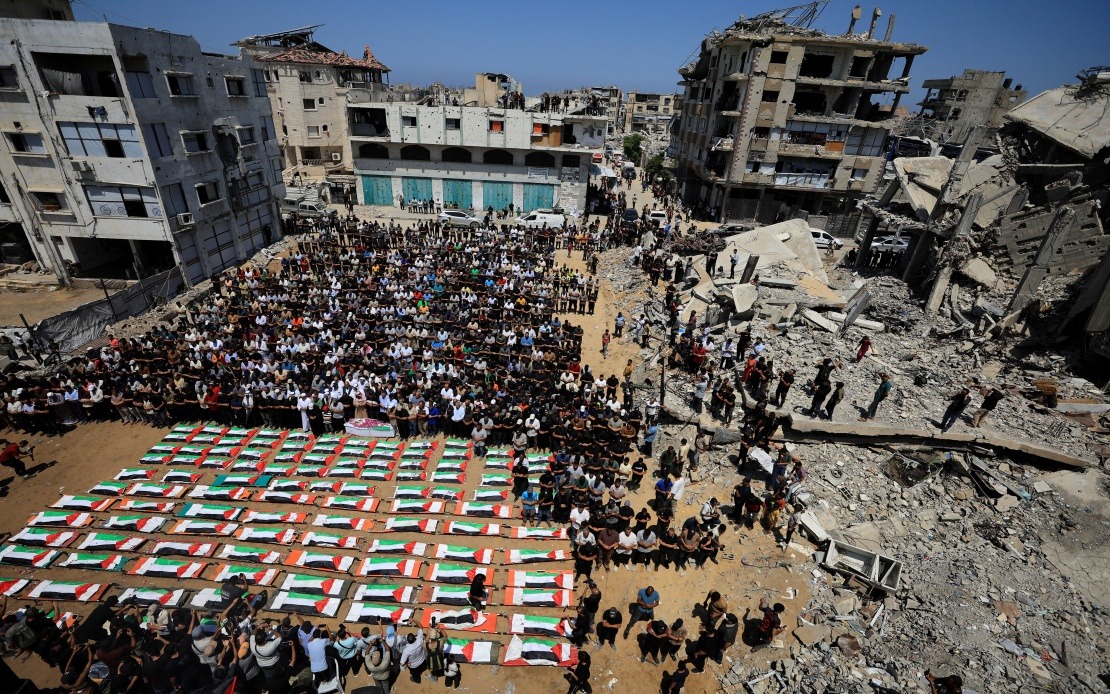
The negotiations over a second phase of the Gaza ceasefire have created a pattern of cautious optimism followed by crushing disappointment for residents whose survival depends on the talks' outcome. For Saeed Helles, a 55-year-old father of five, the emotional toll extends beyond politics—his 13-year-old daughter Saja is battling cancer and needs urgent evacuation from Gaza for specialised treatment that can only be accessed abroad. When Hamas endorsed the mediators' proposal for advancing the ceasefire's next stage, Helles and his family dared to believe that reopening border crossings might finally allow Saja to leave. They began preparing her travel documents for Egypt with cautious hope, acutely aware that every passing day reduces her chances of recovery. Yet that fragile optimism crumbled as conflicting statements from negotiating parties regarding implementation details resurfaced old anxieties about whether progress would materialise.
The breakdown in momentum became apparent after the so-called US-led Board of Peace announced that its high representative for Gaza, Nickolay Mladenov, had met with Israeli Prime Minister Benjamin Netanyahu. According to the board's statement, Israeli forces would only withdraw beyond the so-called Yellow Line after weapons decommissioning was completed, including dismantling both light and heavy weapons as well as tunnel systems. This conditional framework troubled Hamas negotiators, who insisted that progress on the second phase—particularly discussions concerning heavy weapons—should only proceed once Israel halted military operations, fully implemented the agreement's first phase, and withdrew from Gaza. The competing demands illustrated how negotiations remained deadlocked despite rhetorical progress, leaving families like Helles' in renewed uncertainty about whether the border crossing restrictions would lift in time to save lives.
The humanitarian dimensions of this stalemate extend far beyond individual cases. Mohammed Abu Nada, medical director of the Gaza Cancer Centre, revealed that approximately 11,000 cancer patients in Gaza confront severe medication shortages, while roughly 4,000 patients holding valid medical referrals cannot leave Gaza due to restrictions at border crossings. The centre loses about three cancer patients daily due to inadequate treatment, a toll that Abu Nada warned would accelerate further if border restrictions remained in place. This casualty rate reflects not merely individual tragedies but a systematic collapse of medical infrastructure that the ceasefire was supposed to gradually repair. For Malaysian readers familiar with the region's healthcare networks, the situation underscores how regional medical cooperation—typically taken for granted in Southeast Asia—becomes impossible when conflict interrupts normal movement and supply routes.
Beyond medical crises, the negotiations' uncertainty has similarly tormented displaced Palestinians whose homes were destroyed during the conflict. Mariam Qudaih, a 46-year-old mother of four displaced from eastern Khan Younis in southern Gaza, represents tens of thousands who view the ceasefire's second phase not as abstract diplomacy but as their sole pathway home. Although her residence has been reduced to rubble, Qudaih clung to the possibility of returning to her land, imagining her family might at least live in temporary shelter there while rebuilding. She had reassured her children that the negotiations' progress would soon enable their return, and they began excitedly discussing seeing their home again. However, recent developments shattered that narrative. The renewed complications left Qudaih feeling that negotiations had reverted to an earlier starting point, each announcement of progress followed swiftly by setbacks that reset hope and cast doubt on whether meaningful resolution remained possible in any foreseeable timeframe.
This pattern of cyclical hope and disappointment has become the dominant emotional experience for Gaza's population. Helles lamented that every apparent breakthrough in ceasefire talks quickly dissolved into fresh complications, while Qudaih observed that each negotiating update simultaneously advanced and retreated Palestinian expectations. The psychological toll of this oscillation—where families repeatedly prepare for reunion or recovery, only to be told of delays—compounds the existing trauma of displacement and conflict. For external observers, this emotional volatility illustrates why prolonged ceasefire negotiations without concrete implementation create humanitarian costs beyond the immediate deprivation of conflict itself. The uncertainty itself becomes a form of suffering that extends the war's effects through diplomatic channels even as active fighting may reduce.
Political analysts in Gaza have highlighted how the current impasse reflects deeper structural tensions in the negotiating framework. Mustafa Ibrahim, a Gaza-based political analyst, observed that the linkage Israel has established between its withdrawal and the completion of weapons decommissioning fundamentally alters the dynamics that mediators originally proposed. By conditioning its withdrawal on full disarmament completion rather than proceeding in parallel phases, Israel maintains substantial leverage over the timing and implementation of subsequent stages. This structural advantage not only affects military logistics but directly determines whether border crossings will reopen, whether patients can be evacuated, and whether displaced residents can return. Ibrahim's assessment suggests that the current arrangement grants one party disproportionate influence over humanitarian outcomes, raising fundamental questions about whether the negotiated framework can genuinely serve both military and civilian relief objectives simultaneously.
The medical emergency in Gaza carries particular weight because it cannot tolerate extended political negotiation. Unlike infrastructure reconstruction or security arrangements that might unfold over months or years, cancer patients, children requiring emergency treatment, and individuals dependent on specific medications face survival windows measured in days and weeks. Abu Nada's statement that three cancer patients die daily without adequate treatment means that each week of delayed border crossing access costs approximately twenty lives. When scaled across the population of critically ill patients awaiting evacuation for treatment unavailable in Gaza, the humanitarian mathematics of prolonged negotiation become starkly apparent. For Malaysian policymakers considering regional health cooperation or humanitarian frameworks, Gaza's medical crisis illustrates why ceasefire agreements must incorporate immediate humanitarian corridors that function independently of broader security negotiations.
The international dimension of Gaza's ceasefire negotiations also shapes outcomes that extend across the Middle East. The involvement of mediators operating under a US-led framework, alongside Egypt's role in managing border movements, creates multiple stakeholder interests that don't always align with humanitarian priorities. Egypt's cooperation in evacuation medical referrals depends partly on broader regional stability calculations that may not prioritise the speed of individual patient evacuations. Meanwhile, different international actors interpret the agreement's provisions through distinct strategic lenses, generating the conflicting statements that have repeatedly undermined Gazans' confidence in negotiating progress. For Southeast Asian observers, this situation highlights how regional crises become international theatre where humanitarian imperatives compete with geopolitical interests, often with devastating consequences for affected populations.
The specific language surrounding weapons decommissioning versus military withdrawal reflects disagreements about sequencing that directly impact civilian outcomes. When Israel insists on completed disarmament before full withdrawal, it effectively retains military presence in territories where displacement occurred and where refugees must eventually return. This postpones the conditions necessary for large-scale civilian return, extending the limbo state that families like Qudaih's endure. The distinction between strategic withdrawal and complete withdrawal, between light weapons and heavy weapons disarmament, constitutes technical military terminology that translates directly into questions about whether families can safely return home, whether border crossings will function fully, and whether Gaza's recovery can transition from emergency stabilisation to genuine reconstruction. Technical military language therefore carries direct humanitarian significance that affected civilians understand acutely.
For families awaiting medical evacuation or hoping to return home, the current negotiating stalemate has cultivated a weary pragmatism mixed with lingering desperation. Helles continues monitoring ceasefire discussions, aware that Saja's treatment window is closing, while Qudaih maintains her family's belief in eventual return even as she acknowledges the increasingly uncertain timeline. This persistence despite repeated disappointment reveals both the depth of hope and the population's recognition that no viable alternatives exist. They cannot access treatment independently of border opening, cannot return home without ceasefire stabilisation, and cannot force accelerated negotiations. This combination of critical need, limited agency, and delayed resolution creates a humanitarian holding pattern that persists even as international attention shifts elsewhere. The cyclical pattern suggests that until negotiators establish concrete, expedited humanitarian implementation timelines that operate independently of security benchmarks, affected populations will continue experiencing the extended suffering that accompanies prolonged conflict resolution.
Looking forward, the second phase's eventual conclusion—whenever it arrives—must incorporate mechanisms ensuring that humanitarian corridors operate with minimal delay once ceasefire phases advance. Current negotiations' structural disadvantages for civilian relief underscore why future agreements require dedicated humanitarian tracks with their own timeline benchmarks and enforcement mechanisms. For Gaza's residents, this means that medical patients might finally access treatment, displaced families might return home, and the cycle of hope and heartbreak might finally yield to stable recovery. Without such provisions, the negotiating process itself becomes another form of deprivation that extends the conflict's humanitarian consequences indefinitely.

