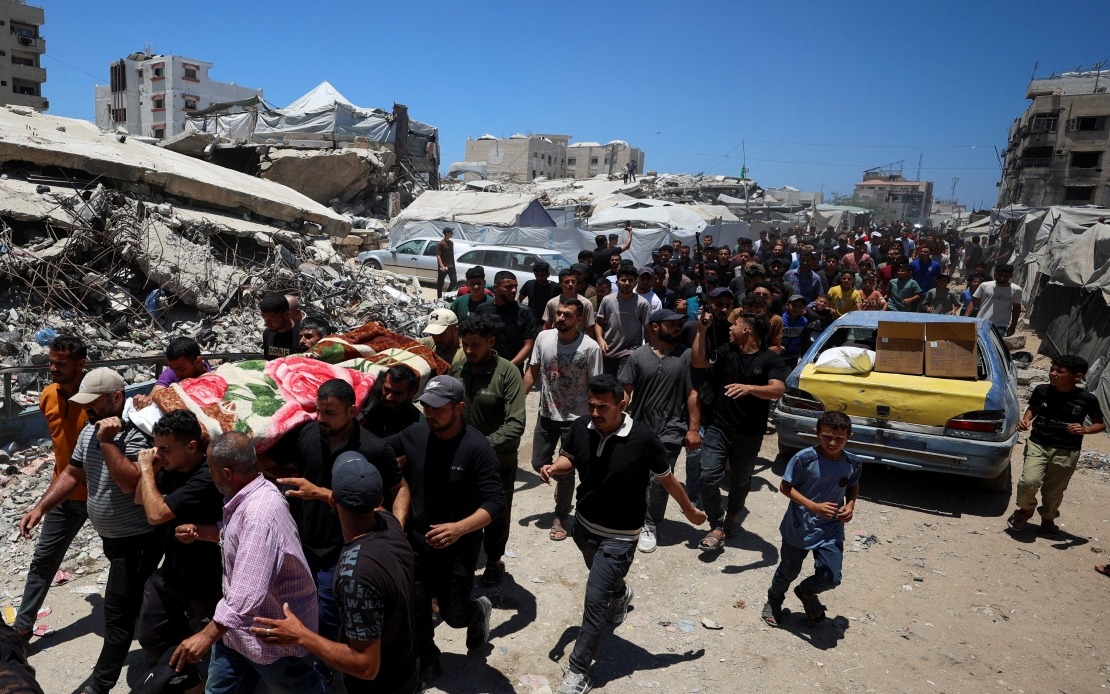
The humanitarian catastrophe unfolding in Gaza has reached a new inflection point, with Palestinian authorities documenting 1,021 additional deaths since the implementation of the ceasefire agreement. The cumulative toll since the conflict's eruption in October 2023 now stands at 73,032, according to figures released by the Palestinian Prime Minister's Office through its latest situation report. These figures underscore the persistence of violence even as ceasefire mechanisms theoretically restrict military operations, raising urgent questions about enforcement mechanisms and the sustainability of any peaceful settlement in the territory.
The deterioration of conditions on the ground appears paradoxical given the nominal ceasefire framework. The Government Communication Centre reports that Israeli bombardments have continued unabated, particularly targeting populated areas including Nuseirat, Al-Mawasi, Khan Younis and Gaza City. Simultaneously, restrictions imposed on humanitarian aid delivery have tightened rather than eased, creating a compounding crisis where residents face both direct military threats and the slow-moving emergency of resource scarcity. For Malaysian observers and policymakers, this pattern reveals how ceasefire agreements without robust international enforcement mechanisms can collapse into prolonged low-intensity conflict that devastates civilian populations.
The housing crisis in Gaza has reached catastrophic proportions, with 76.6 per cent of the enclave's residential infrastructure either destroyed or damaged beyond safe habitation. Consequently, nearly one million Palestinians—roughly 40 per cent of the territory's population—are now living in temporary tent settlements, many without adequate sanitation or protection from weather elements. This displacement has created a secondary humanitarian emergency where disease transmission, psychological trauma, and family separation compound the immediate dangers of military operations. The scale of destruction exceeds what most conflict-affected regions experience, presenting challenges to reconstruction that will likely persist for decades even assuming immediate cessation of hostilities.
Children have borne a disproportionate toll in the violence. According to data from UNICEF, 265 Palestinian children have been killed since the ceasefire announcement alone, with more than 400 additional children sustaining injuries. These figures represent not merely statistical casualties but represent an entire generation experiencing trauma, displacement, and developmental disruption during formative years. The long-term psychological and social consequences of such widespread childhood exposure to violence and loss will shape Palestinian society's recovery trajectory for generations, a concern that extends beyond Gaza to affect regional stability and humanitarian burden-sharing across the Middle East.
Access to fundamental resources has become critically constrained. The persistent shortage of clean drinking water exemplifies how the combination of infrastructure destruction and aid restrictions creates conditions approaching humanitarian emergency classification. Most residents have become dependent on whatever limited humanitarian supplies international organizations manage to deliver through severely congested entry points. Organisations including Oxfam have presented testimonies to the United Nations Security Council documenting how Israeli restrictions continue obstructing aid distribution networks, effectively preventing life-saving assistance from reaching vulnerable populations including children, elderly residents, and persons with medical conditions requiring ongoing treatment.
Agricultural destruction across the West Bank reflects a broader pattern of economic devastation beyond the Gaza enclave. The Palestinian Ministry of Agriculture has documented the destruction of 7,258 trees, including 1,270 olive trees specifically, with estimated financial losses reaching approximately US$5.17 million. These losses represent both immediate economic damage and long-term agricultural capacity destruction, as olive groves in particular require years to mature and produce commercially. For a Palestinian economy already severely constrained by occupation restrictions and conflict-related disruptions, this agricultural damage represents a serious impediment to economic self-sufficiency and food security.
Displacement pressures within the West Bank have accelerated markedly during the calendar year 2025. The United Nations High Commissioner for Human Rights has documented significant increases in forced displacement across the West Bank including East Jerusalem, driven by a combination of settler violence, military home demolitions, movement restrictions, and forced evictions. In the refugee camps of Jenin, Tulkarem, and Nour Shams specifically, Israeli military operations have displaced more than 33,000 Palestinians since January 2025 alone. This northward trend of displacement and settlement pressure represents a structural transformation of Palestinian territorial control and autonomy, with implications for any eventual territorial settlement or state-formation process.
Detention conditions for Palestinian prisoners have deteriorated significantly according to institutional oversight bodies. Severe overcrowding, inadequate sanitation, insufficient medical care, and documented disease transmission within Israeli detention facilities have created conditions that human rights organisations characterise as potentially constituting torture under international law. The health and welfare of detained Palestinians has become a secondary casualty of the broader conflict, with implications for family structures and social cohesion within Palestinian communities already stressed by displacement and loss.
Controversy surrounding control of religious sites has emerged as a distinct concern within the occupied territories. Israeli authorities have assumed planning and construction powers at the Ibrahimi Mosque in Hebron, a development that Palestinian officials argue violates the 1997 Hebron Agreement and contravenes international law regarding the status and administration of religious properties. Such disputes over access to and control of sacred sites intersect with broader questions of Palestinian sovereignty and self-determination, extending the conflict's reach beyond immediate military operations into cultural and spiritual dimensions.
Remarkably, Palestinian educational systems have continued functioning despite extraordinary operational constraints. The Palestinian government has completed preparations for this year's General Secondary Education Examination, involving approximately 91,000 students across both Gaza and the West Bank. Notably, approximately 37,000 Gaza students will sit for examinations electronically for the third consecutive year, representing an attempt to maintain educational continuity under conditions where physical schools have been destroyed or repurposed as displacement shelters. This educational persistence, though diminished in quality and reach, reflects Palestinian institutional determination to preserve hope and forward trajectory despite overwhelmingly adverse circumstances.
The continuation of violence even within nominal ceasefire periods highlights the limitations of temporary agreements unsupported by durable enforcement mechanisms or genuine political resolution pathways. For Malaysia and other Southeast Asian nations engaged in humanitarian response and diplomatic efforts, the Gaza situation underscores the necessity of supporting not merely temporary ceasefires but sustainable political solutions addressing underlying grievances and power asymmetries. The humanitarian cost of indefinite conflict extension falls disproportionately on civilian populations, particularly children and persons dependent on public services, creating moral imperatives for international engagement beyond declaratory statements.