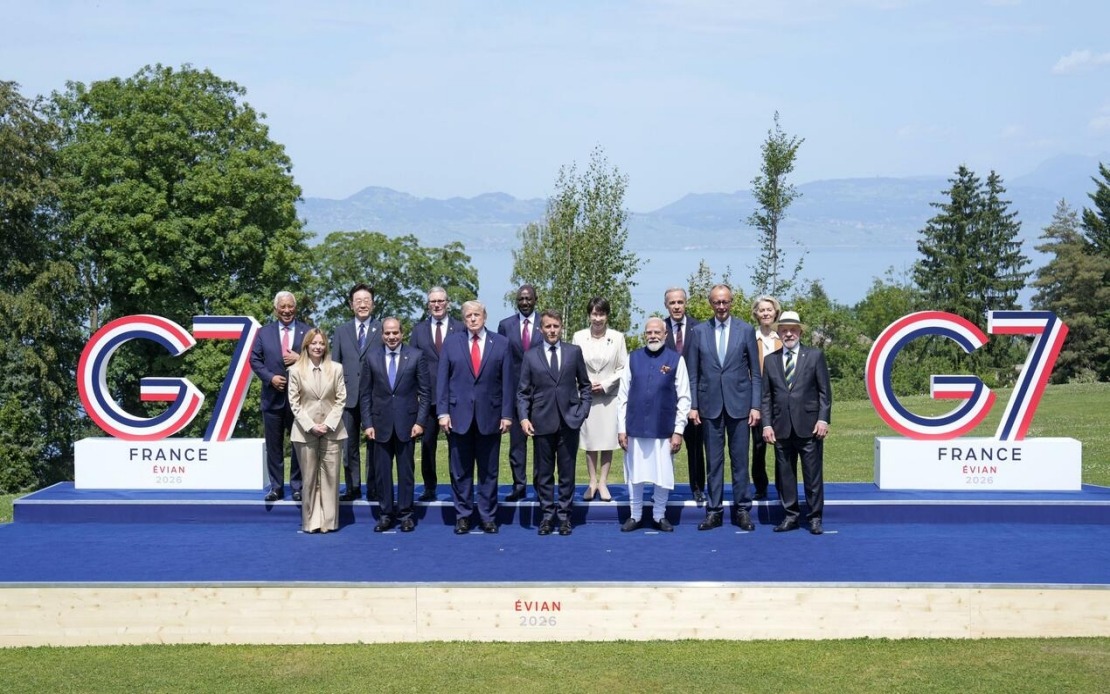
The Group of Seven's annual summit in Evian-les-Bains, a lakeside French resort town, yielded a unified commitment to deepen support for Ukraine, though the gathering underscored persistent rifts between the United States and its European allies on several fronts. The agreement, forged during Tuesday's proceedings, represents a rare moment of cohesion as the nations pledged continued efforts toward what they termed a "just and lasting peace" by maintaining diplomatic and economic pressure on Moscow. This consensus, however, masks considerable strategic disagreement among member nations regarding the appropriate path forward, particularly regarding the role of direct negotiation with the Kremlin versus sustained military and financial assistance.
US President Donald Trump seized the opportunity to publicly call on Russia to enter serious peace negotiations, framing the conflict in terms of mutual exhaustion. "Russia should make a deal. Russia has lost tremendous amounts of people, and so has Ukraine," Trump declared to assembled journalists, signalling his preference for a rapid diplomatic settlement over prolonged military engagement. His statement carries particular weight given Washington's outsized influence within the alliance, yet it diverges markedly from Kyiv's strategy of seeking to consolidate battlefield gains through European partnerships. Trump indicated willingness to employ economic leverage as incentive, suggesting that temporary sanctions relief previously implemented to stabilize global oil markets could be reversed if Moscow proves obstinate in negotiations.
The diplomatic calculus has shifted considerably since Russia's February 2022 invasion. Trump referenced preliminary progress in resolving the Iran conflict as a template for achieving peace in Ukraine, noting that a breakthrough in Middle Eastern negotiations has freed administration attention for the European theatre. He emphasized that restored oil flows following the tentative US-Iran accord would enable Washington to recalibrate its Russia strategy without destabilizing energy markets. This linkage between geopolitical developments in different regions illustrates how great-power competition remains interconnected, with progress in one theatre creating space for initiatives elsewhere.
Ukrainian President Volodymyr Zelenskyy, invited to address the summit directly, articulated priorities diverging subtly from Washington's emphasis. His focus centered on expanding air defence capabilities and advancing diplomatic frameworks while fundamentally changing Russia's strategic calculations about continuing the war. Zelenskyy's framing prioritizes deterrence through strengthened defensive capacity alongside negotiation, rather than accepting present circumstances as grounds for immediate settlement. His social media post emphasized that "peace is needed," yet the context suggests Ukrainian understanding that lasting peace requires first demonstrating unsustainability of Russia's military objectives.
Japanese Prime Minister Sanae Takaichi emerged as a voice for preserving alliance unity while expressing concerns about expanding authoritarian alignments. She warned that unilateral territorial changes imposed through military force cannot be accepted, signalling broader Asian anxieties about precedents set in Europe. Her explicit mention of deepening military cooperation between Russia and North Korea carries particular resonance for Japan and regional partners increasingly concerned about coordinated challenges from revisionist powers. The reference to Russia-China military ties reflects Tokyo's strategic anxiety about encirclement pressures in Asia, where similar territorial disputes and security dilemmas persist.
The summit's inclusion of guest nations from Africa, Asia, and the Middle East reflects evolving G7 strategy toward development partnerships. France's presidency has pushed the group toward creating reciprocal arrangements with developing nations, moving beyond traditional aid models toward mutual benefit frameworks. Recognition that conventional official development assistance increasingly fails to meet poorer nations' infrastructure and investment needs has prompted recalibration of the group's development philosophy. The emphasis on mobilizing private capital for long-term projects signals acknowledgment that public budgets alone cannot address global development deficits, particularly in critical sectors like energy transition and digital infrastructure.
West Asian developments occupied significant summit attention, with leaders welcoming the preliminary US-Iran agreement while emphasizing urgency for finalization. The working lunch discussion on Iran and its regional implications demonstrates how the region's stability affects global commerce and energy security. The group specifically highlighted the importance of maintaining free navigation through the Strait of Hormuz, through which approximately one-third of seaborne crude oil passes. Any disruption to this critical waterway reverberates through Asian economies dependent on reliable energy supplies, making the issue directly relevant to Malaysian and broader Southeast Asian prosperity.
Tensions underlying the summit's surface consensus merit careful scrutiny for regional observers. Trump's willingness to negotiate with Russia, his threats regarding NATO spending and Greenlandic acquisition, and his broader "America First" rhetoric have strained the Atlantic partnership. European nations worry that American commitment to collective security may prove conditional on financial contributions meeting presidential expectations. For Southeast Asian nations, this transatlantic friction raises questions about the durability of existing security architectures and the reliability of Western partners in regional contingencies. The demonstrated ability of individual leaders to reshape alliance policy suggests that institutional frameworks provide less protection than commonly assumed.
The summit's development finance discussions carry implications for Southeast Asia's infrastructure aspirations. Discussions about creating mutually beneficial partnerships that account for strategic interests signal that traditional non-interference doctrines may yield to explicit acknowledgment of geopolitical considerations in development lending. For countries like Malaysia, which benefit from infrastructure investment from multiple external sources, this shift toward explicitly strategic development partnerships could reshape available options and the conditionality attached to foreign capital inflows. The G7's recognition that development finance must address strategic interests openly rather than obscuring such motivations under humanitarian language represents a significant admission about how global investment flows operate.
Looking forward, the summit's outcomes reflect both genuine consensus on Ukraine's importance and genuine disagreement about paths forward. The commitment to continued support remains firm, yet Trump's emphasis on rapid negotiation introduces uncertainty about the durability of Western backing if Moscow signals willingness to discuss peace terms. European nations remain concerned that premature American disengagement could leave them managing ongoing Ukrainian conflict without reliable American military and economic support. For regional powers like Malaysia observing these dynamics, the message is clear: great power alignments remain fluid and responsive to individual leadership changes, making strategic hedging and relationship diversification prudent policies.
The summit underscored how global security challenges increasingly interconnect across regions. Ukraine and Iran cannot be treated as isolated conflicts; rather, they form part of a broader competition between revisionist and status-quo powers. How this competition resolves in Europe carries direct implications for Asia's security environment, where similar tensions between rising powers and established orders persist. The G7's renewed emphasis on defending rules-based international order reflects anxiety that multiple regional conflicts could collectively undermine the liberal international system. For Southeast Asian nations positioned between great power competition, maintaining these rules-based frameworks remains essential to protecting smaller states' ability to chart independent courses.
Technical disagreements about development finance reform may appear obscure to general audiences, yet they signal important shifts in how wealthy nations approach engagement with developing countries. The movement toward explicitly strategic partnerships, while refreshingly honest, means that developing nations must increasingly demonstrate alignment with G7 strategic interests to access development capital. Malaysia's position as a middle-income country with significant strategic importance—controlling maritime chokepoints, serving as a regional financial hub, and positioned between major power spheres—grants significant leverage in these evolving negotiations. Understanding how the G7's development philosophy is shifting proves essential for policymakers seeking to maximize benefits from external partnerships while minimizing constraints on autonomous decision-making.