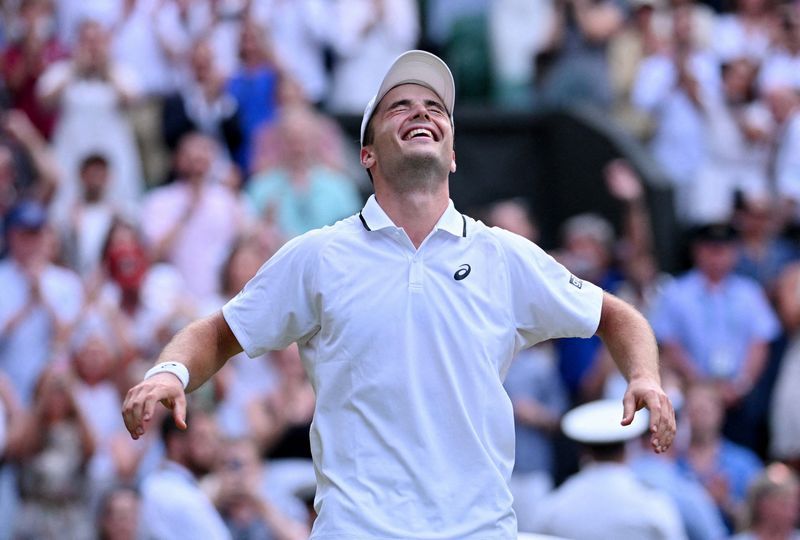
Arthur Fery's journey to the Wimbledon semi-finals reads like a screenplay rejected for being too implausible for cinema audiences. The 23-year-old wildcard entry, ranked 114th in the world and carrying merely two previous Grand Slam victories on his record, has somehow navigated his way to within two matches of lifting the most coveted trophy in grass-court tennis. That he achieved this feat while growing up within walking distance of Centre Court only amplifies the cinematic quality of his rise through the tournament draw.
The stakes have never been higher as Fery prepares to confront Alexander Zverev, the French Open champion and second seed, in Friday's semi-final. Should he overcome the formidable German, Fery would contest the final on Sunday—his 24th birthday—presenting an extraordinary opportunity to join an exclusive club of just one member: Goran Ivanisevic, who in 2001 became the sole wildcard entrant to claim the Wimbledon singles title. The magnitude of this possibility cannot be overstated, yet Fery's measured demeanor suggests he remains focused on the immediate challenge rather than the historical narrative already being written around him.
Fery's path to the semi-finals became fully apparent when he dismantled Italian ninth seed Flavio Cobolli 6-4, 7-6(4), 6-0 on Centre Court, earning him a place among only the fifth British male player in the professional era to reach this stage of the tournament. The performance drew admiration from the Royal Box, where Queen Camilla observed the young Briton's commanding display, later congratulating him at the match's conclusion. The queen's words of encouragement—"Congratulations, keep going"—reflected the broader sentiment sweeping through British tennis circles as the nation searched for a champion following a disastrous first-round elimination of 15 of its 19 singles competitors.
Fery's presence has already captured the attention of tennis luminaries beyond the royal household. Roger Federer, the eight-time Wimbledon champion, visibly acknowledged his approval during Fery's thrilling five-set victory against Grigor Dimitrov in the fourth round, a match that showcased both the physical and mental resilience required to survive such grueling contests. Princess Kate similarly offered her support during an earlier encounter against Otto Virtanen, embedding Fery's achievement within Britain's broader cultural narrative.
Despite his modest 5ft 9in frame, Fery displayed remarkable court coverage against Cobolli, retrieving seemingly unreachable balls and constructing an impenetrable defensive wall that left his opponent searching for solutions. The scorching Centre Court atmosphere appeared to energize rather than intimidate the young Briton, who fed directly off crowd momentum to produce increasingly dominant tennis as the match progressed. This composure under pressure stands in sharp contrast to the elevated expectations now surrounding his campaign.
Yet Fery's remarkable composure stems not from naiveté but from deliberate life planning. Rather than turning professional immediately, he chose the American college route, attending Stanford University where he majored in science, technology and society while simultaneously becoming the nation's top-ranked college player. This unconventional pathway provided intellectual grounding alongside athletic development, creating a measured perspective that has served him well during the intense scrutiny of a Wimbledon run.
His philosophical approach to the upcoming challenge underscores this measured temperament. When asked about preparing for arguably the most significant match of his career, Fery responded with characteristic restraint: "It's good that I don't have two weeks before my next match. They keep coming fast. So that's good. Just staying in my bubble and just carrying on." This refusal to be overwhelmed by external narrative and his commitment to remaining process-focused rather than outcome-obsessed may prove more valuable than raw talent in navigating Zverev's world-class abilities.
Fery's unlikely emergence as Britain's standard-bearer assumes additional poignancy when considering the nation's devastated opening round. The tournament's early stages witnessed a near-complete British collapse, with home nation representation nearly decimated before Fery's subsequent rounds began capturing imaginations. His presence now represents not merely individual achievement but collective redemption for British tennis, embodying hope that the domestic system can still produce champions capable of thriving on the sport's grandest stage.
Intriguingly, France might legitimately rue the path not taken. Fery's story contains a fascinating international dimension: born in the Parisian suburb of Sèvres, mere kilometers from Roland Garros, to French parents, with his father Loïc a multi-millionaire hedge fund manager and football club owner and his mother Olivia a former professional player, Fery possessed impeccable French tennis credentials. He briefly represented France at junior level before establishing himself as unambiguously British.
Fery's British identity reflects neither compromise nor convenience but rather authentic connection forged through formative experiences. Moving to London as a child, attending King's College located in Wimbledon, and progressing through the British tennis system created legitimate belonging that transcends birthplace. His father confirmed this perspective to French sports publication L'Equipe, noting that his son represents "a true Wimbledon boy"—someone who grew up five minutes from the tournament venue and attended school in its immediate vicinity, creating a relationship with the championship that no accident of birth in Paris could diminish.
This combination of circumstance, careful planning, and sustained excellence has produced a competitor whose potential trajectory could reshape British tennis. Zverev, despite his superior ranking and experience, faces an opponent unburdened by expectation yet elevated by possibility, playing on grass he has known since childhood and in front of crowds primed to witness history. Whether Fery progresses or falls to the second seed, his semi-final appearance has already vindicated the gamble of a wildcard entry and suggested that sometimes the most improbable stories contain the deepest roots in reality.

