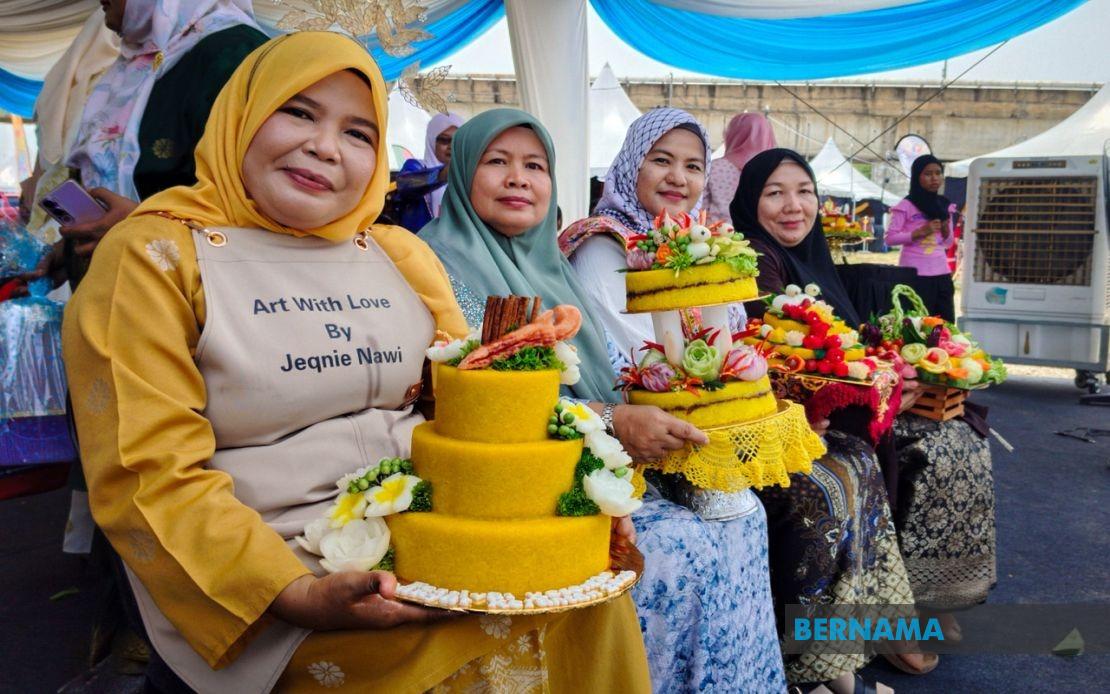
Nortiny Nawi's decision to abandon her career in hospitality marketing has proven prescient, culminating in a thriving homegrown business that capitalizes on a distinctly Malaysian culinary tradition. Operating from her residence in Kampung Gong Cokoh, Pasir Puteh, the 46-year-old artisan has cultivated a reputation for exquisite pulut kuning arrangements that command steady demand throughout Kelantan. Her trajectory demonstrates how strategic career pivots, grounded in genuine personal interest rather than market chasing, can yield sustainable livelihoods in rural Malaysia's emerging creative economy.
The pulut kuning arrangement market, while niche, occupies a meaningful space within Kelantan's celebration and event sector. These labour-intensive creations serve as centrepieces for thanksgiving ceremonies, birthday gatherings, and formal bridal dinners known locally as makan beradab. Unlike mass-produced desserts, pulut kuning arrangements demand fresh preparation, precise timing, and artistic skill—attributes that distinguish Nortiny's offerings in an increasingly commercialized events landscape. Her pricing structure, ranging from RM100 to RM280 per arrangement, reflects both material costs and the technical expertise embedded in each creation.
Nortiny's pathway into this specialized craft was neither accidental nor impulsive. During her employment at a resort, she cultivated her culinary interest through informal apprenticeship-style observation in professional kitchens. This period of patient learning, undertaken during leisure hours, provided foundational knowledge that later enabled her to transition into independent entrepreneurship. Her decision to pursue cooking full-time came only after carefully weighing her passion against employment security—a calculated move rather than an impetuous leap, reflecting pragmatic career planning among rural Malaysian women entrepreneurs.
The operational reality of her business reveals the physical and temporal demands underlying artisanal food production. Production commences at 3 am to steam glutinous rice, followed by kneading, cooling, and elaborate shaping into decorative configurations. This compressed timeline contrasts sharply with conventional cake production, where refrigeration enables advance preparation. The perishable nature of pulut kuning creates logistical constraints that simultaneously protect her market position; competitors cannot easily scale production or stockpile inventory. Currently managing up to six daily orders, Nortiny operates at a capacity threshold where further expansion requires operational restructuring rather than simple intensification.
Her clientele reflects institutional integration across Kelantan's public and private sectors. Individual customers form the obvious base, but repeat business from schools and government departments indicates penetration into bulk-order segments. This diversification provides business stability while reducing dependence on discretionary consumer spending tied to celebrations. The steady flow of bookings—near-daily according to her account—suggests that demand substantially exceeds current supply capacity, a condition that typically precedes business expansion among successful entrepreneurs.
Recognition within formal cultural frameworks has validated Nortiny's expertise. Her competition entry at the Kelantan Folk Arts Festival (FKRK) in Tok Bali showcased an eight-kilogramme pulut kuning arrangement embellished with intricate white radish carvings. Winning top prize carries implications beyond monetary reward; it establishes credentials within Kelantan's cultural institutions and signals quality assurance to prospective customers. Such formal recognition becomes particularly valuable for rural entrepreneurs operating outside urban commercial networks, serving as third-party validation that substitutes for conventional marketing channels.
The craft itself demands aesthetic sensibility alongside culinary competence. Decorative arrangements require sculptural skill, colour sense, and architectural understanding to ensure structural integrity while achieving visual impact. Nortiny's work exemplifies how traditional food preparation intersects with fine artistry—a synthesis that elevates pulut kuning from mere sustenance to experiential centrepiece worthy of premium pricing. This positioning within the luxury celebration market partially insulates her from price competition with industrial food production.
Nortiny's expressed motivation—continued improvement driven by customer appreciation—reflects intrinsic satisfaction alongside commercial viability. This alignment between personal fulfillment and business success represents an ideal often discussed but rarely achieved in entrepreneurship literature. Her commentary emphasizes that customer compliments inspire continued refinement, suggesting a virtuous cycle where reputation enhancement attracts more demanding clientele, which in turn spurs creative development. Such positive feedback loops typically characterize sustainable small businesses in culturally grounded sectors.
Expansion plans centre on securing larger premises, indicating that space constraints currently limit growth. The progression from home-based operation to dedicated commercial facility represents a natural business evolution, though it introduces complications including rental costs, regulatory compliance, and workforce management. Nevertheless, the accumulated demand suggests that expansion would likely proceed from established business strength rather than speculative investment. Her willingness to contemplate this transition indicates confidence in market durability and personal capability to manage scaled operations.
Nortiny's enterprise carries broader significance for understanding economic opportunity in rural East Coast Malaysia. Her success contradicts assumptions that creative livelihoods require urban locations or digital sophistication; instead, she demonstrates how localized cultural traditions can sustain contemporary entrepreneurship. The pulut kuning business model relies on cultural knowledge, artisanal skill, and deep integration within community networks rather than technology adoption or external market access. This pattern offers lessons for policymakers considering rural economic development strategies beyond conventional manufacturing or plantation agriculture.
The sustainability of her business depends partly on cultural continuity. As long as celebrations in Kelantan incorporate pulut kuning as status-conferring centrepieces, demand will persist. Economic development pressures and dietary modernization pose potential risks to such traditions, yet the consistent demand Nortiny experiences suggests cultural resilience. Her pricing power—customers willingly pay premium rates—reflects genuine cultural value rather than nostalgia-driven consumption.
Looking forward, Nortiny's trajectory illuminates viable pathways for women entrepreneurs across Southeast Asia seeking to monetize cultural expertise. Her enterprise required minimal capital investment, avoided technology dependence, leveraged existing domestic knowledge, and created employment aligned with personal interests. These characteristics make the model potentially replicable across communities with analogous food traditions, from Thai sticky rice presentations to Philippine kakanin specializations. The challenge lies in identifying entrepreneurs with sufficient passion and skill to match Nortiny's demonstrated standards.

