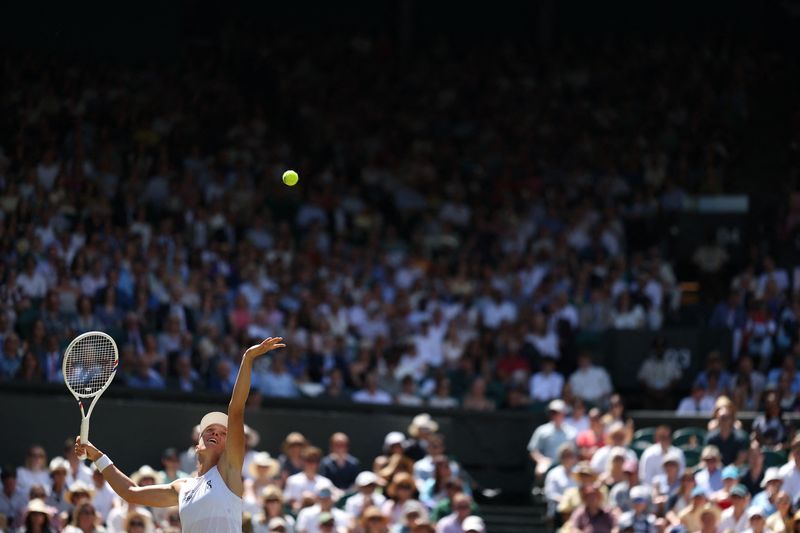
Alexandra Eala's Wimbledon journey reached an extraordinary milestone on Saturday when the rising Filipino star dismantled defending champion Iga Swiatek in a thrilling Centre Court encounter, winning 7-6(9) 6-2 in the third round. The 25-year-old Polish third seed, who had ended years of speculation about her ability to perform on grass with her triumph just twelve months earlier, found herself outmanoeuvred by an opponent playing with the kind of freedom and confidence that comes from having nothing to lose. For Eala, the victory represents far more than a remarkable result at one of tennis's most prestigious events—it marks the culmination of years of dedication and sacrifice that began in the Philippines with training sessions after school and the kind of determination that transforms childhood ambitions into reality.
Swiatek's path to this match had been far from convincing. Despite proving her credentials on grass with last year's championship run, the world number three arrived at the All England Club under considerable pressure, having suffered an early exit at the Bad Homburg warm-up tournament. This lack of preparation and consistency provided Eala with psychological advantage, and the left-hander's powerful baseline game proved ideally suited to unsettle a player still searching for her rhythm on the surface. Swiatek's struggles became apparent in the opening set, which stretched to a tiebreaker at 6-6 before Eala sealed it 9-7, demonstrating both technical prowess and mental composure under intense pressure. The Pole's emotional reactions—including racket slamming and animated exchanges with her coaching team—suggested frustration mounting as Eala's assault continued unabated.
The second set showcased the full extent of Eala's dominance. Breaking serve at the outset and again racing to a 3-0 lead, the Filipino appeared destined for a straightforward progression to the fourth round. Though Swiatek managed to retrieve one break in a brief rally of resistance, Eala's superiority ultimately proved insurmountable. A forehand winner sealed the match and sent the Centre Court crowd into raptures, with supporters energised by witnessing a genuine David-versus-Goliath narrative unfolding before them. This atmosphere, so crucial to any Wimbledon experience, seemed to elevate Eala's performance rather than intimidate her, transforming what could have been an overwhelming occasion into an opportunity to showcase her talents on sport's most famous stage.
Eala's post-match reflections offered genuine insight into the significance of her achievement. Speaking with evident emotion yet remarkable clarity, she reflected on the journey from her childhood in the Philippines—training with her brother and grandfather, wearing ruffled socks and light-up shoes—to competing against one of the world's finest players on Centre Court. She acknowledged that while her success might appear modest to champions like Serena and Venus Williams or the multiple Grand Slam winner she had just defeated, for someone with her background the accomplishment represents something profoundly personal and meaningful. This perspective provides important context for Southeast Asian sports fans: Eala's breakthrough reflects the potential for players from the region to compete at the highest levels of international tennis, challenging the traditional dominance of European and American competitors.
The tactical battleground between these two competitors reveals interesting contrasts in playing style and approach. Swiatek, traditionally a clay-court specialist who has dominated on the European circuit, continues to grapple with the adjustment required for grass's unpredictable bounces and faster points. Eala, conversely, has developed a more complete game that translates effectively across different surfaces. Her baseline power, particularly the formidable shot-making that troubled Swiatek from the opening exchanges, combined with improved serve consistency, suggests a player entering a new phase of competitive maturity. The earlier encounter between these two players in Miami last year, which Eala had won before Swiatek gained revenge on Madrid's clay courts, added intriguing context to their Centre Court clash. That historical head-to-head record underscored that this was no fluke result, but rather the logical conclusion of an emerging rivalry between two genuinely talented competitors.
Swiatek's defeat raises important questions about her suitability for grass-court tennis despite last year's championship success. Championship wins at individual Grand Slams do not necessarily signal mastery of specific surfaces, and the Polish champion's struggles in recent weeks suggest she may remain more comfortable on clay than on grass. For Malaysian tennis followers, Swiatek's struggles serve as a reminder that even the most accomplished players face vulnerability when competing outside their preferred environment. Meanwhile, Eala's confident progression to the fourth round positions her to face 2024 runner-up Jasmine Paolini, another compelling matchup between rising talents who represent the next generation of women's professional tennis.
The broader significance of Eala's achievement for Philippine and Southeast Asian sports cannot be overstated. Professional tennis has traditionally been dominated by players from Western nations and a small number of Asian powerhouses, particularly Japan, South Korea, and China. Eala's presence at Wimbledon's second week, competing successfully against the sport's elite, signals that talented players from beyond these established centres can achieve success at the sport's highest levels. Her obvious emotional connection to her opportunity, combined with her stated determination to seize moments rather than merely participate, suggests genuine hunger that may drive further accomplishments throughout her career.
The atmosphere at Centre Court during this encounter provided compelling evidence of how grass-court tennis at Wimbledon remains fundamentally different from other Grand Slam tournaments. The enclosed setting, the partisan support channelled effectively towards the underdog, and the acceleration of play on grass all contributed to creating conditions where technical superiority alone proved insufficient for Swiatek. Eala's ability to thrive in this environment, feeding off crowd energy while maintaining focus on execution, distinguishes her as a player capable of performing under circumstances that might overwhelm others. Her comments thanking supporters for the atmosphere demonstrated sophistication in understanding how to harness public backing rather than being overwhelmed by it, a critical skill for sustained success at major tournaments.
Looking ahead, Eala's progression to the second week of Wimbledon represents a watershed moment in her career trajectory. Beyond the immediate challenge of facing Paolini, she has demonstrated that she belongs among tennis's elite competitors. The magnitude of defeating a defending Grand Slam champion on that champion's preferred surface cannot be understated, and Eala's emotional yet focused response to her success suggests mental resilience alongside technical excellence. For young athletes across Southeast Asia watching this tournament, Eala's journey from childhood training sessions in the Philippines to Centre Court glory offers both inspiration and tangible proof that international success remains achievable regardless of geographic origin. The implications for grassroots tennis development throughout the region extend beyond individual achievement to suggest that systematic investment in player development could yield significant international results in coming years.

