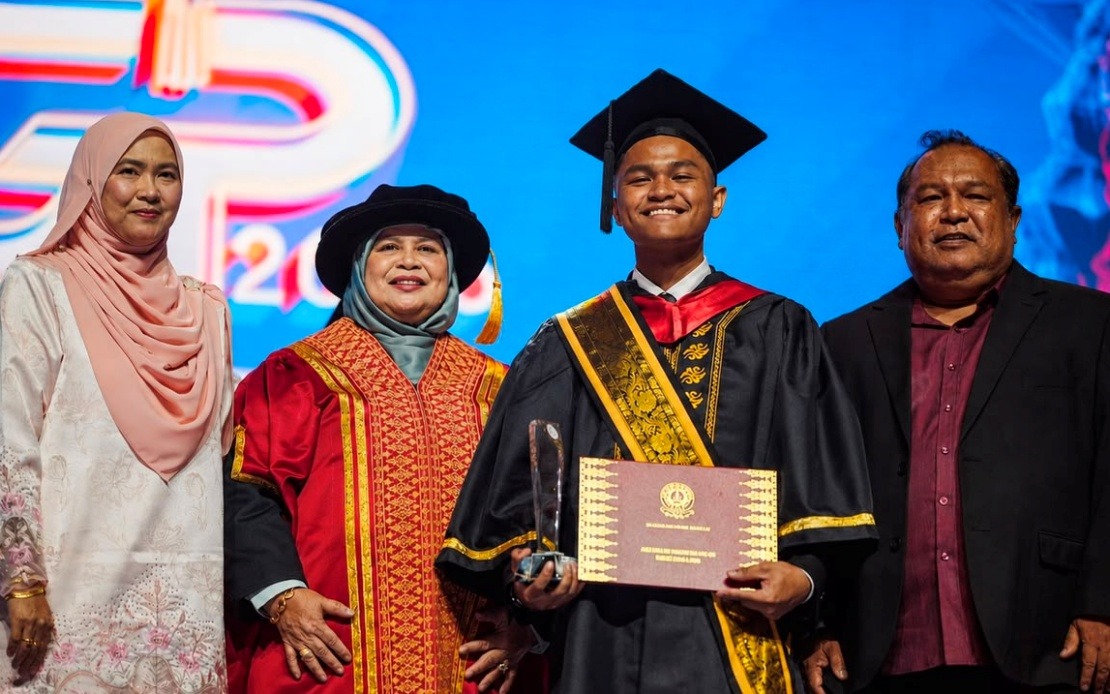
Muhammad Aaqif Dino Faezal represents a growing cohort of Malaysian students whose educational trajectory has been reshaped by targeted government investment in talent development. The 19-year-old, who progressed from MARA Science Junior College (MRSM) Tun Ghafar Baba in Melaka through to Kolej MARA Banting (KMB), will commence studies in Geology at Imperial College London this September—a pathway that underscores MARA's expanded commitment to cultivating Malaysian talent capable of competing on the world stage.
Muhammad Aaqif's educational journey illuminates the strategic role that Malaysia's premier scholarship bodies play in democratising access to elite education. Receiving sponsorship under MARA's Young Talent Development Programme (YTP) to pursue the International Baccalaureate Diploma Programme (IBDP) at KMB from 2024 to May 2026, he has become emblematic of how targeted institutional support can overcome financial barriers that might otherwise restrict opportunities to families with substantial means. His ascent through the MARA system reflects deliberate efforts to identify and nurture promising students early, equipping them with internationally recognised qualifications and global perspectives essential for competing in knowledge-driven sectors.
The financial dimension of Muhammad Aaqif's achievement cannot be understated. International tertiary education, particularly at prestigious institutions like Imperial College London, represents a significant investment that remains beyond reach for most Malaysian families regardless of their children's intellectual capacity. By removing this economic constraint through comprehensive sponsorship, MARA has enabled a talented individual to pursue advanced studies in a field—Geology—that carries strategic importance for Malaysia's hydrocarbon and renewable energy sectors. Muhammad Aaqif himself acknowledged this reality, noting that without MARA's intervention, the costs associated with studying and residing abroad would have proved insurmountable.
His academic performance underscores the calibre of students selected for MARA's programmes. Achieving 44 out of 45 points in the IBDP examination in May 2026 places Muhammad Aaqif in the upper echelon of international school graduates globally. This result reflects not merely rote competency but the sophisticated analytical and independent thinking skills that the International Baccalaureate cultivates. For a Malaysian student educated entirely within the national system before KMB, such a score suggests that quality education—when adequately resourced and purposefully structured—can produce outcomes comparable to international boarding school counterparts.
Beyond academics, Muhammad Aaqif's designation as the 2026 MARA College Graduate Icon signals that MARA's pedagogical philosophy extends beyond examination results. His election recognised outstanding academic achievement, leadership qualities, contributions to society and potential for future impact. Serving as president of KMB's Students' Representative Council (MPP) whilst maintaining academic excellence demonstrates the multidimensional development that institutional leaders at MARA-affiliated colleges are attempting to foster. This holistic approach aligns with contemporary scholarship on talent development, which increasingly emphasises that intellectual capability divorced from character, emotional intelligence and collaborative skills produces incomplete leaders.
Muhammad Aaqif's intentions regarding his future career trajectory carry significance for Malaysia's resource and energy sectors. Upon completing his Imperial College degree, he has indicated a commitment to applying his expertise towards advancing Malaysia's oil, gas and energy industries. This represents a form of human capital retention—the conversion of publicly-funded educational investment into domestic economic benefit. Should he fulfil this commitment, he exemplifies the intended outcome of MARA's development philosophy: producing graduates whose international training enhances rather than diminishes their contribution to the Malaysian economy.
The residential college model that KMB exemplifies provides distinctive educational value beyond curriculum delivery. Muhammad Aaqif's participation in co-curricular activities, his assumption of student leadership roles and his integration within a structured boarding community all contribute to character formation. Arfaseela Amir, KMB's director, explicitly linked his achievements to the college's aspiration to produce intellectually capable human capital possessing strong ethical and interpersonal foundations. In Malaysia's context, where concerns about skill gaps and graduate employability persist, this emphasis on integrated personal and academic development addresses real labour market requirements.
The MARA system's expansion to support IB programmes represents a strategic recalibration of how Malaysia engages with global educational standards. Historically, elite international education remained concentrated within private institutions accessible primarily to wealthy Malaysians, potentially creating a bifurcated talent pool. By enabling high-performing students from less affluent backgrounds to access equivalent educational pathways through KMB, MARA widens the aperture through which Malaysian talent can emerge. Muhammad Aaqif, born and raised in Selangor with no apparent family wealth advantage, demonstrates that such expansion democratises rather than merely replicates elite education.
His recognition as the 2026 MARA College Graduate Icon also carries institutional messaging value. MARA is publicly cementing its commitment to identifying and celebrating excellence among its scholarship recipients, creating visibility and prestige around MARA-supported pathways. For younger Malaysian students considering educational options, Muhammad Aaqif's profile—progressing from a state-level MRSM college to an elite London institution—provides a tangible alternative model to the privatised international education narrative that often dominates Malaysian discourse about global qualification pathways.
The strategic importance of Geology as an academic discipline warrants consideration. As Malaysia navigates energy transition and positions itself within global climate and resource frameworks, geological expertise in petrochemical extraction, mineral resource management and potentially renewable energy applications becomes increasingly valuable. Muhammad Aaqif's pursuit of this specialisation at a world-leading institution suggests that MARA's talent identification processes may be aligning sponsorship decisions with sectoral economic needs, a sophisticated approach to human capital development.
Muhammad Aaqif's gratitude toward his family, teachers, KMB and MARA reflects a recognition that individual achievement emerges from systemic support. This framing is particularly significant in Malaysian discourse, which sometimes emphasises heroic individual achievement at the expense of institutional enablement. By acknowledging the ecosystem that made his trajectory possible, Muhammad Aaqif models a more sophisticated understanding of educational success—one that resonates with contemporary scholarship on educational equity and opportunity structures.
As Muhammad Aaqif embarks on his Imperial College journey this September, his case studies an important dimension of Malaysia's knowledge economy development strategy. The effectiveness of MARA's Young Talent Development Programme will ultimately be measured not merely in examination scores or university admissions to prestigious institutions, but in whether supported students convert their international qualifications into productive contributions to Malaysia's sectoral development, technological advancement and research capabilities. Muhammad Aaqif's commitment to applying his Imperial College education toward Malaysia's energy sectors suggests one positive vector in that measurement.

