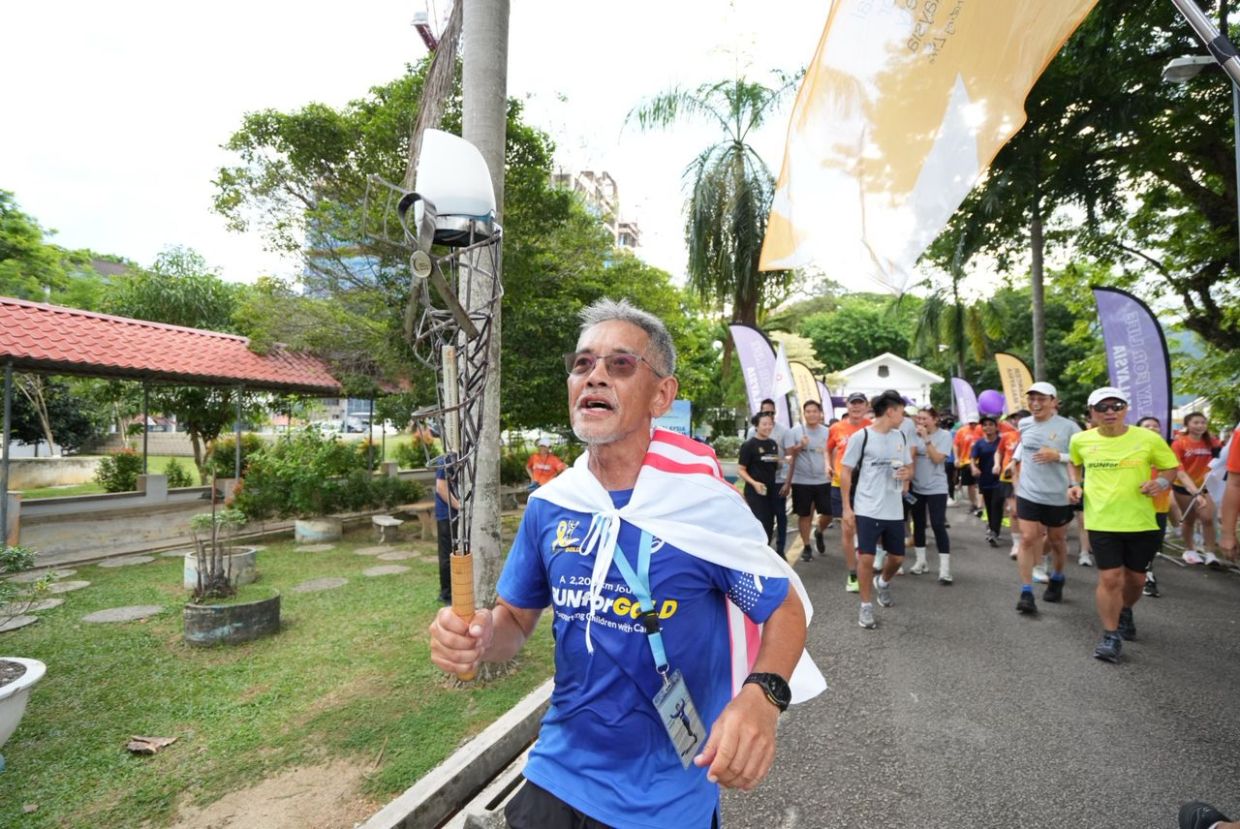
When SG Lim faced retirement at 66, he expected the typical slowdown that accompanies life's final chapter. Instead, the Penang-based civil engineer and runner confronted something far more demanding: learning to navigate existence without Goh Joo Lee, his wife of decades, who succumbed to cancer in 2024 at age 63. Rather than retreat into solitude, Lim embarked on a geographical and emotional odyssey, splitting his time between Australia where his children live, Malaysia with extended family, and Hong Kong as a personal refuge. It was during these travels that grief metamorphosed into something purposeful.
Lim remembers his wife in stark, revealing terms. Beyond the conventional descriptions of a devoted spouse, he emphasises her "loving" and "caring" nature—qualities that extended remarkably beyond her immediate circle. Even from her hospital bed, Goh prioritised others' wellbeing over her own suffering. A particular memory crystallises this generosity: though battling her own malignancy, she asked her husband to purchase flowers for another cancer patient hospitalised nearby, a stranger whose husband had become her tireless caregiver. That spontaneous act of compassion, witnessed by Lim during his wife's darkest hours, revealed the breadth of her empathy and would later inform his own mission.
Goh's artistic talents—her drawings, paintings, and pop-up creations shared across social media—remain living testaments to her creative spirit. For Lim, these digital remnants serve as cherished touchstones connecting him to her vibrant personality. As he processed his bereavement through solitary reflection and geographic displacement, he encountered a transformative text by Laurence Carter that inspired an audacious vision: undertaking an extended running or walking expedition across Peninsular Malaysia. Consulting directly with Carter, Lim refined his concept and secured partnership with the National Cancer Society Malaysia (NCSM), which helped brand the initiative as "Run For Gold," explicitly dedicating the endeavour to raising awareness and generating financial support for children diagnosed with cancer.
The preparation regime demanded meticulous discipline. Following his completion of the Sydney Marathon in August, Lim systematically increased his running mileage whilst conditioning his body for Malaysian heat and humidity. He enforced 5am wake-up routines, executed afternoon runs under intense sun exposure, committed to strength conditioning sessions, and acquired video editing skills to document his progress for social media audiences. This wasn't merely physical preparation; it represented a deliberate transformation of his grief into structured action, each training session a meditation on purpose and commitment.
When Lim finally commenced his journey traversing 11 states and federal territories, the lived experiences he encountered deepened his resolve exponentially. His inaugural visit to a children's oncology ward operated by NCSM confronted him with the raw reality he was fighting for: emaciated children and visibly anguished parents whose helplessness mirrored his own vulnerabilities. In that moment, the abstract objective crystallised into urgent moral clarity. He wasn't merely running kilometres; he was witnessing suffering and channelling his own loss into potential alleviation for others.
The human connections forged during his odyssey proved equally transformative. In Pekan, Pahang, Lim encountered a retired teacher and his spouse whose participation embodied the crowdsourced nature of his mission. While lacking financial resources to directly support child cancer patients, the couple contributed through physical presence and relentless advocacy, visiting local eateries to personally articulate the cause to strangers. Their multi-stage accompaniment across Johor, Melaka, and Penang revealed a particular poignancy: watching their mutual devotion and support system activated Lim's lingering grief, reminding him viscerally of what he had lost.
After nearly three months and 2,200 kilometres of accumulated effort, Lim crossed the finish line in George Town, Penang. His initial utterance encapsulated the entire emotional arc of his journey: "Darling, we made it!" The acknowledgment that his late wife remained his psychological companion throughout the expedition, that her memory motivated each stride, underscored the alchemy he had achieved—transforming private bereavement into public service.
Yet perhaps the most remarkable outcome transcended the fundraising metrics or cancer awareness statistics. When Lim completed his final stretch, he encountered not only immediate family but also childhood classmates, former colleagues, and complete strangers who had followed his journey via social media and come to welcome him home. This gathering illustrated a profound social truth: grief channelled into collective purpose generates resonance that extends far beyond the bereaved individual. What began as one man's attempt to process loss through physical exertion had evolved into a movement that touched communities across Malaysia, validating his instinct that honouring his wife's memory through service to vulnerable children created meaning transcending personal tragedy.
For Malaysian society, particularly those managing cancer diagnoses or supporting afflicted families, Lim's journey offers a compelling counter-narrative to grief's typical paralysis. Rather than accepting loss as a terminus, he demonstrated how bereavement could catalyse transformative action aligned with the deceased's values and character. His 2,200-kilometre testament becomes more than an athletic achievement; it represents a template for channelling private anguish into structures that benefit vulnerable populations, specifically children whose cancer diagnoses impose unconscionable burdens on families already emotionally devastated. The National Cancer Society Malaysia's partnership with Lim amplifies this model's scalability, suggesting that institutional support combined with individual determination can generate both immediate resource mobilisation and long-term awareness infrastructure benefiting Malaysia's youngest cancer patients.

