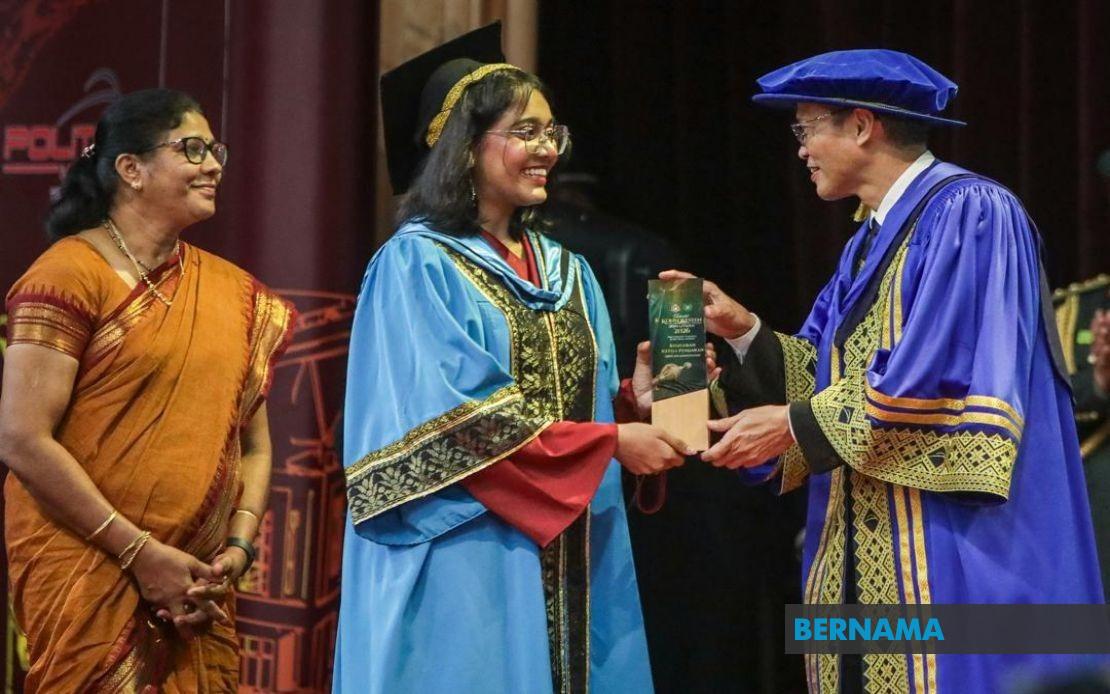
Teerti Ganapathi Rao's journey through tertiary education stands as a testament to the power of perseverance in the face of personal tragedy. The 22-year-old graduate from the Department of Information and Communication Technology at Politeknik Tuanku Syed Sirajuddin (PTSS) in Arau has been recognised for her outstanding academic performance, receiving the prestigious Director-General's Award and the Academic and Co-Curricular Excellence Award at the Northern Zone Polytechnic and Community College Convocation Ceremony held on August 3, 2024. Her achievement carries particular weight given that she completed her Semester Two examinations in 2023 while grieving the sudden loss of her father, an experience that could have derailed many students from continuing their studies.
The recognition came during the first session of the three-day convocation ceremony graced by the Raja of Perlis, Tuanku Syed Sirajuddin Jamalullail, which saw 6,104 graduates from polytechnics and community colleges across Perlis, Kedah and Penang celebrate their academic milestones. Among this large cohort, Teerti's distinction reflects not merely technical competence but the kind of emotional fortitude that Malaysian educators increasingly recognise as essential to student success. Her cumulative grade point average of 3.61 positions her among the top tier of her graduating class, a remarkable accomplishment that underscores the depth of her commitment to her chosen field.
What makes Teerti's story particularly resonant is the critical juncture she faced following her father's passing. Speaking to reporters after the ceremony, she described how she initially doubted whether she would be eligible for such recognitions, making the actual announcement of her awards all the more meaningful. She revealed that during the period of grief, she had contemplated abandoning her diploma programme to pursue a foundation course instead—a decision that would have set back her educational trajectory significantly. However, the counsel and encouragement her father had provided before his death became her psychological anchor, a set of principles to return to whenever her resolve wavered.
As the youngest of four siblings, Teerti found herself drawing upon her father's legacy of academic persistence. His repeated emphasis on the importance of completing her diploma, even when faced with the temptation to change course, proved instrumental in keeping her focused on her original academic goals. This intergenerational transmission of educational values—passing from parent to child the belief that challenges should be met with determination rather than retreat—reflects broader family dynamics that are common across Malaysian households but often remain unspoken. In Teerti's case, that paternal guidance transformed from abstract advice into concrete motivation during her darkest moments.
During her three-year tenure at PTSS, Teerti demonstrated consistent excellence across multiple semesters. She received the Head of Department's Award for Semesters One, Three and Four, signalling not a single peak performance but a sustained commitment to excellence throughout her studies. Beyond the classroom, she engaged actively in the Student Representative Council (MPP), where she developed practical skills in leadership, communication and collaborative teamwork. These extracurricular involvements enriched her educational experience and built competencies that extend well beyond her chosen technical discipline, preparing her for the complex interpersonal environments of modern IT workplaces.
Teerti's academic portfolio also includes significant practical contributions to her field. She represented PTSS at collaborative programmes and academic seminars at Universiti Putra Indonesia, positioning her work within regional educational networks. Most notably, her final-year project—the Koop Printing System—addressed a real operational challenge by designing a platform to enhance the efficiency of cooperative printing service management. This project-based learning approach, increasingly common in polytechnic education across Southeast Asia, allowed her to translate theoretical knowledge into solutions applicable to the business environment, a competency highly valued by employers in Malaysia's growing digital economy.
Teerti's linguistic capabilities further distinguish her profile as an emerging technology professional. Her fluency in Mandarin, Tamil and Telugu, combined with her native proficiency in Bahasa Melayu and English, provides her with substantial advantages in a region as linguistically diverse as Southeast Asia. She has additionally acquired foundational knowledge of French, Japanese and Korean—languages chosen with apparent strategic intent given their relevance to international technology markets and collaborative opportunities. This multilingual foundation positions her as a bridge-builder in international digital initiatives, a role increasingly important as Malaysian tech companies expand their regional and global footprint.
Looking ahead, Teerti's ambitions reflect the expanding aspirations of Malaysia's polytechnic graduates. She is currently awaiting results from her application to pursue a Bachelor's degree in Information Technology, with Universiti Malaya listed as her preferred institution. Her ultimate goal extends even further: completing a Doctor of Philosophy (PhD) and establishing herself as a research-level contributor to her field. This progression from diploma to bachelor's to doctoral studies mirrors the educational pathways increasingly common among high-achieving Malaysian students seeking to move from practitioner roles to thought leadership and academic positions.
The genesis of Teerti's interest in information technology traces back to her teenage years. At age 16, she was introduced to computers and coding through friendships formed in online gaming communities—a reminder that career pathways in the digital age often emerge from unexpected social contexts. She describes the field as inherently challenging, yet has discovered that systematic, conceptual learning transforms apparent complexity into manageable skill development. This pedagogical insight—that deep understanding of foundational concepts renders advanced applications more accessible—reflects a maturity in how she approaches professional development that should serve her well throughout her career.
Teerti's achievement holds broader significance for Malaysian polytechnic education and the resilience narratives it exemplifies. Her story demonstrates that institutional support systems, combined with personal determination and family encouragement, can help students navigate devastating personal circumstances without compromising their academic trajectory. As Malaysia seeks to increase the proportion of its workforce holding tertiary qualifications and to develop technical expertise aligned with Industry 4.0 requirements, examples like Teerti's illustrate the human capacity to transcend grief through structured educational engagement. Her recognition at the convocation ceremony not only celebrates her individual achievement but also validates the polytechnic sector's role in nurturing the kind of intellectually rigorous and emotionally resilient professionals that the nation requires.

