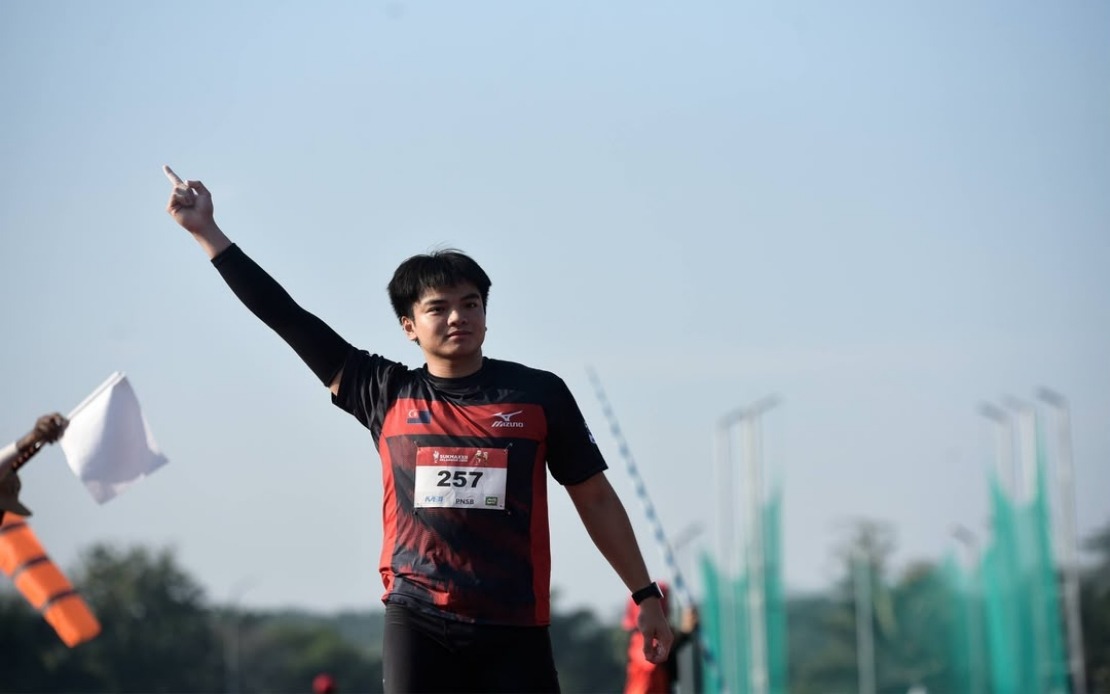
Johor's Chai Kai Le has rewritten the history books at the Selangor 2026 Malaysia Games, hurling the javelin 64.44 metres to obliterate a record that had stood for more than a quarter-century. The 18-year-old's stunning performance at the Universiti Putra Malaysia Sports Centre erased the previous mark of 62.33 metres set by Sarawak's Kho Mei Kuan during the 2000 edition held in Penang, marking a significant achievement in Malaysian athletics at a pivotal moment in his development as an athlete.
Yet behind this triumphant breakthrough lies a story that began not on the javelin runway, but across a badminton court. Kai Le's initial passion was for badminton, where he competed as a schoolboy in his earlier years. It was during these formative days that a perceptive teacher noticed something distinctive about his sporting ability—specifically, the remarkable speed and technique with which he released the badminton shuttle. Rather than dismissing this observation as mere commentary, the educator recognised the potential for Kai Le's natural arm mechanics to translate into a completely different athletic discipline.
That single moment of recognition would prove transformative. The teacher's suggestion to transition toward javelin proved prescient, and by the time Kai Le reached Standard Six, he had embarked upon his new sporting path. What began as an experiment in exploring a different throwing discipline gradually evolved into a serious pursuit as he progressed through secondary school. His engagement with the sport deepened considerably as he began participating in open competitions and observing how established senior athletes performed at regional and national levels. Witnessing these elite throwers propel the javelin across considerable distances planted an ambition within him—a conviction that with sufficient dedication, he too could reach such heights.
The infrastructure supporting Kai Le's athletic development extends far beyond coaching or training facilities. Central to his journey has been the steadfast commitment of his father, Chai Yin Huan, whose financial and emotional investment has proven absolutely essential. Kai Le acknowledges that his father has never wavered in providing whatever resources his career demands, whether through funding rehabilitation treatments following injuries, purchasing new equipment as older gear wears out, or simply maintaining the psychological support that elite-level athletics demands. This parental backing reflects a philosophy that prioritises the athlete's wellbeing and personal growth over winning at all costs.
According to Kai Le, his father's approach has always emphasised effort and health rather than results. The elder Chai never pressured his youngest son to achieve elite status; instead, he consistently encouraged Kai Le to perform to his highest capability whilst maintaining physical wellness. This balanced perspective may have proved crucial during periods when injuries threatened to derail his progress. As a pre-university student at Bukit Jalil Sports School, Kai Le has contended with a series of significant physical challenges over the past twelve months, including chronic back pain alongside recurring problems affecting his right shoulder and elbow.
The injury landscape facing Kai Le presents considerable complexity, as these ailments have not fully resolved despite ongoing treatment and rehabilitation efforts. Many young athletes would have retreated from competition under such circumstances, but Kai Le demonstrated remarkable resilience by continuing his training regime and entering competitive events despite incomplete recovery. This determination was evident earlier in the year when he competed at the Indonesia Open, where he achieved two significant milestones simultaneously. At that competition, he established both a personal record and a national under-20 record by throwing 65.65 metres, suggesting that his technical development continues progressing despite the physical obstacles he faces.
The SUKMA record Kai Le has now established represents merely a waypoint in his trajectory rather than a final destination. The young thrower has already articulated his next objective: achieving a 70-metre throw during the coming year. This ambitious target serves a practical purpose beyond personal aspiration, as attaining such a distance would substantially strengthen his credentials for selection to the Malaysian contingent competing at the 2027 SEA Games. To support this objective, Kai Le has arranged specialist training in Japan for early next year, a month-long intensive programme designed to refine his technique under expert coaching whilst potentially addressing his lingering injury concerns.
Kai Le's confidence in achieving these objectives stems from both his demonstrated capacity for improvement and his philosophical approach to athletic development. When discussing his prospects, he emphasised that sustained desire and genuine commitment translate into tangible results. This mindset—viewing goals as attainable through dedication rather than merely as wishful thinking—permeates his approach to every phase of his athletic career. His trajectory from a schoolboy badminton player noticed by an observant teacher to a record-breaking javelin thrower within the span of several years illustrates how marginal advantages in early talent identification, combined with family support and personal determination, can produce exceptional outcomes.
For Malaysian athletics, Kai Le's emergence carries broader significance. The Southeast Asian region has traditionally produced competitive javelin throwers, and Malaysia's ability to develop young talent capable of challenging regional and international standards depends partly on nurturing athletes during their formative years. The combination of factors enabling Kai Le's success—early coaching observation, familial support, access to specialised training facilities through Bukit Jalil Sports School, and his own mental resilience—provides a template worth examining as Malaysian athletics administrators consider how to cultivate future champions. His record-breaking performance at Selangor 2026 suggests that Malaysian javelin has entered a new phase of competitive capability.

