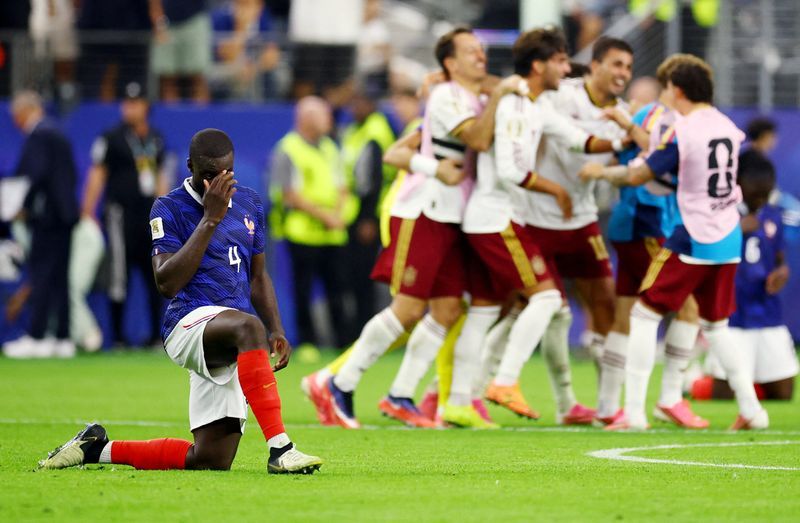
France's World Cup campaign ended in humiliation on Tuesday as Spain delivered a masterclass in midfield control and clinical finishing, defeating the tournament favourites 2-0 in the semi-final at Arlington, Texas. What was meant to be a coronation proved instead to be a reckoning, as the French side that had been installed as title contenders crumbled under the first sustained pressure they faced, their defeat marking one of the tournament's most dramatic reversals in fortune.
The collapse was all the more striking because of how comprehensive it proved to be. Unlike their performance in the 2022 World Cup final against Argentina, where France clawed their way back into a match they had dominated early on before falling only to penalties, there was no redemption narrative here. Spain's control never wavered, and France never mounted a meaningful comeback. Coach Didier Deschamps acknowledged the harsh reality in his post-match assessment, telling his devastated players that France had simply been outmatched on the day. The technical superiority lay entirely with the Spanish, he insisted, placing responsibility squarely on his squad's shoulders rather than offering excuses about injuries or tactical misfortunes.
The loss exposed a fundamental miscalculation by those who had backed France to win the tournament. The pre-match consensus appeared to underestimate Spain's ability to impose their pattern of play on opponents, controlling the tempo and dictating the rhythm of proceedings. France's second-half substitute Rayan Cherki later reflected on this strategic oversight, explaining that the Spanish had understood perfectly how to leverage their strength in slowing down the game. The French, by contrast, had failed to adjust to this approach when it mattered most, finding themselves drawn into a contest where their usual dynamism counted for little.
Young Spanish winger Lamine Yamal had set the tone for his team's swagger before the match, declaring that France should be the ones fearful of the encounter. That confidence proved entirely justified as the teenager and his teammates systematically dismantled what had been presented as an irresistible force. The Spanish midfielder Rodri became the fulcrum around which everything revolved, gliding through the middle of the pitch with ruthless authority and dictating play with the kind of composure that only comes from genuine technical mastery. His performance represented the blueprint for how to neutralise France's attacking ambitions.
The symbolic figure of France's failure was Michael Olise, the playmaker who had been thrust into Ballon d'Or conversations and tasked with unlocking Spain's defensive shape. On the Dallas pitch, Olise looked utterly adrift, starved of space and ideas in equal measure. He surrendered possession with alarming regularity, relinquishing the ball twenty times throughout the match while failing to complete a single dribble—a damning statistic for a player of his supposed calibre whom France had relied upon to provide the creative spark against one of the tournament's most organised defensive units. Olise's struggles against Rodri's authority painted a telling picture of the gulf that emerged between the two sides.
However, the French attacking malaise extended far beyond one player's poor performance. Ousmane Dembele produced virtually nothing of note on the flank, while Bradley Barcola struggled to impose himself in the forward line. When Barcola was substituted, his replacement Desire Doue proved equally ineffective, leaving France's supposedly vaunted attacking options looking strangely toothless. Even Kylian Mbappe, the superstar everyone had expected to produce a moment of brilliance when France needed it most, never found his rhythm. The most memorable moment involving star power came not from the French attackers but from the sight of David and Victoria Beckham appearing on the stadium's giant screen, a reminder of the occasion's significance drawing more reaction than anything the French forwards managed to produce.
France's vulnerability became apparent from the opening exchanges as Spain pressed forward with purpose and clarity. Didier Deschamps' double pivot in midfield was quickly overwhelmed by the Spanish's superior organisation and intensity. Adrien Rabiot received an early yellow card that forced him to temper his typically aggressive approach, while Aurelien Tchouameni, already operating below optimal fitness levels after missing the previous two matches through a hamstring injury, struggled to keep pace with Spain's relentless midfield runners. The Spanish turned their midfield dominance into a concrete advantage, leaving the French defence hopelessly exposed and vulnerable to the kind of incisive passing that had been absent from their own play.
The Spanish converted their dominance into goals with clinical efficiency. Mikel Oyarzabal converted a penalty in the twenty-second minute after France's backline had made a costly error, giving Spain an early advantage they never relinquished. Pedro Porro added a second goal just before the hour mark, effectively ending the contest and confirming that France's tournament dream was finished. There would be no dramatic rally, no penalty-shootout heartbreak, no narrative of brave failure. Spain had simply been better in every department that matters in football.
When the final whistle sounded, the emotional toll was written across the French players' faces. Mbappe stood alone on the pitch, isolated and contemplative, while some teammates sank to their knees in despair and others buried their faces in their hands. The weeks of talk about squad unity and cohesion that had dominated French media coverage leading up to the match suddenly felt hollow and irrelevant. The defeat represented not merely a loss in a sporting contest but a comprehensive rejection of the narrative that had been constructed around this French team—that they were inevitable, invincible, and destined to reclaim the World Cup crown they had held before Argentina's triumph two years earlier.

