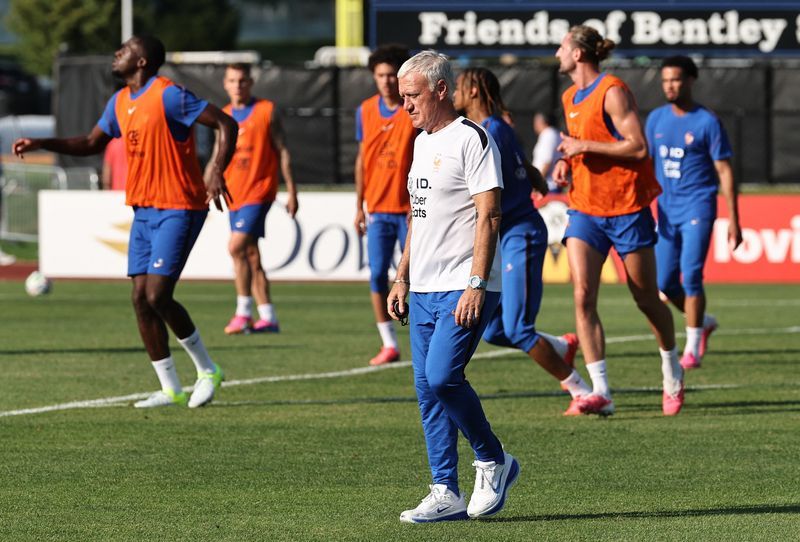
France's journey through the World Cup group stage has been defined by prolific attacking football and clinical finishing, yet as coach Didier Deschamps prepares his squad for Tuesday's Round of 32 clash against Sweden, tactical refinements remain necessary to address specific vulnerabilities before the tournament advances to its knockout format. Despite accumulating a flawless record atop Group I with victories over Senegal, Iraq and Norway, during which the team netted ten goals, the French left flank has emerged as a source of inconsistency that could be exploited by more organised opponents in the high-pressure environment of single-elimination football.
The attacking prowess that has carried France through the group stage rests substantially on the interplay between three extraordinary talents: Kylian Mbappe, Ousmane Dembele and Michael Olise have formed what many observers regard as the tournament's most formidable attacking trident. Mbappe has orchestrated France's assault with his characteristic intelligence and finishing, whilst Dembele's dynamism, exemplified by his hat-trick performance against Norway, demonstrates the depth of threatening options at Deschamps' disposal. Olise's creative contributions from wide areas have added another dimension, allowing the French attack to generate opportunities through multiple channels rather than relying on predictable patterns that opposition defenders might anticipate and neutralise.
Yet this extraordinary offensive capacity masks underlying structural concerns that have prompted tactical adjustments. The left defensive flank has not operated with the cohesion and reliability demanded in knockout football, with left-back Theo Hernandez failing to deliver the consistent performance expected of a defender of his calibre. Consequently, Deschamps has signalled his intention to introduce Lucas Digne into the starting eleven, a tactical shift that prioritises defensive solidity and measured distribution from wide positions over the attacking instability that has occasionally characterised Hernandez's recent displays. This substitution reflects the manager's pragmatic reassessment of priorities as France transitions from a group stage where overwhelming numerical superiority of chances often compensated for occasional lapses.
Beyond defensive reorganisation at left-back, Deschamps intends to modify France's attacking shape on the left wing by deploying Bradley Barcola in place of Desire Doue. This change appears designed to inject greater directness and explosive pace into transitions, addressing a specific strategic approach against opponents likely to adopt a compressed, defensive posture. Where Doue offers technical security, Barcola brings a running intensity and natural wideness that could destabilise a Swedish team expected to defend with deep organisation and seek opportunities through set-piece scenarios and counter-attacking movements in the spaces between France's defensive units and goalkeeper.
The return of William Saliba to the central defensive partnership represents another stabilising element, introducing organisational structure to a backline that has occasionally appeared vulnerable to rapid transitions. Saliba's presence should provide the defensive platform necessary to support the attacking ambitions that remain central to Deschamps' tactical philosophy. Nevertheless, France's fundamental challenge remains inherent to their squad composition: the concentration of elite attacking talent creates both tremendous offensive potential and defensive exposure in numbers, a paradox that opposition teams with strategic discipline can occasionally exploit, as evidenced by fleeting moments against Norway's reserve elements during the group stage.
Sweden presents the kind of organised, physically imposing opponent that could theoretically capitalise on this vulnerability, though their credentials remain substantially inferior to France's multi-dimensional threat. The Scandinavian nation finished second in Group F behind the Netherlands after defeating Tunisia 5-1 in their opening match, only to experience a similarly emphatic reverse against the Dutch before drawing with Japan. The inconsistency demonstrated across these results suggests a team capable of producing tactical discipline and collective organisation, yet lacking the individual quality and attacking sophistication to match France's capacity for overwhelming opposition through sustained pressure and multiple scoring avenues.
Former England international Gary Lineker, analysing the contest for French sports daily L'Equipe, articulated the essential asymmetry in the matchup, acknowledging Sweden's attacking weaponry in Alexander Isak, Viktor Gyokeres and Anthony Elanga whilst simultaneously recognising the qualitative gap between these options and the exceptional concentration of French talent. Lineker's assessment captures an uncomfortable reality for Sweden: whilst they possess sufficient quality and organisation to compete for periods, France's bench depth—including Barcola, Doue, Rayan Cherki, Jean-Philippe Mateta and Marcus Thuram—offers an embarrassment of riches that few international squads can match. The capacity to introduce fresh attacking impetus through substitution decisions itself represents a competitive advantage that typically proves decisive in knockout football.
France's knockout-stage pedigree provides additional confidence, with the team having lost only once since 2014 in this format, the notable exception being the 2022 World Cup final against Argentina. This historical record, combined with the present squad's attacking capacity, establishes France as qualitatively different from most opponents that Sweden might encounter. The knockout format itself does introduce variables absent during the group stage, where tactical discipline and defensive solidity assume heightened importance as a single mistake can prove terminal. Yet even accounting for these complications, France's attacking depth and individual quality appear sufficiently pronounced to overcome Swedish resistance.
Deschamps' tactical adjustments on the left flank represent not wholesale reimagining but rather fine-tuning designed to address specific vulnerabilities whilst preserving the attacking principles that have generated France's group-stage dominance. The introduction of Digne and Barcola aims to tighten the left-sided structure whilst maintaining the pace and directness necessary to break down disciplined opposition. Should these adjustments prove effective, France will advance to face either Germany or Paraguay in the Round of 16 having consolidated their position as one of the tournament's outstanding teams. The fundamental question remains whether Sweden's defensive organisation and physical presence can sustain resistance against an attacking force whose scoring capacity appears almost limitless, or whether French firepower will again prove decisive.

