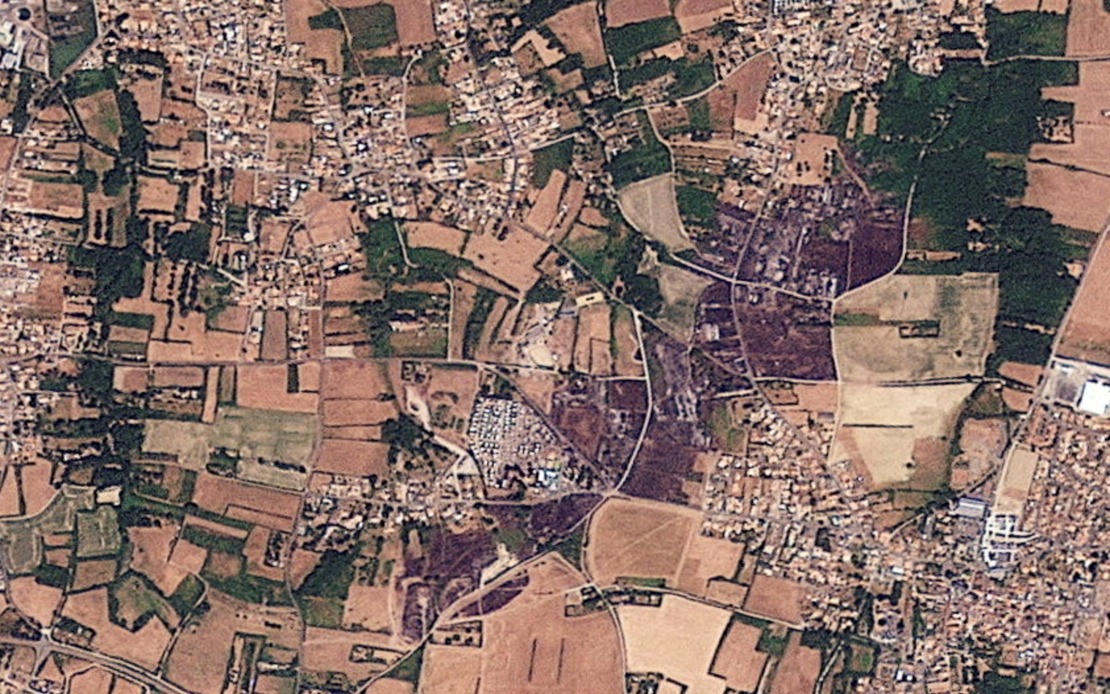
France is facing an intensifying wildfire emergency with two separate blazes in the Fontainebleau forest having consumed nearly 1,920 hectares of land by mid-July, prompting widespread deployment of emergency resources and renewed scrutiny of arson prevention measures. The fires, which have persisted overnight despite active firefighting operations, represent a serious threat to both natural ecosystems and civilian safety, with approximately 600 firefighters maintaining a continuous presence at the scene to contain the spreading flames.
The initial fire, which ignited on Sunday, has devastated roughly 1,500 hectares of forest, whilst a secondary blaze that emerged subsequently has destroyed between 300 and 400 additional hectares. This dual-front crisis has stretched emergency services, yet French authorities have achieved one significant breakthrough by apprehending two individuals suspected of deliberately starting the first fire. The arrests underscore a troubling pattern: arson appears to be a significant factor in France's current wildfire crisis, with law enforcement resources increasingly dedicated to identifying and prosecuting those responsible for intentional blazes.
The deliberate nature of certain fires has prompted forceful responses from French government officials, most notably Transport Minister Philippe Tabarot, who has advocated for exceptionally stringent sentences for those found guilty of arson. Tabarot's position reflects growing governmental concern that inadequate penalties may fail to deter potential offenders. His remarks demonstrate a nuanced approach to the problem, however, distinguishing between individuals who deliberately ignite fires and those compelled by pyromania—a psychological compulsion. He has called for severe criminal penalties for confirmed arsonists whilst arguing that those suffering from pyromania should receive medical intervention rather than purely punitive measures.
The scale of the arson problem across France has become evident in the cumulative arrest figures: authorities have detained 59 individuals since the fire season commenced on suspicion of intentionally setting wildfires. This statistic suggests that deliberate fire-setting represents a chronic challenge requiring sustained law enforcement attention and coordinated prevention strategies. The arrest figures paint a picture of widespread criminality that extends beyond a handful of isolated incidents, indicating systemic vulnerabilities in fire prevention and enforcement mechanisms.
Beyond the Fontainebleau crisis, France is confronting wildfire emergencies across multiple regions, with significant infrastructure disruptions accompanying the environmental damage. The Trevillach wildfire, which erupted earlier in July within the Pyrenees-Orientales region, has caused substantial damage to railway infrastructure along a critical transport corridor. The blaze has severely compromised the Perpignan-Villefranche-Vernet-les-Bains railway line, forcing the national railway operator SNCF to suspend train services between Ille-sur-Tet and Villefranche-Vernet-les-Bains until at least July 20. This disruption illustrates how wildfires extend their impact beyond immediate ecological concerns, affecting regional economic activity and civilian mobility.
Simultaneously, Brittany has experienced its own wildfire emergency, with a heath fire emerging near Cap Fréhel in the Côtes-d'Armor department consuming approximately 38 hectares and necessitating the evacuation of more than 100 residents. These evacuations represent the human cost of the crisis, displacing families from their homes and creating temporary shelter and welfare challenges for local authorities. The breadth of Brittany's incident demonstrates that the wildfire problem is not geographically confined but rather represents a nationwide phenomenon affecting diverse regions with varying terrain and population density.
The Lozère region has similarly experienced significant fire damage, with authorities documenting approximately 107 hectares of burned territory. The repeated occurrence of substantial fires across geographically dispersed regions—from Fontainebleau in the north-central zone to the Pyrenees in the south and Brittany in the northwest—reveals a systemic vulnerability affecting France's fire management systems. This geographic distribution suggests that no single regional factor fully explains the crisis; rather, a combination of climatic conditions, vegetation management practices, and human factors are contributing to the unprecedented scale of incidents.
For Southeast Asian observers, the French wildfire crisis carries instructive lessons regarding the vulnerability of developed nations to environmental disasters and the complex intersection of criminal activity with ecological emergencies. Malaysia's own experiences with transboundary haze, particularly during the 2015 Southeast Asian haze crisis originating from Indonesian forest fires, provide a regional context for understanding how wildfires can generate impacts extending far beyond their immediate geographic origin. Unlike the Malaysian context, where uncontrolled agricultural burning drives much of the haze problem, France's crisis appears significantly shaped by deliberate arson, suggesting that developed economies face distinct wildfire challenges requiring different policy approaches.
The French government's differentiated response to arson versus pyromania reflects sophisticated policymaking that recognizes the heterogeneous nature of wildfire causation. By proposing severe criminal penalties for deliberate arsonists whilst advocating treatment for those with psychological compulsions, French authorities demonstrate understanding that one-size-fits-all punitive approaches may prove counterproductive. This nuance carries implications for how regional governments might approach fire prevention, particularly in Southeast Asian contexts where distinguishing between deliberate criminality and carelessness could inform more effective enforcement strategies.
The resource intensity of the French response—maintaining 600 firefighters in the field across multiple active fires—underscores the substantial operational and financial costs associated with large-scale wildfire suppression. For developing Southeast Asian nations with more constrained emergency services budgets, the French experience illustrates why prevention through enforcement and land management may prove more cost-effective than attempting to suppress large-scale fires once they have commenced. Malaysia's relatively advanced firefighting capabilities, though sometimes strained during major incidents, might benefit from intensified focus on arson prevention through investigation and prosecution rather than treating all fires as primarily environmental phenomena requiring suppression responses.

