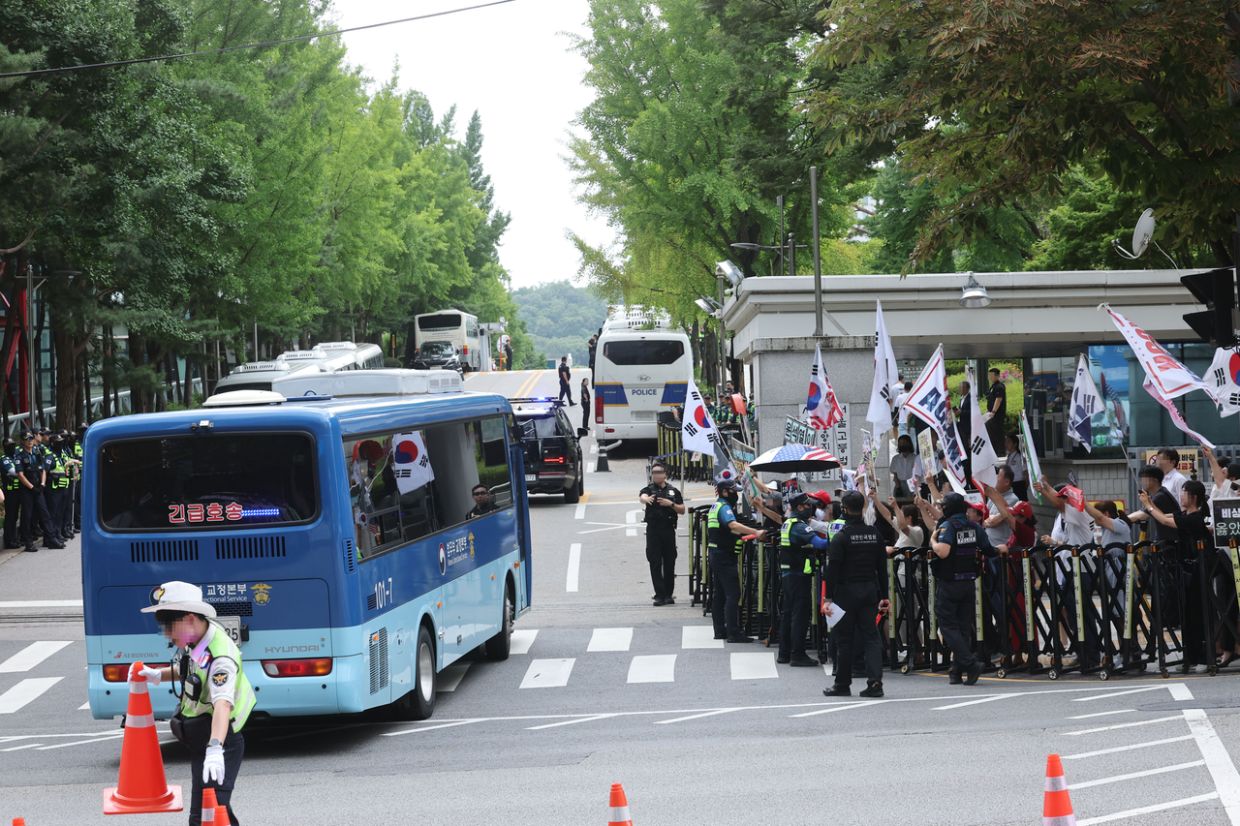
Former South Korean President Yoon Suk Yeol has been handed a two-year prison sentence for illegally accepting free political polling services during his successful 2021-2022 presidential campaign. The Seoul Central District Court found him guilty of violating the Political Funds Act on Monday, concluding that he received surveys worth 27.92 million won (approximately $18,600) from political broker Myung Tae-kyun without proper disclosure or compensation. The conviction represents a significant moment in South Korea's legal accountability for former heads of state, as the country continues to grapple with how to balance democratic norms with prosecuting powerful political figures.
The court's judgment centres on 14 specific surveys out of the 58 that prosecutors initially alleged had been improperly provided. Presiding Judge Lee Jin-gwan emphasized the democratic implications of the case, noting that opinion polls wield considerable influence over voter behaviour and that their integrity forms a cornerstone of legitimate elections. The judge articulated concern that when political actors receive polling services outside the formal framework of the Political Funds Act, the entire electoral process risks becoming compromised through distorted public opinion and unfair competitive advantage.
The case reveals an intricate web of relationships between Yoon, his wife former first lady Kim Keon Hee, and Myung. Court findings established that Kim had authorized Myung to control the technical aspects of the surveys, including their timing, content, methodology, and publication decisions. Yoon was found to have been aware of this arrangement and to have tacitly agreed to it, creating what the court described as a successive and implicit consensus among all three parties regarding the provision of polling services.
Beyond the polling arrangement itself, the court identified a quid pro quo element involving the nomination of former lawmaker Kim Young-sun to the People Power Party. The evidence suggested that Yoon had promised Myung that Kim Young-sun would secure the party's nomination in exchange for the surveys, and subsequently leveraged his influence as president-elect through then chief of staff Chang Je-won to facilitate that nomination. However, the judge made clear that proving such an explicit exchange was not strictly necessary to establish a violation of the Political Funds Act.
Myung Tae-kyun, the political broker at the centre of the scheme, was sentenced to 18 months in prison and immediately taken into custody in the courtroom. His conviction underscores the court's determination to hold accountable not only the recipients of improper campaign support but also those who facilitate such arrangements. The divergence in sentencing between Yoon and Myung suggests the court weighted Yoon's status as a sitting president and his ability to exercise executive power as aggravating factors.
The verdict creates a notable asymmetry with the treatment of Kim Keon Hee in her parallel case concerning the same polling services. The former first lady was acquitted at both trial and appellate levels on related Political Funds Act charges. Judge Lee explained that the allegations in the two cases, whilst stemming from the same polling arrangement, could not be regarded as identical in their legal dimensions. In Kim's case, lower courts determined that prosecutors failed to establish that she received a quantifiable financial benefit equivalent to the surveys' cost or that the polling was provided specifically to secure her support for Kim Young-sun's nomination.
The distinction between Yoon's conviction and Kim's acquittal reflects the complex evidentiary challenges in prosecuting campaign finance violations. Prosecutors must demonstrate not merely that improper payments occurred, but that the recipient understood the nature of the arrangement and actively participated in it. The courts found sufficient proof of Yoon's knowledge and consent, whilst determining that the evidence regarding Kim remained insufficient. The Supreme Court is scheduled to deliver its final verdict in Kim's case on Thursday, which could provide further clarification on how South Korea's judiciary interprets financial benefit in campaign finance contexts.
This case arrives amid broader efforts within South Korean society to establish stronger guardrails against political corruption and abuse of power. The country has experienced multiple instances of former presidents facing criminal prosecution after leaving office, from tax evasion to abuse of authority charges. The polling scandal represents a more subtle form of campaign impropriety than outright bribery or embezzlement, yet the court's willingness to prosecute it signals an institutional commitment to preventing the normalization of off-the-books campaign support.
For Southeast Asian observers, the South Korean precedent raises important questions about how democracies manage accountability for former leaders without descending into partisan persecution. The careful judicial reasoning in the Yoon case, particularly the distinction between different types of evidence and the refusal to assume culpability without specific proof, demonstrates one approach to maintaining legitimacy even when convicting politically powerful figures. However, the case also highlights the persistence of informal networks and off-the-record arrangements that continue to shape electoral competition in advanced democracies.
The sentencing carries implications for South Korea's political landscape as well as its international standing. Yoon's conviction while still maintaining significant support among substantial portions of the electorate demonstrates the deep polarization within South Korean society. The case will likely face additional appeals and could reach the Constitutional Court, where fundamental questions about the limits of presidential authority and accountability may be revisited. Meanwhile, other investigations into Yoon's conduct remain ongoing, suggesting this verdict may represent only the beginning of his legal entanglements following his presidency.

