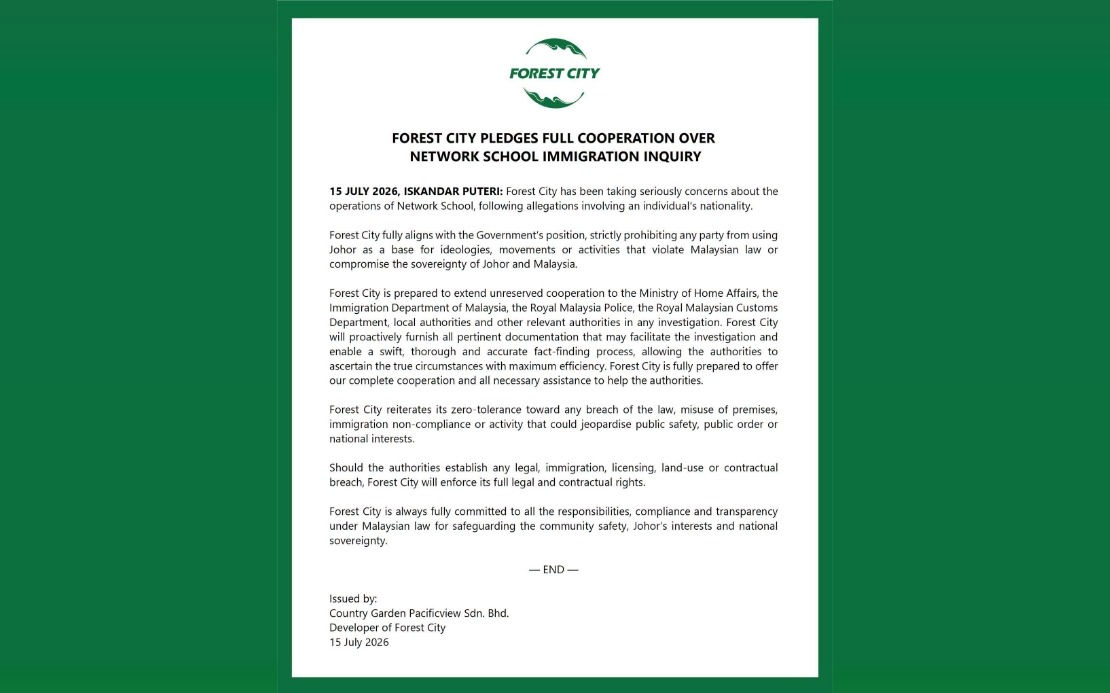
Forest City's developer, Country Garden Pacificview Sdn Bhd, has signalled its willingness to work closely with government agencies investigating allegations that the Network School facility within the sprawling residential development hosted Israeli nationals. The statement, released in Johor Bahru on July 15, represents an important moment in the unfolding controversy surrounding the prestigious development and underscores broader concerns about immigration compliance and national security at large-scale commercial projects across Malaysia.
The developer's pledge to cooperate extends across multiple government bodies, including the Home Ministry, Immigration Department, Royal Malaysia Police, Royal Malaysian Customs Department, and local authorities. This multi-agency involvement reflects the seriousness with which officials are treating the matter, particularly given allegations that individuals may have exploited fraudulent or secondary passports to circumvent normal immigration procedures. Such breaches strike at the heart of Malaysia's immigration sovereignty and raise questions about how oversight mechanisms function at major developments.
Country Garden Pacificview has committed to submitting comprehensive documentation to facilitate thorough investigations. The developer emphasised that it maintains a zero-tolerance position toward legal violations, misuse of premises, immigration non-compliance, and activities that could jeopardise public safety. This explicit positioning appears designed to distance the company from any suggestion that management deliberately permitted or overlooked infractions at the facility.
The controversy gained momentum when Johor Menteri Besar Datuk Onn Hafiz Ghazi publicly called for investigations into the Network School's operations. Onn Hafiz highlighted concerns that foreign nationals had potentially exploited dual passport systems to enter Malaysia under false pretences, a practice that circumvents standard immigration vetting procedures and poses intelligence and security risks. His intervention signals that state-level political leadership views the matter with sufficient gravity to warrant formal scrutiny.
Immediate follow-up action came swiftly, with the Immigration Department conducting a substantial inspection sweep of 266 foreign nationals representing 40 countries throughout the Forest City compound. Initial findings indicated that all individuals examined possessed valid immigration documentation at the time of inspection, though investigators emphasised that comprehensive investigations remained ongoing. This suggests that authorities are investigating not merely current status but historical movements and documentation patterns.
The Network School allegations touch on a sensitive dimension of Malaysian governance: the tension between welcoming international education initiatives and safeguarding against activities that exploit residency or visa frameworks. Foreign educational programmes can contribute valuable expertise and cross-cultural exchange, yet they create vulnerability points where immigration procedures may be circumvented or monitoring lapses may occur. The case underscores how even sophisticated developments with strong brand recognition remain subject to scrutiny regarding compliance.
For Malaysian readers and regional observers, the incident illuminates broader questions about how oversight functions at large mixed-use developments. Forest City itself has generated considerable debate since its inception, balancing its role as a major foreign investment project with concerns about foreign ownership concentration and integration with the local community. The Network School investigation adds another layer to this complex conversation.
The developer's cooperative stance likely reflects both genuine commitment to regulatory compliance and strategic consideration of reputational impact. Any perception of obstruction could deepen public concern and complicate future licensing, regulatory approval, or expansion plans. By pledging transparency and voluntary submission of records, Country Garden Pacificview positions itself as a responsible corporate actor subject to the same legal frameworks as other entities operating in Malaysia.
The case also highlights evolving immigration enforcement capabilities in Southeast Asia. Malaysian authorities have increasingly sophisticated tools for identifying irregular migration patterns and documentary fraud. The scale of the inspection—examining 266 individuals across multiple nationalities—demonstrates the capacity and willingness of immigration authorities to mount comprehensive audits when allegations emerge, particularly in contexts involving potential national security considerations.
For broader policy implications, the incident may influence how future educational and institutional activities are regulated within major residential and commercial developments. Authorities may implement enhanced vetting procedures for programmes involving foreign nationals, or require developers to maintain more detailed records of facility usage and participant origins. Such measures could affect how institutions structure their operations while balancing security with legitimate educational exchange.
The investigation's progression will be closely watched within Malaysia's business community and among foreign investors. How authorities ultimately determine whether any legal breaches occurred, and whether any charges or enforcement actions follow, will establish precedent for how similar situations are handled. The involvement of multiple government agencies also suggests that findings may carry implications beyond immigration concerns to encompass broader questions about institutional governance and compliance culture.
As investigations continue, the case serves as a reminder that large-scale developments, regardless of their prominence or international credentials, must maintain robust internal compliance systems. The cooperation pledge from Country Garden Pacificview demonstrates recognition of this principle, though the ultimate test will come through the investigation's findings and any resulting determinations about what occurred and whether systemic vulnerabilities at the facility require remediation or enhanced oversight mechanisms.

