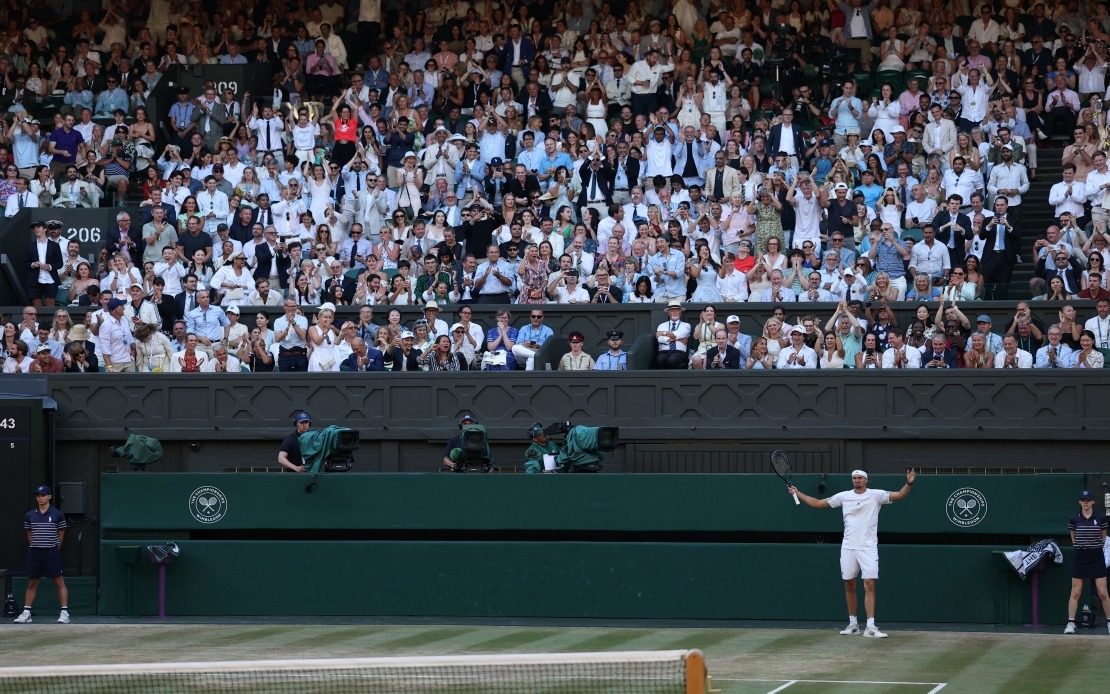
Jannik Sinner's commanding four-set victory over Alexander Zverev in the men's singles final provided a spectacular bookend to a fortnight that captured the drama, resilience, and human emotion that makes Wimbledon one of sport's most compelling stages. The championship delivered far more than a coronation of a new men's champion; it produced moments that will endure in the collective memory of tennis fans worldwide, particularly those following the sport across Southeast Asia where interest in elite tennis continues to grow steadily.
Kateryna Noskova's remarkable women's singles triumph demonstrated the volatile nature of championship tennis and the psychological fortitude required to compete at the highest level. The Ukrainian player's maiden appearance in a grand slam final seemed destined for heartbreak when she surrendered a commanding 5-2 advantage in the second set, squandering five separate opportunities to claim the opening set. Instead of collapsing under the weight of such adversity, the 21-year-old demonstrated composure that belied her inexperience, ultimately prevailing in a tense final set that tested every fiber of her competitive spirit.
The parallels drawn between Noskova's near-catastrophe and the celebrated suffering of Jana Novotna, another Czech great, provide important historical context. Novotna's famous tears on the shoulder of the Duchess of Kent following her agonizing loss to Steffi Graf in 1993 transformed into vindication five years later when she finally claimed her Wimbledon crown in 1998. That Noskova could recover from similar circumstances—even invoking her own vow to claim the trophy while passing it in the corridor—suggests a generation of mentally resilient competitors emerging in women's tennis.
British wild card Harry Fery captured the hearts of home supporters and neutrals alike with an improbable run to the semi-finals, his journey representing a rare bright spot for tennis in the host nation during an otherwise disappointing tournament. The 23-year-old from Wimbledon itself, ranked a modest 114 in the world at the start of his campaign, found himself trailing by three games in both the fourth and fifth sets against Belgian Zizou Bergs while battling the brutal conditions of a sweltering Court 18. Three nosebleeds during that match underscored the physical toll extracted by Wimbledon's unique demands.
Fery's comeback from those deficits showcased the mental acuity and physical reserves that distinguish champions from journeymen competitors. After levelling the match through a tie-break, he held his nerve in a ten-point super-breaker as his higher-ranked opponent began to unravel under pressure. The achievement carries particular significance within British tennis culture; Fery became only the fifth British male player in the twenty-first century to progress beyond the second week at the All England Club, a statistic that underscores both his accomplishment and the broader challenges facing British men's tennis.
Novak Djokovic's quarter-final marathon against Felix Auger-Aliassime added another chapter to the Serbian champion's remarkable longevity narrative, though it also highlighted the physical toll of elite competition even for the most accomplished players. At 39 years of age, Djokovic contested what became the longest quarter-final match in Wimbledon history, lasting five hours and fifteen minutes and finishing just eight minutes before the tournament's eleven o'clock curfew. The physical demands were evident from the opening set, when a troublesome calf strain forced him to seek medical attention, subsequently generating further controversy when he engaged in a heated dispute with tournament referee Denise Parnell regarding the closure of the court roof.
Despite grinding out a victory against the third-seeded Auger-Aliassime, Djokovic's reserves appeared depleted by the ordeal, contributing to his semi-final exit at the hands of Sinner. The match encapsulates a broader tension within professional tennis: the increasing physical demands of modern matches, played with greater intensity and precision than ever before, conflict with players' capacities for recovery and self-preservation.
Karolina Muchova's semi-final encounter against Coco Gauff distilled the essence of grand slam tennis into a single decisive tie-break that alternated between exhilaration and agony for both competitors. The 18-minute tie-break contained multiple match points for each player, with fortune and misfortune alternating in ways that seemed to transcend rational explanation. When Muchova received a time violation at 8-8 and subsequently sent her serve long, Gauff captured her first opportunity at victory. The American seemed to have sealed her triumph with a simple drop shot, only to inexplicably net what should have been the finishing blow. Muchova's conversion of her subsequent match point, engineered through superior court positioning and forcing errors from Gauff's exhausted forehand, illustrated the fine margins separating victory from defeat.
Serena Williams' return to competitive tennis at age 44, nearly four years after stepping away from professional competition, transcended sport itself, becoming a cultural moment that captured global attention. Her wild card entry and return to Centre Court generated electric anticipation; the standing ovation that greeted her entrance reflected the affection and respect accumulated across nearly three decades of tennis excellence. Against Ajla Tomljanovic, an Australian player 24 years her junior, Williams demonstrated sufficient competitive fire to take an early break in the deciding set, suggesting that her comeback narrative might conclude with a triumphant final victory.
The reality proved more complicated and ultimately poignant. Williams' physical condition deteriorated noticeably as the match progressed, her movement becoming increasingly laboured despite her opponent's defensive brilliance. Her performance eventually came to an abrupt conclusion when a knee injury sustained during the opening set rendered further participation untenable. The injury not only cost Williams her competitive return but also prevented a planned doubles reunion with her sister Venus, adding a layer of disappointment to what had been presented as a sentimental championship moment. Nevertheless, her presence and participation represented a broader validation of Williams' legacy and the lasting impact of longevity in elite sport.
These five matches collectively defined Wimbledon 2026 as a championship distinguished by competitive drama, personal narratives of triumph and disappointment, and the enduring human dimensions of sport that transcend rankings and statistics. For Malaysian and Southeast Asian tennis enthusiasts, these encounters demonstrated the caliber of drama that continues to make grand slam competition compelling at the highest levels of the sport.

