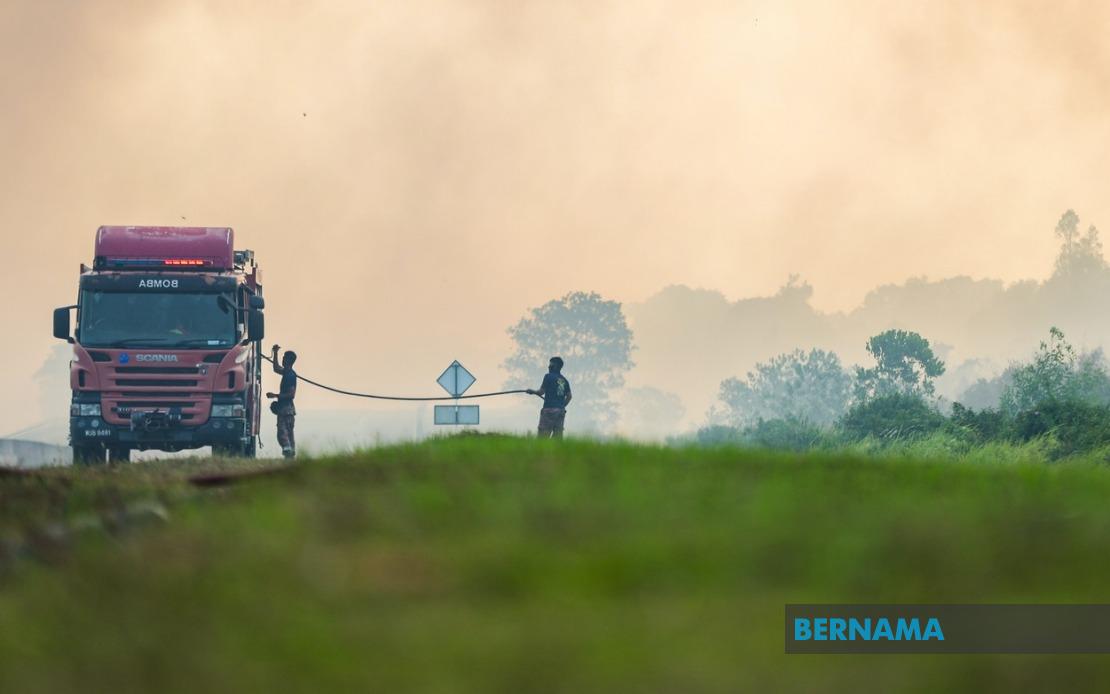
A major peatland fire that erupted on Monday in the Punggai-Sebana Cove area along Jalan Bypass near Kota Tinggi has been substantially contained, with firefighting teams bringing more than 57 per cent of the affected zone under control. As of 4 pm on Monday, 29 hectares of the 51.4-hectare site had been successfully extinguished, according to the Sungai Rengit Fire and Rescue Station. The achievement represents meaningful progress in what has evolved into a complex and resource-intensive operation spanning two distinct operational sectors across the peatland expanse.
The incident highlights the particular challenge posed by peatland fires in Malaysia, which differ significantly from conventional vegetation blazes. Peat—partially decomposed organic matter accumulated over thousands of years—burns differently than surface vegetation, often smouldering beneath the ground and reigniting unexpectedly if not properly managed. These fires can persist for extended periods and generate substantial smoke, creating environmental and public health concerns across wider geographical areas. The Pengerang incident demonstrates why authorities maintain continuous round-the-clock monitoring and suppression efforts even after initial containment appears successful.
Operations commander Fire Superintendent II Baharuddin Idris emphasised that the firefighting teams were maintaining vigilant oversight through 24-hour rotational operations designed not merely to extinguish visible flames but to control subsurface burning and establish protective firebreaks that would prevent any resurgence. This multi-layered approach reflects established protocols for peatland fire management, where incomplete suppression can lead to rapid flare-ups. The division of the affected area into Sector A and Sector B allowed teams to concentrate resources effectively, with Sector B approaching complete extinguishment while Sector A still required substantial additional firefighting and firebreak work covering approximately 21 hectares.
Recognising the scale of the challenge, authorities escalated the response by deploying aerial support. An aircraft approved by the Air Operations Control Centre took flight at 2.30 pm, adding a critical dimension to ground-based efforts. Aerial firefighting can access areas difficult for terrestrial teams to reach and apply suppressant more efficiently across expansive zones, making it particularly valuable for large peatland incidents. The deployment reflected a coordinated inter-agency decision to deploy available resources strategically rather than relying solely on ground personnel.
The response operation mobilised a substantial workforce across multiple government and private-sector organisations. Thirty-six firefighters formed the core of the suppression effort, supplemented by nine personnel from the Malaysian Civil Defence Force, whose expertise in emergency management and civilian coordination proved valuable. Ranhill SAJ, a water services company operating in Johor, contributed 14 personnel with specialised equipment and technical capabilities. Environmental specialists from the Department of Environment worked alongside firefighters, assisting with impact assessment and restoration planning, while representatives from the Pengerang Municipal Council provided logistical support and local knowledge critical for field operations.
The Pengerang location, situated within the Kota Tinggi district near what is developing into an increasingly industrial zone, underscores the tension between economic development and environmental preservation in Johor. Peatlands, while often viewed as marginal agricultural land, perform irreplaceable ecological functions including carbon storage, water filtration, and biodiversity support. When peatland areas catch fire, the environmental cost extends beyond immediate property damage to include long-term carbon release and habitat destruction. The incident thus carries implications for regional air quality and climate considerations that extend into neighbouring states and, under certain wind conditions, across the Strait into Singapore.
The timing and circumstances of the fire's origin remained under investigation, though officials focused primarily on containment during the immediate aftermath. Understanding how the blaze ignited would eventually inform prevention strategies, particularly given the dry season patterns that typically increase fire risk across Southeast Asian peatlands. The investigation process would involve multiple stakeholders determining whether the fire resulted from agricultural practices, industrial activity, accidental ignition, or other causes—information essential for preventing recurrence.
For Malaysian readers, the incident exemplifies ongoing vulnerabilities in managing natural disaster risks, even within relatively developed regions with established emergency response infrastructure. The Pengerang fire demonstrated both the capabilities of Johor's fire and rescue services and the reality that large-scale environmental incidents still require extraordinary mobilisation of resources. The successful deployment of aerial support and coordinated multi-agency response represented effective crisis management, yet the sheer scale of the effort required highlights how resource-intensive and challenging such incidents remain.
The incident also reflects broader Southeast Asian patterns of peatland vulnerability. Indonesia and Malaysia together manage the world's most extensive tropical peatland ecosystems, making both nations critically important to global climate stability. Major fires in these regions have previously caused transboundary air pollution affecting millions across Southeast Asia. While the Pengerang fire remained regionalised in immediate impact, it served as a reminder that proactive management, rapid response capabilities, and sustained suppression efforts remain essential to minimising damage when incidents do occur.
As firefighting operations continued into subsequent days, authorities remained cautious about declaring victory. The history of peatland fires demonstrates that apparent containment can prove illusory if subsurface burning continues unchecked. The commitment to continuous 24-hour operations acknowledged this reality, positioning teams to respond immediately to any signs of rekindling. Beyond the immediate crisis, the incident would likely prompt discussions among Johor authorities regarding peatland management policies, land-use planning in fire-prone areas, and investment in prevention infrastructure. For Malaysian policymakers, such events underscore the necessity of balancing development ambitions with environmental stewardship and disaster preparedness.

