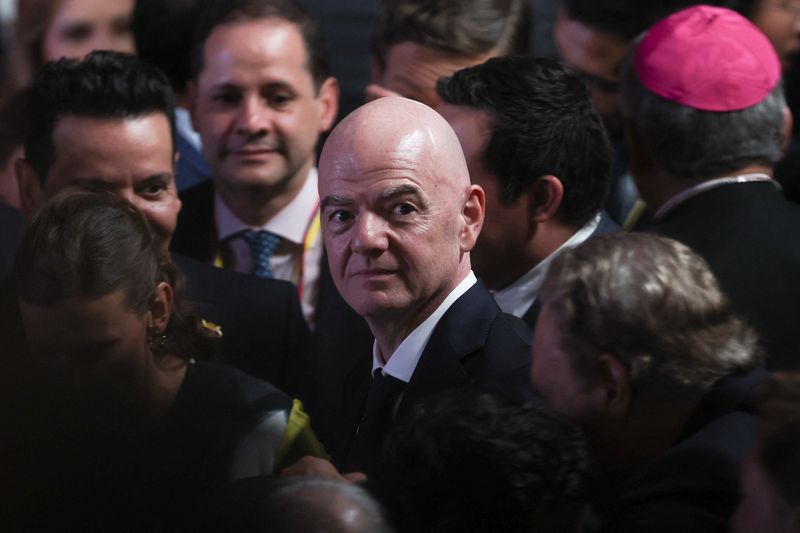
The leadership of global football faces a critical juncture as pressure mounts on FIFA president Gianni Infantino, with the Confederation of African Football's Patrice Motsepe now publicly advocating that the organization's full membership should determine the embattled executive's political future through formal elections. Speaking to Sky News, Motsepe insisted that the democratic process scheduled for the FIFA Congress on March 18 in Rabat, Morocco represents the appropriate mechanism for resolving the internal crisis gripping world football's governing body, rather than allowing regional confederations to force an early exit.
Infantino's tenure has become increasingly contentious following an ambitious but ultimately failed effort to attract private investment into FIFA competitions, a proposal that triggered an unprecedented backlash from three of the sport's most powerful continental confederations. The Union of European Football Associations (UEFA), Asian Football Confederation (AFC), and Confederation of North, Central American and Caribbean Football (CONCACAF) have collectively demanded his resignation, citing concerns about his leadership conduct and the manner in which the investment initiative was pursued without broader consultation.
Motsepe's intervention represents a significant endorsement of the electoral framework that has historically governed FIFA's leadership transitions, suggesting that attempting to circumvent this mechanism would undermine the organization's foundational principles. The CAF president framed the upcoming Congress as an opportunity for alternative candidates to challenge Infantino's incumbency, effectively inviting dissatisfied confederations to present their own nominees rather than pursue extra-institutional pressure tactics. This approach emphasizes legitimacy through ballot rather than through backroom maneuvering or coordinated boycotts.
The African football leader articulated a broader vision centered on unity and collaborative problem-solving, positioning the question of Infantino's leadership within a larger context of football's development challenges across the continent. Motsepe argued that energy currently directed toward leadership disputes could be redirected toward addressing substantive issues affecting the sport's growth, governance frameworks, and commercial viability in an increasingly competitive global sporting landscape. His framing suggests that for African football's interests, stability and continuity in FIFA's institutional arrangements may offer greater benefit than the uncertainty and divisiveness that could result from forced leadership change.
Regarding accountability and governance standards, Motsepe acknowledged that leaders must remain subject to rigorous scrutiny and interrogation when their conduct raises legitimate concerns. However, he positioned FIFA's existing institutional procedures and complaint mechanisms as adequate instruments for addressing governance breaches or misconduct allegations. This reflects a legalist approach that distinguishes between substantive governance concerns—which should follow established FIFA processes—and political disagreements about strategic direction or decision-making style, which are properly resolved through electoral competition.
The CAF president's emphasis on due process, governance integrity, and legality resonates particularly with African member associations, many of which have historically valued FIFA's institutional stability and formal procedural rules. For developing football nations across Africa, Asia, and the Caribbean, institutional predictability and clear procedural frameworks often provide essential protection against arbitrary decision-making by more powerful confederations. A precedent of removing elected leaders through confederation pressure rather than membership votes could destabilize FIFA's institutional architecture in ways that disadvantage smaller or less wealthy football associations.
Motsepe's statement that Infantino "enjoys the support of Africa" underscores a significant geographic and economic dimension to the leadership dispute. While European and North American confederations have mobilized against the FIFA president, many African, Asian, and Caribbean nations have received substantial investment and development assistance under his administration. The proposed private investment vehicle, had it succeeded, would likely have directed substantial resources toward FIFA competitions and development projects, with benefits distributed across the membership. For confederations operating with more limited resources, this prospect carries considerable appeal.
The timing of the March 2027 Congress will be critical, arriving just months before the 2026 FIFA World Cup in the United States, Canada, and Mexico. The uncertainty surrounding FIFA's leadership during the period leading up to world football's flagship tournament creates obvious complications for operational planning, sponsorship arrangements, and broadcast negotiations. A prolonged leadership crisis could complicate preparations across multiple jurisdictions and affect the tournament's commercial success, creating pressure on member associations to resolve the matter decisively at the ballot.
The contrast between Motsepe's advocacy for electoral resolution and the more aggressive stance taken by UEFA, AFC, and CONCACAF reflects deeper tensions within FIFA regarding representation and influence. European and North American confederations, representing football markets with substantially greater commercial revenues, have traditionally exercised outsized influence within FIFA's decision-making structures. The mobilization of these three confederations against Infantino represents an effort to reassert their collective leverage, potentially challenging Africa's growing voice in FIFA governance under an administration that has actively expanded the continental confederation's resources and strategic role.
For Malaysian and Southeast Asian football stakeholders, Motsepe's position carries significant implications, given that AFC's alignment with UEFA and CONCACAF in opposing Infantino represents a departure from customary Asian solidarity with FIFA's institutional continuity. The AFC's public criticism signals that even traditionally FIFA-aligned confederations believe governance concerns warrant vocal challenge. Yet the question remains whether this represents principled objection to specific policies or reflects broader structural tensions within FIFA's governance hierarchy.
The resolution of this dispute will establish important precedents for how FIFA addresses future leadership challenges and whether membership votes or confederation pressure campaigns determine executive tenure. A successful defense of electoral process would reinforce FIFA's democratic legitimacy while potentially weakening the veto power of the largest confederations. Conversely, should Infantino withdraw or lose significant backing before the formal vote, it would signal that coordinated confederation pressure represents an effective mechanism for removing executives deemed unacceptable, regardless of formal procedures or broader membership sentiment.

