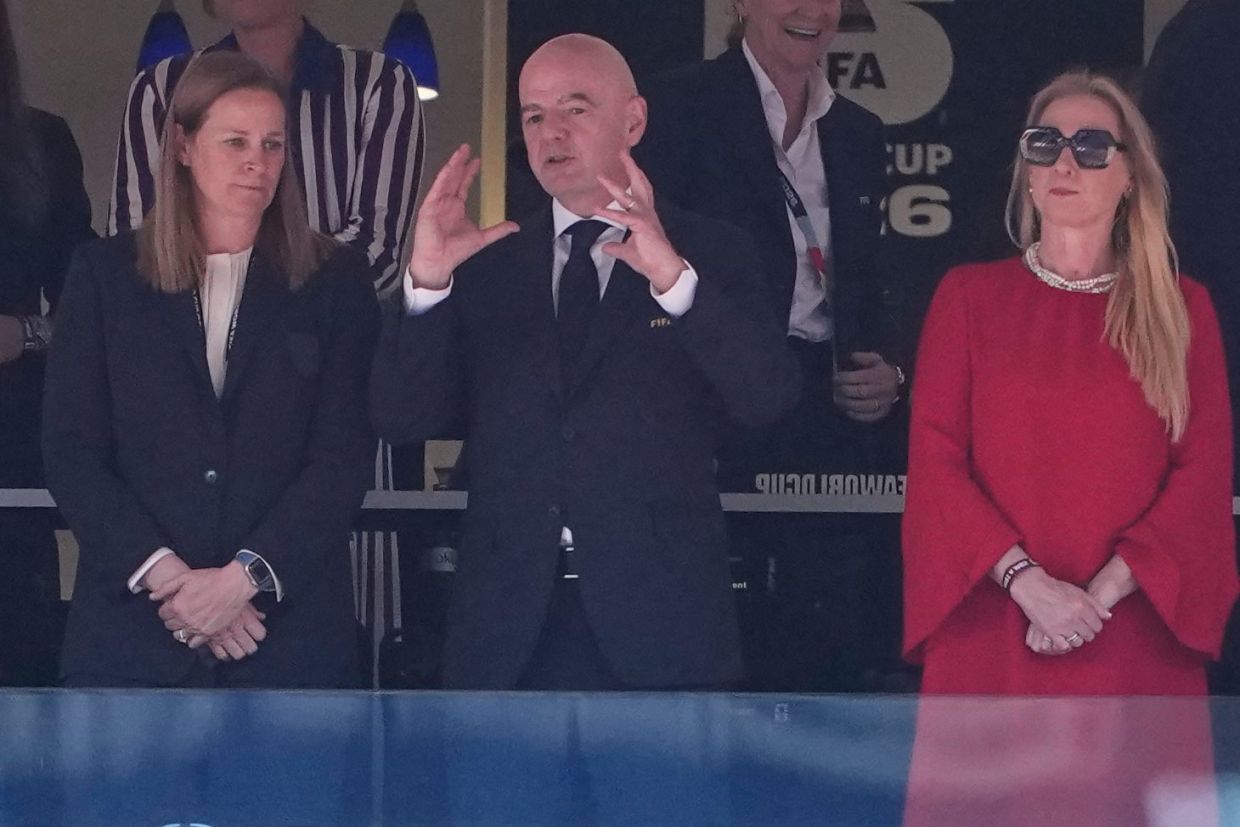
Gianni Infantino's position as FIFA president appears more entrenched than ever, even as the 2026 World Cup has been dogged by a series of contentious incidents ranging from elevated ticket prices to the controversial reinstatement of a suspended American player under apparent political pressure. The storm of criticism that engulfed global football's governing body in recent days—stemming from Donald Trump's reported intervention in a disciplinary matter—has already begun to recede from public consciousness, allowing Infantino to maintain his focus on what has genuinely become his defining strength: the generation of unprecedented revenue.
The controversies that have marked this tournament reflect deeper tensions within football's governance. The disputed red card reversal for US striker Folarin Balogun attracted particular scrutiny because it raised fundamental questions about whether FIFA could remain neutral when confronted by pressure from powerful political figures. Sports lawyer Nick De Marco articulated the core concern, observing that the issue transcends the merits of any individual disciplinary decision and instead strikes at the heart of FIFA's credibility as the sport's global regulatory authority. When political actors can influence on-field outcomes, the entire structure of competitive fairness becomes compromised.
Yet controversy has proven remarkably ineffective at challenging Infantino's authority. The storm of protest that surrounded the Balogun incident dissipated almost immediately after Belgium's decisive 4-1 victory over the United States, suggesting that short-term outrage, however vociferous, fails to translate into sustained institutional pressure. This pattern reflects a fundamental reality: for the vast majority of FIFA's member federations, the financial benefits flowing from Infantino's tenure vastly outweigh concerns about governance or integrity.
The financial dimensions of the 2026 tournament illuminate why Infantino's political position remains unassailable. FIFA is projected to generate approximately $9 billion in direct revenue from this World Cup, representing a $2 billion increase compared to the 2022 Qatar edition. This extraordinary wealth represents the core of Infantino's appeal to member federations worldwide. The expansion from 32 to 48 participating teams has doubled the prize pool to a record $871 million, with every nation guaranteed a minimum payout of $12.5 million simply for participation. For smaller football associations, these payments often represent vital funding that sustains their operations and development programmes.
The scale of this redistribution becomes apparent when examining specific cases. Cape Verde, which enjoyed a historic tournament run, earned over $21 million—equivalent to approximately 0.75 percent of the entire nation's GDP. This magnitude of funding to a small African state underscores why opposition to Infantino within poorer regions remains virtually non-existent. Similar calculations apply across the developing world, where FIFA payments often represent the largest source of revenue available to national football bodies. Federations from Asia, South Africa, and the African continent have already committed their support for Infantino's expected re-election in early 2027, when the FIFA Congress convenes in Rabat, Morocco.
The revenue streams feeding FIFA's coffers extend beyond the organisation itself. Stadium concessionaires have dramatically increased prices, with spectators at some venues spending up to $100 per person on food and beverages during matches—nearly double what American football fans spend during NFL games. Mandated hydration breaks, introduced ostensibly for player welfare, have effectively transformed the traditional two-half structure into an American-style four-quarter format favourable to broadcasters and advertisers. Host cities, which entered the tournament expressing budgetary concerns, have already recorded substantial spending increases, with Bank of America data indicating credit and debit card expenditures in World Cup venues rose 6.3 percent year-on-year between June 10-21, while non-local spending surged 16.7 percent.
Infantino inherited FIFA at a moment of profound institutional crisis. When he assumed leadership in 2016, succeeding Sepp Blatter during the corruption scandal that had engaged US federal prosecutors, the organisation faced existential legitimacy questions. His initial response combined symbolic reform with dramatic operational expansion. Transparency mechanisms were incrementally strengthened, though critics note these measures remained marginal. Simultaneously, Infantino systematically enlarged the global reach and commercial scope of FIFA's tournaments, fundamentally transforming the organisation's financial model. This dual strategy—marginal governance improvements coupled with aggressive commercialisation—proved extraordinarily effective at consolidating support among member federations.
The mathematical reality of FIFA's electoral system ensures Infantino's continued dominance. With 211 member associations each possessing a single vote, and Infantino running unopposed for his third term, the 2027 election represents merely a procedural formality. The broad coalition backing him spans continental associations across Africa, Asia, and South America, creating a voting bloc impossible to overcome through conventional electoral challenge. Even the Western European federations that have occasionally voiced concerns—represented most publicly by former Liverpool manager Jurgen Klopp's criticism that allowing Trump to influence disciplinary decisions represents "madness"—lack the coordinated political will to mount meaningful opposition.
The tournament itself has delivered genuine sporting excellence that partially insulates Infantino from sustained criticism. Stadiums have operated at capacity despite prohibitive ticket pricing, and football's elite players have performed at exceptional levels. The expanded format has genuinely increased African representation, with nine African nations reaching the knockout stages compared to typical participation levels. Host nations have demonstrated substantial hospitality and organisational competence. These genuine accomplishments provide legitimate counterarguments to critics and supply member federations with convincing justifications for their continued support.
Yet these substantive achievements cannot fully obscure the governance concerns that Infantino's tenure has crystallised. The conflation of money, political influence, and sporting authority that characterised his leadership has now materialised into concrete incidents affecting competition integrity. The ambiguous circumstances surrounding the Balogun decision—whether Trump directly influenced Infantino remains officially unconfirmed—exemplify a structural problem: when FIFA's leader possesses such concentrated authority and operates within an environment saturated with financial incentives, the appearance of impropriety becomes nearly inevitable.
The silence from major football figures carries particular significance. Beyond Klopp's intervention and expressions of concern from UK and Belgian politicians, the global football community has largely refrained from sustained institutional challenge. This reflects partly the effective silencing that comes from financial dependency, and partly the difficulty of mounting international coordination against an organisation controlling the world's most significant sporting competition. Individual federations and players lack the structural leverage to challenge FIFA's supremacy.
Looking forward to the 2027 election in Rabat, the pathway appears set for Infantino's coronation rather than competitive contest. His re-election will represent the completion of a remarkable consolidation of power within world football, achieved not through reform of institutional structures but through their exploitation for revenue generation. Whether this outcome ultimately serves the sport's broader interests remains a question that FIFA's member associations appear content to leave unexamined, provided the financial flows continue.

