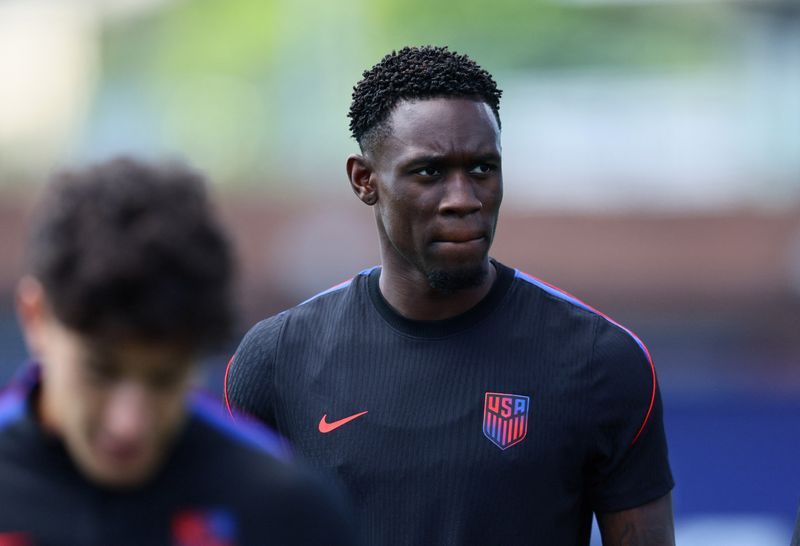
FIFA's decision to suspend United States striker Folarin Balogun's automatic one-match ban on Sunday has ignited an unprecedented controversy surrounding political interference in international football. The move, which allows Balogun to face Belgium in Monday's World Cup last-16 encounter, followed a telephone call between U.S. President Donald Trump and FIFA President Gianni Infantino—a fact that has overshadowed the sporting merits of the decision and raised fundamental questions about how the world's governing football body manages its disciplinary framework.
The suspension of Balogun's ban represents a direct challenge to the foundational regulations governing red card incidents. According to FIFA's own Disciplinary Code, Article 66.4 explicitly mandates that a red card automatically results in a suspension for the team's subsequent match. This provision has been consistently applied throughout the tournament, with multiple players serving their suspensions without exception. By invoking Article 27 of the same code—which permits the FIFA Disciplinary Committee to suspend previously imposed sanctions—FIFA has created a selective application of its own rules that appears arbitrary and potentially precedent-setting during an ongoing competition.
The Belgian Football Association's response crystallised the core objection: FIFA appears to have bypassed mandatory regulatory requirements by treating them as discretionary options subject to exception. The association's statement highlighted that automatic suspensions following red cards exist precisely because they are non-negotiable principles embedded in football law, not administrative conveniences that can be waived on a case-by-case basis. This interpretation raises the uncomfortable reality that if FIFA can suspend such fundamental rules for one player, the entire architecture of consistent disciplinary enforcement collapses.
German Football Association president Bernd Neuendorf directly challenged the political dimensions of the decision, demanding FIFA issue a swift statement clarifying whether presidential intervention influenced the disciplinary outcome. His intervention reflects broader European concern that allowing political figures to successfully lobby for changes to sporting decisions fundamentally compromises competition integrity and FIFA's credibility as an independent regulatory body. The suggestion that football governance has become subject to political pressure rather than neutral sporting principles represents a watershed moment for the organisation.
The precedent-setting implications for the remainder of the tournament cannot be overstated. When a governing body creates exceptions to mandatory rules in the middle of a competition, it establishes the expectation that similar situations will require equal treatment. Other teams and players who have already served suspensions under the same regulations now face the uncomfortable reality that their compliance with the rules may have been unnecessarily disadvantageous. This retroactive application of differential standards undermines the fundamental fairness that tournaments must maintain to retain legitimacy among participants and spectators alike.
The controversy also casts a shadow over any potential American success in the competition. Should the United States defeat Belgium, questions about the legitimacy of that victory will inevitably linger, with Balogun's participation remaining a contested element of the match outcome. This taints not only the team's accomplishment but also FIFA's ability to manage the tournament narrative and maintain public confidence in its decisions. Observers have noted that this outcome damages the United States as much as FIFA—by allowing the team to progress under controversial circumstances, the decision ensures that any subsequent achievement remains permanently clouded by doubt.
The apparent involvement of Trump in directly lobbying FIFA's decision-making process represents an extraordinary breach of the principle that political and sporting governance operate in separate spheres. While governments naturally take interest in their national teams' performances, the direct intervention of a sitting president in a disciplinary matter during an ongoing tournament establishes a troubling precedent. It signals to other political leaders that sufficiently prominent pressure can bend international sporting regulations, thereby weaponising politics as a tool for gaining competitive advantage.
From a Southeast Asian perspective, this incident carries particular resonance given the region's own struggles with maintaining institutional independence and resisting political pressure on sporting bodies. The FIFA situation demonstrates how even the world's most powerful sporting organisation can be vulnerable to political influence when sufficient pressure is applied from high-level actors. Regional sporting federations and governing bodies, which often operate with fewer resources and institutional safeguards than FIFA, must consider the implications of allowing political interference to override sporting regulations.
The broader question of FIFA's disciplinary consistency extends beyond this single incident. The Disciplinary Code contains numerous provisions, and the selective invocation of Article 27 to override Article 66.4 suggests that FIFA interprets its regulations as containing built-in contradictions that permit discretionary outcomes. This interpretation fundamentally undermines the purpose of having written rules at all. If automatic provisions can be suspended at the discretion of the Disciplinary Committee whenever deemed appropriate, then no rule is truly automatic, and every decision becomes subject to potential negotiation based on external pressure or political consideration.
Football's regulatory integrity depends on consistent application of established rules across all teams and players, regardless of their political influence or commercial importance. When that consistency is compromised, the entire competitive framework becomes suspect. The Balogun decision has exposed FIFA's vulnerability to political interference and revealed the fragility of its commitment to neutral rule application. For Malaysian and Southeast Asian football enthusiasts, this incident underscores the importance of maintaining institutional boundaries between sporting governance and political influence—a principle that should extend to every level of the game, from international tournaments to domestic competitions within the region.

