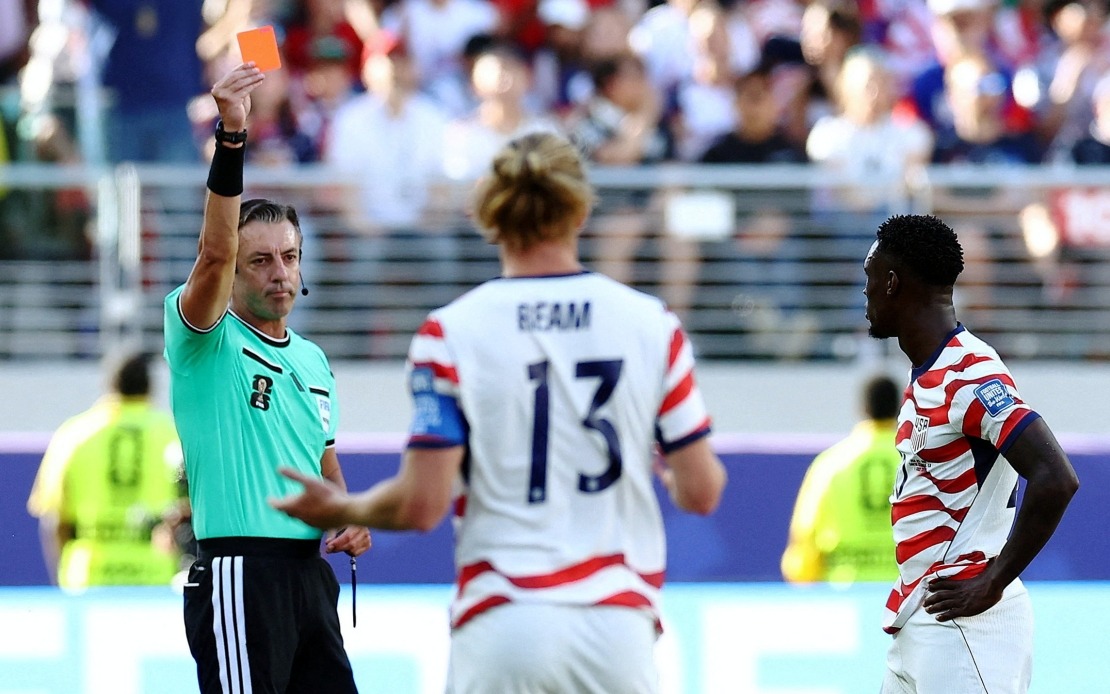
The football world faces a rare procedural controversy as FIFA's decision to suspend Folarin Balogun's disciplinary suspension has sparked a formal protest from Belgium ahead of their knockout encounter with the United States at the 2026 FIFA World Cup. The American striker, who has emerged as a key forward for his country with three tournament goals, received a red card during the opening knockout phase match against Bosnia and Herzegovina on July 1 following an incident that appeared to violate standard fair play expectations. FIFA's subsequent ruling to invoke a technical clause allowing Balogun to avoid immediate punishment has created tension between the sport's governing body and participating federations, threatening to overshadow one of the tournament's marquee matchups in Seattle on Monday.
Balogun's dismissal came during an otherwise comfortable 2-0 victory for the Americans over Bosnia and Herzegovina when he stamped on defender Tarik Muharemovic. The FIFA Disciplinary Committee, applying Articles 14 and 66 of its governing code, initially handed down a standard one-match suspension following the red card incident. This decision appeared consistent with precedent established throughout the tournament, where previous red cards had resulted in automatic match bans enforced without exception. The typical application of such sanctions represents fundamental accountability within international football, ensuring that player conduct standards remain uniform across all nations and competitions. Balogun's moment of poor discipline therefore seemed destined to sideline him from the crucial knockout stage fixture.
However, FIFA reversed course by invoking Article 27 of its Disciplinary Code, which grants the disciplinary committee discretionary power to suspend enforcement of sanctions during a probationary period. This administrative maneuver, while technically permissible under the regulatory framework, effectively nullified the automatic ban that normally follows a red card. The global governing body stated that if Balogun commits another infringement of comparable gravity during the one-year probationary period, the suspension will automatically activate alongside any fresh penalties imposed for the subsequent offense. This conditional application transforms what appeared to be a definitive sanction into a deferred disciplinary measure, fundamentally altering the consequences of the player's conduct during the Bosnia and Herzegovina match.
The Royal Belgian Football Association's response articulated a technical and philosophical objection to FIFA's decision. Belgium's federation highlighted that Article 66.4 of the same Disciplinary Code explicitly mandates automatic suspension for any player receiving a direct red card, creating an apparent contradiction with Article 27's suspension mechanism. The Belgian federation emphasized that throughout the current World Cup competition, this automatic suspension rule had been consistently and uniformly applied to every red card incident without deviation or exception. This established pattern of enforcement across the entire tournament adds weight to Belgium's contention that FIFA's application of Article 27 represents an unprecedented deviation from established procedure rather than a legitimate regulatory interpretation.
Belgium further buttressed its legal position by referencing Article 10.5 of the FIFA World Cup 2026 Competition Regulations, which explicitly stipulates that any player or team official dismissed by direct red card or accumulated caution will "automatically be suspended from their team's subsequent match," with additional sanctions permitted at FIFA's discretion. The Belgian federation documented that this automatic suspension principle was formally reaffirmed through FIFA World Cup 2026 Circular No. 16, distributed to all participating member associations on May 12, and reinforced during pre-tournament coordination meetings and official workshops conducted specifically for match officials and federation representatives. This comprehensive communication trail demonstrates that participating nations received explicit notice regarding the intended enforcement of automatic suspension rules.
The timing of FIFA's decision creates additional complications for tournament integrity and competitive fairness. Belgium must now prepare strategically for an opponent whose lineup composition may differ fundamentally from their preparation assumptions, potentially affecting tactical organization and personnel planning at a critical stage. This administrative uncertainty, occurring mere hours before a high-stakes knockout match with quarterfinal qualification at stake, exemplifies how regulatory inconsistency can introduce competitive disadvantage through procedural rather than sporting means. The RBFA consequently announced its intention to explore all available legal and regulatory options to contest FIFA's determination and protect what it characterizes as the legitimate interests of all participating nations.
For Malaysian and Southeast Asian readers observing international football governance, this episode illustrates broader questions about institutional decision-making in global sporting administration. FIFA's discretionary application of technical clauses, particularly when departing from established tournament practice, raises concerns about consistency and predictability in high-stakes competitions. Similar controversies have periodically affected regional football competitions, including AFC tournament fixtures, where disciplinary interpretation and enforcement occasionally generate friction between member associations. The Balogun controversy demonstrates how regulatory frameworks, despite comprehensive documentation and advance communication, remain subject to interpretation in ways that can advantage particular participants while disadvantaging others based on administrative decisions rather than sporting performance.
The United States' pursuit of its first World Cup quarterfinal appearance since 2002 would be substantially strengthened by Balogun's availability, given his commanding goal-scoring contribution throughout the tournament. Conversely, Belgium's expected competitive position rests partly on the assumption that disciplinary sanctions against opposing players would be enforced uniformly according to pre-tournament specifications. The controversy thus encapsulates a fundamental tension within international sports governance: the perpetual balance between discretionary administrative authority and predictable rule enforcement. FIFA's regulatory code necessarily contains interpretive elements permitting flexibility for extraordinary circumstances, yet the threshold for invoking such flexibility remains contentious, particularly when applied to high-profile matches with substantial competitive consequences.
Belgium's formal objection signals that participating federations will increasingly scrutinize administrative decisions departing from established tournament precedent. The federation's willingness to challenge FIFA's determination, despite the organization's hierarchical authority, reflects changing expectations about transparency and consistency in competition management. Future international tournaments will likely face renewed pressure to clarify precisely when discretionary regulatory clauses may be invoked and under what circumstances such applications would be considered appropriate versus inconsistent. The Balogun suspension decision thus represents not merely a isolated disciplinary matter but a test case regarding how FIFA manages tension between flexibility and uniformity in administering complex global sporting competitions.
As the Monday matchup approaches, Belgium and the United States prepare under decidedly different circumstances than anticipated. The regulatory controversy may introduce psychological dimensions affecting both teams' preparation and on-field focus, beyond purely tactical implications. For Belgium, proceeding despite formal concerns about procedural fairness presents its own challenges regarding team morale and institutional confidence in competition management. For the Americans, the benefit of retaining their leading scorer arrives shadowed by legitimate questions about whether that benefit reflects sporting judgment or administrative discretion. This World Cup encounter will therefore occupy dual significance: determining which nation advances toward potential final tournament glory, while simultaneously illuminating how FIFA's governance structures respond when technical rule application intersects with high-stakes competitive circumstances.

