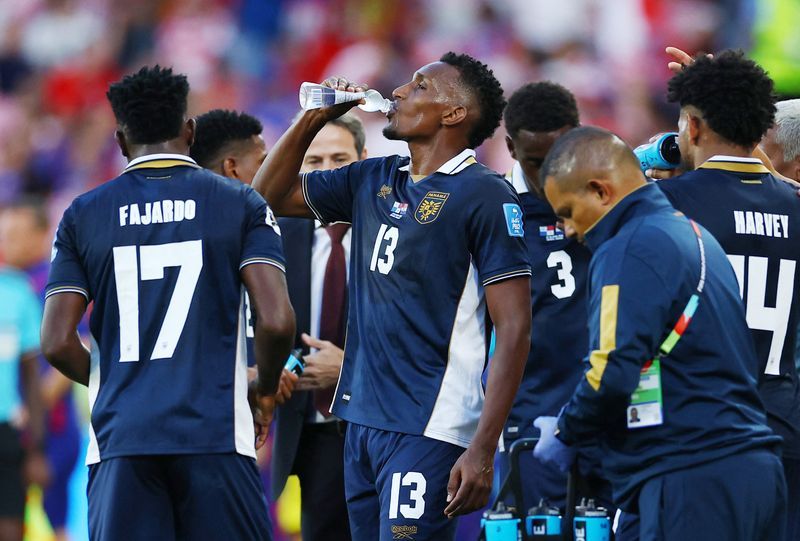
FIFA president Gianni Infantino has pushed back against mounting criticism of the mandatory hydration breaks introduced at the World Cup, characterizing the stoppages as a purely sporting initiative designed to safeguard player welfare amid challenging climatic conditions. The three-minute breaks, implemented at the 22nd and 67th minutes of every match across the North American tournament, have attracted considerable scrutiny since the competition's opening fixtures, with detractors questioning both their impact on the game's fundamental character and the motivations behind their introduction.
While Infantino acknowledged that broadcasters have capitalized on the stoppages to insert additional advertising content, he firmly rejected suggestions that FIFA's decision was financially motivated. He emphasized that all commercial broadcasting agreements had been finalized well before the breaks were instituted, meaning the governing body does not receive incremental revenue from the expanded advertising windows. This assertion carries significance given the substantial sums involved in World Cup broadcasting rights, which command premium prices globally. The clarification addresses a central concern among sceptics who suspected FIFA had engineered the breaks partly to create lucrative commercial opportunities disguised as health-and-safety measures.
The introduction of structured rest periods has fundamentally altered match dynamics in ways that extend beyond simple player recovery. Coaching staffs now possess formal opportunities to deliver tactical instructions during the breaks, a development that several prominent managers have criticized as distorting the competitive balance and eroding the sport's core appeal. Thomas Tuchel, managing England, characterized the interruptions as fundamentally changing the match's identity, while Marcelo Bielsa of Uruguay contended that fragmenting games into shorter, segmented periods eliminates what he considers the essential nature of football as a continuous, flowing contest. These objections reflect deeper concerns about how rule modifications can reshape strategic gameplay and tactical possibilities in ways that older generations of football may not have anticipated.
Yet opinion among elite coaches remains divided on the merits of the initiative. Some high-profile figures, including Spain's Luis de la Fuente and Netherlands captain Virgil van Dijk, have acknowledged the legitimate health rationale underpinning the breaks, particularly given forecasts of intense heat across North American venues. Their reservations, however, focus on implementation rather than principle. Both have questioned whether breaks of identical length and timing remain necessary in cooler climatic conditions or at stadiums equipped with climate-controlled facilities, suggesting a more nuanced, context-sensitive approach might better serve the competition's integrity while still protecting player welfare.
Infantino's justification for the breaks rests on two interconnected arguments. The primary rationale centres on player welfare during a grueling tournament schedule where teams potentially compete in eight matches across a 39-day window. The cumulative physical demands of this compressed calendar, combined with the environmental stresses of summer competition in North America, create genuine circumstances where structured recovery windows provide measurable benefits to athlete health and safety. This argument gains credibility when considered alongside medical literature documenting the physiological impacts of heat stress on athletic performance and injury risk.
The FIFA president's secondary justification addresses competitive fairness, a principle fundamental to sporting integrity. Infantino argued that providing identical rest and tactical adjustment opportunities to all teams regardless of weather conditions ensures that no squad gains unearned advantage through coaching adjustments simply because their particular matches occur under hotter conditions. This logic seeks to level the playing field and prevent scenarios where climatic variation accidentally becomes a competitive factor that disadvantages teams who happen to play earlier fixtures in cooler conditions. The principle reflects FIFA's broader commitment to standardized competition frameworks across all matches within a tournament.
Infantino further contended that the breaks have not diminished match intensity or player performance quality, suggesting that footballers have successfully maintained high-tempo play throughout matches despite the stoppages. This claim invites closer examination, as the subjective experience of commentators and fans suggests that the interruptions, regardless of whether players maintain physical intensity, do disrupt the rhythm and flow that many consider essential to football's aesthetic appeal and dramatic tension. The distinction between measurable performance metrics and the qualitative experience of the game represents a fundamental tension in the debate.
The controversy surrounding hydration breaks reflects broader tensions within professional football regarding how the sport should evolve in response to contemporary challenges. Climate change is increasing the frequency and severity of extreme heat events in major sporting venues globally, making the management of player welfare in hot conditions an increasingly pressing operational concern. Yet football has historically resisted modifications to match structure, with the 45-minute halves and continuous play remaining remarkably consistent since the sport's formalization in the 19th century. This makes even minor interruptions feel disruptive to those who view the sport's traditional format as intrinsic to its identity.
For Malaysian and Southeast Asian readers, the hydration breaks debate carries particular relevance given the region's tropical climate and the likelihood that upcoming tournaments might face similar pressures. Malaysia's national football program, along with clubs competing in regional competitions, may eventually encounter comparable requirements should international governing bodies expand heat-management protocols across different competitions. Understanding FIFA's rationale and the implementation challenges documented at the World Cup could prove valuable for local administrators planning for future tournaments or preparing domestic teams for international competition in demanding climatic conditions.
The unresolved question underlying this debate concerns where FIFA should draw the line between preserving football's traditional structure and implementing necessary adaptations to protect player welfare. Infantino's steadfast defense of the breaks as sporting rather than commercial measures seeks to reframe what critics view as a troubling precedent into a reasonable accommodation of modern realities. Whether the football community ultimately accepts this characterization will likely depend less on Infantino's assurances and more on how these breaks perform across an extended sample of matches and whether they become a permanent feature of the World Cup and other major competitions.

