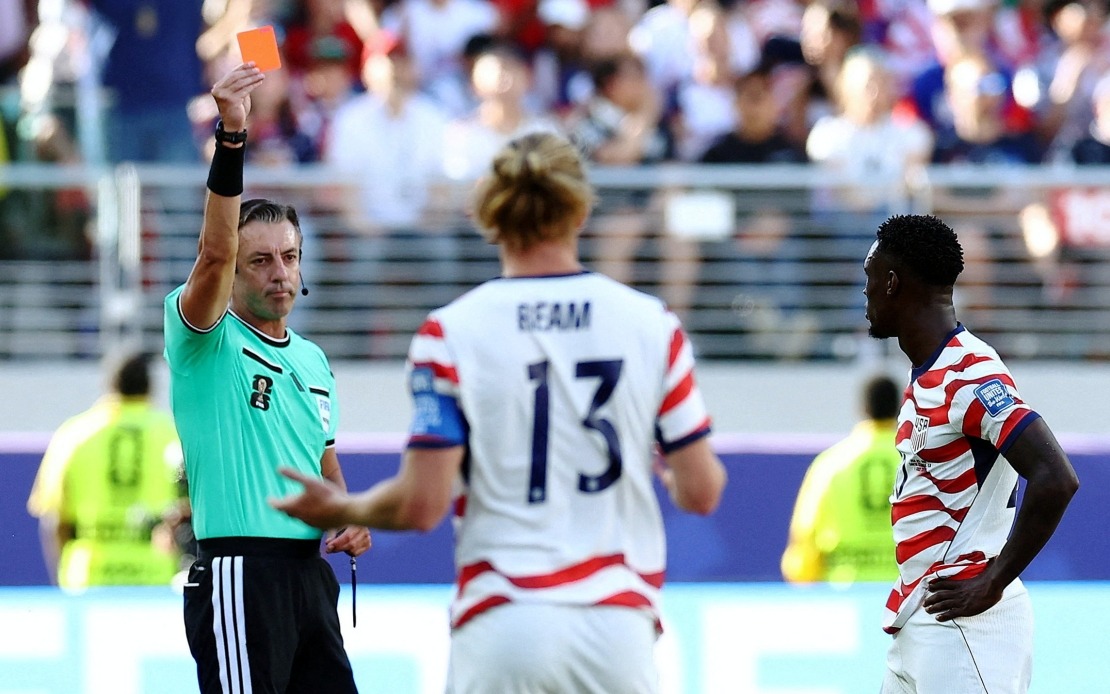
FIFA has moved swiftly to defend Brazilian referee Raphael Claus after United States President Donald Trump publicly questioned his officiating at the FIFA World Cup 2026. The controversy centres on Claus's decision to send off US striker Folarin Balogun during a VAR review in the last-32 encounter against Bosnia and Herzegovina last week, a judgment that drew sharp rebuke from the American leader who labelled the official's conduct "suspect" on Monday.
The red card incident became sufficiently contentious that Balogun's suspension was controversially rescinded on Sunday, enabling the player to participate in the subsequent last-16 fixture against Belgium. The US side ultimately suffered a heavy 4-1 defeat in that Seattle match on Monday, a loss that may have intensified scrutiny over the earlier dismissal and whether it fundamentally altered the team's tournament trajectory.
In a formal statement, FIFA moved to rehabilitate Claus's reputation, characterising him as "one of the world's leading professional referees and a valued member of Team One" at the tournament. The governing body underscored what it described as consistent demonstrations of "the highest standards of professionalism and integrity" throughout his career, attempting to place the disputed decision within a broader context of established competence.
Pierluigi Collina, FIFA's chief of referees, offered a more personal endorsement of the Brazilian official. Collina highlighted that Claus was undertaking his second FIFA World Cup assignment, having previously officiated at Qatar in 2022, thereby positioning him as an experienced figure within the elite refereeing hierarchy. The Italian's remarks carried particular weight given his own legendary status in football officiating, with Collina noting that FIFA maintained "full confidence in him as a trusted match official."
The backing from football's governing body represents a deliberate institutional response to political pressure. Trump's intervention, whether through direct communication or public statements, represents an unusual intersection of high-level politics and sports administration. The fact that FIFA President Gianni Infantino was reportedly contacted personally by Trump to "review" the Balogun decision indicates the depth of American diplomatic engagement on the matter.
Infantino himself issued a measured defence of the refereeing corps, though notably without naming Claus specifically. The Swiss FIFA chief took to Instagram to celebrate what he termed the "overwhelming success" of the tournament while praising the quality of match officials selected through what he described as a rigorous evaluation process. His emphasis on "skills, consistency, and quality over a sustained period" appeared designed to underscore that Claus and his colleagues represented the cream of global refereeing talent.
Infantino's broader message about respect for referees and the rules governing football carried implicit criticism of the politicisation of sporting decisions. By reiterating that "without referees, there is no football," the FIFA president appeared to be drawing a line under the dispute and discouraging further political intervention in match administration. This stance reflects FIFA's institutional interest in protecting referee autonomy from external pressure, however prominent the source.
For Malaysian and Southeast Asian observers, this episode offers instructive parallels regarding how international sports bodies navigate political interference and national interests. The region has witnessed similar tensions between governments and sports administrators, particularly surrounding controversial decisions affecting national teams in regional competitions. The willingness of FIFA to publicly defend a referee against presidential criticism suggests an attempt to establish boundaries around political influence in officiating matters.
The possibility that Claus could eventually referee the World Cup final—a prospect that became realistic only after Brazil's last-16 elimination—suggests FIFA intends to continue showing confidence in the Brazilian official despite the controversy. Such an assignment would represent a significant statement of institutional backing and vindication of his professional standing. It would also signal to other nations that political pressure alone does not determine referee selection for the tournament's most significant matches.
The incident underscores the tension inherent in modern football between sporting decisions and national pride. For the United States, the Balogun dismissal represented more than a technical ruling; it symbolised potential disadvantage in a competition where the nation was seeking strong performance. Yet FIFA's response demonstrates that sports administration, when functioning effectively, maintains independence from such national considerations.
For referees operating at football's highest levels, the Claus case illustrates both the scrutiny they face and the institutional support available when their decisions attract external criticism. The backing from Collina and FIFA provides professional reassurance amid the maelstrom of public and political commentary. However, it also highlights how controversial decisions—whether correct or mistaken—can generate diplomatic consequences that extend far beyond the pitch.
The resolution of this dispute may ultimately depend on how subsequent decisions by Claus are perceived. Should he continue to referee at the tournament without further controversy, the initial storm will likely fade from public memory. Conversely, any subsequent controversial rulings could reignite debate about his suitability for high-profile matches. For now, FIFA has drawn a clear line: institutional confidence in its referees supersedes external political pressure, a principle that Malaysian sports administrators and other regional bodies may find both challenging and necessary to uphold.

