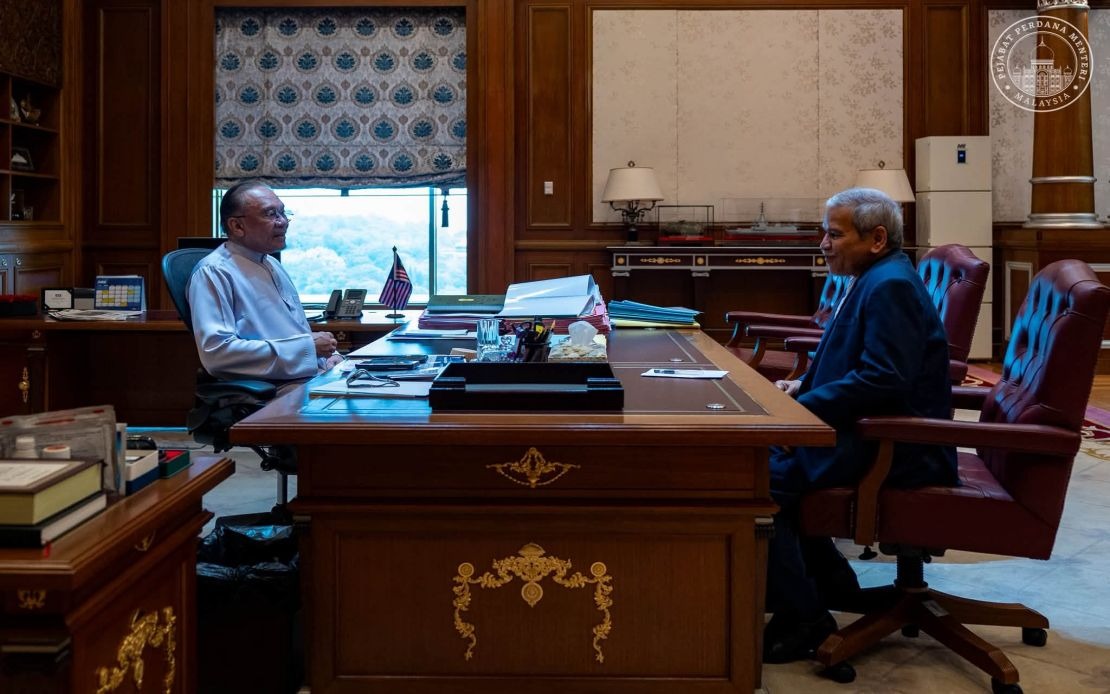
Prime Minister Datuk Seri Anwar Ibrahim has stressed that the Federal Land Development Authority must remain a robust institution dedicated to enhancing the quality of life for its settler communities and their dependents. The remarks came during a courtesy visit by newly appointed FELDA chairman Tan Sri Ahmad Badri Mohd Zahir to Putrajaya, where Anwar reiterated the government's commitment to the organisation that has historically served as a cornerstone of rural development and agricultural productivity in Malaysia.
The Prime Minister, who concurrently holds the Finance portfolio, articulated a vision that integrates the immediate welfare requirements of current settlers with broader strategic objectives centred on bolstering FELDA's economic viability and long-term sustainability. This dual emphasis reflects growing recognition within government circles that schemes designed to support smallholder farmers and rural communities must balance compassionate social support with the hard realities of market competitiveness and financial performance. The tension between these two imperatives has long characterised discussions around FELDA's operational direction and funding priorities.
A particular focus of Anwar's remarks was the necessity to address the specific challenges confronting younger-generation settlers, many of whom inherit land parcels or enter schemes with contemporary expectations about income stability, technological access, and career diversification. This generational dimension adds complexity to FELDA's mandate, as traditional approaches to settler support may not adequately address the needs and aspirations of those entering the scheme in an era of digital agriculture, climate volatility, and shifting commodity markets. The acknowledgment suggests the government views modernisation of FELDA's service delivery and support frameworks as integral to its future viability.
Ahmad Badri assumes the chairmanship with an explicit mandate to oversee restoration initiatives that rebuild institutional strength and public confidence. His appointment on July 15 succeeds Datuk Seri Ahmad Shabery Cheek, whose tenure concluded on June 30. The transition occurs at a time when FELDA faces multifaceted pressures ranging from ageing settler populations and succession planning challenges to competition from alternative land uses and shifting agricultural economics. The leadership change represents an opportunity to recalibrate institutional strategy and operational priorities in response to evolving socioeconomic realities.
Anwar's expressed confidence in Ahmad Badri's capacity to drive the restoration agenda underscores the Prime Minister's direct engagement with FELDA's trajectory. The Finance Minister's involvement signals that FELDA reform features prominently within broader government economic and social policy discussions. This executive-level attention carries implications for resource allocation, policy coordination across relevant ministries, and the urgency with which operational reforms are pursued. Such visibility can catalyse institutional change but also raises performance expectations among stakeholders.
The MADANI Government's commitment to furnish comprehensive support for FELDA reflects a strategic decision to position the authority as a continuing vehicle for rural upliftment and agricultural development. This endorsement comes amid broader policy conversations about rural-urban inequality, agricultural modernisation, and the role of state-supported schemes in addressing regional development disparities. FELDA's relevance to these conversations extends beyond its direct beneficiaries to encompass its symbolic importance as a pioneering institution in Malaysia's post-independence development architecture.
For settlers themselves, the emphasis on institutional strengthening carries practical implications regarding the predictability and adequacy of support services, market access, input subsidies, and technical assistance. Many settler families have invested decades in schemes with expectations of stable, if modest, livelihoods. Economic pressures from fluctuating commodity prices, rising production costs, and environmental stressors have tested this stability in recent years. Government reaffirmation of commitment provides some reassurance, though settlers remain keenly aware that rhetorical support must translate into tangible policy interventions and resource commitments.
The framing of FELDA as an institution that must remain relevant for future generations signals acknowledgment that static approaches to scheme design and settler support are insufficient. This forward-looking orientation suggests openness to exploring innovations in land utilisation, crop diversification, value-added processing, cooperative arrangements, and integration with broader agricultural supply chains. Such evolution could position FELDA settlers to capture greater value from their assets and labour, though realising these possibilities requires substantial investment in training, infrastructure, and market linkages.
Regionally, FELDA's trajectory holds interest for other Southeast Asian countries grappling with similar challenges around smallholder agricultural productivity, rural income stability, and the sustainability of state-supported land settlement schemes. Malaysia's experience offers lessons regarding both the potential and limitations of such programmes in addressing rural development objectives within a market-oriented economy. The renewed government focus on FELDA strengthening may encourage comparative analysis and knowledge-sharing among regional peers managing analogous institutions.
The coordination between FELDA leadership and the Prime Minister's office, evident from this courtesy call, suggests a collaborative approach to addressing institutional challenges. Such engagement can facilitate more rapid decision-making and resource mobilisation compared to situations where FELDA operates with limited executive-level attention. However, it also places heightened responsibility on both Ahmad Badri and relevant government ministers to demonstrate tangible progress in strengthening the institution and improving settler welfare within reasonable timeframes.
As FELDA contemplates its future trajectory under new leadership and renewed government focus, the institution must navigate complex terrain involving demographic transitions among settler populations, climate-related agricultural risks, commodity market volatility, and evolving social expectations. The Prime Minister's public affirmation of support provides political backing for necessary reforms, though translating this backing into sustainable improvements in settler livelihoods and institutional performance remains the practical challenge ahead. Success will ultimately be measured not by rhetorical emphasis but by demonstrable improvements in the economic security and quality of life of FELDA families.

