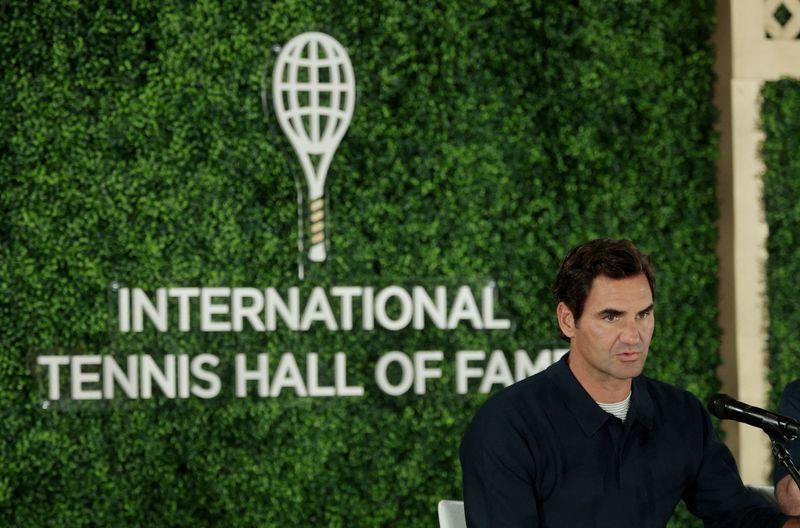
Roger Federer marked his induction into the International Tennis Hall of Fame this weekend with contemplation about a career whose significance he believes transcends tournament victories and statistical accomplishment. Speaking at a press conference ahead of his enshrinement in Newport on Saturday alongside broadcaster Mary Carillo, the 45-year-old Swiss great described the honour as fundamentally different from the tangible rewards that dominated his playing years. Where trophies and world rankings once served as the primary measures of success, Federer suggested his Hall of Fame moment offered something more reflective—a chance to assess his broader footprint on professional tennis as an institution and ecosystem.
Federer's résumé speaks to extraordinary dominance across multiple formats. His eight Wimbledon titles remain unmatched in men's singles, complemented by six Australian Open victories, five U.S. Open crowns and the French Open triumph in 2009 that completed his career Grand Slam collection. He captured Olympic doubles gold with Stan Wawrinka in 2008 and captained Switzerland to Davis Cup victory in 2014. Upon retirement in 2022, he had accumulated 103 ATP Tour titles and spent 310 weeks positioned as world number one—benchmarks that would seem to define any athlete's legacy entirely.
Yet Federer deliberately steered his reflection toward contributions that sit outside the scoreboard. He highlighted his involvement in dialogues with ATP leadership, Grand Slam tournament directors, player councils and other stakeholders about the direction of professional tennis. This collaborative work, conducted across conversations rather than captured in statistics, has influenced tangible improvements in the sport's economic structure and working conditions. Federer pointed specifically to expansion of prize money distribution that now reaches competitors in early-round matches, not merely champions, fundamentally altering the financial viability of professional tennis careers for the broader player population.
The accessibility question underpins his assessment. Federer emphasised that his hoped-for legacy included helping create circumstances where significantly more athletes can sustain themselves financially through tennis. This reflects a conscious philosophical shift—from measuring success purely through individual triumph toward measuring it through systemic improvements that benefit the entire professional ecosystem. Prize money expansion in the opening rounds of major tournaments represents a structural change with implications for hundreds of players worldwide, many of whom will never contend for titles but depend on consistent earnings from competing.
Beyond economics, Federer referenced improvements across multiple operational dimensions of professional tennis. Enhanced conditions for players across tournaments, upgraded facilities, better support for media personnel, and expanded medical infrastructure all represent areas where his advocacy allegedly contributed weight. These may seem incremental compared to winning majors, yet each represents a real-world improvement affecting daily professional experiences for athletes, staff and support personnel in ways that compound across careers.
Federer's pathway to embracing such a mindset offers instructive context for understanding his current perspective. He described feeling like a winner from his emergence as a talented Swiss adolescent, gravitating naturally toward elite stages and prestigious venues rather than lower-profile competitions. This early self-awareness about ambition and competitive identity shaped his psychology throughout a career where external expectations mounted exponentially as his achievements accumulated. Rather than viewing this pressure as burdensome, he characterised his approach as one of calculated embrace—deliberately leaning into the intensity accompanying his rise rather than resisting it.
However, Federer acknowledged the psychological toll that can accompany such positioning. The constant din of external commentary, judgment and analysis surrounding elite sport creates what he described as a mental storm capable of eroding enjoyment of competition itself. Players evaluated solely on whether they accumulate victories face particular vulnerability to this phenomenon. Federer suggested he largely navigated this challenge successfully, maintaining satisfaction with his career despite pressures that could easily have overwhelmed or embittered him, though he did not claim immunity from these destabilising forces.
Looking forward, Federer left open several pathways through which he might continue contributing to professional tennis. The possibility of becoming a Laver Cup captain attracted his interest, offering an avenue to mentor emerging talent directly. Commentating represents another potential role, while general engagement with the sport's ongoing evolution remains appealing to him. He indicated attending several events annually keeps him sufficiently connected to understand where his involvement might generate meaningful impact.
This forward-looking openness reflects Federer's description of the mental rejuvenation he experiences through continued exposure to professional tennis. Rather than retreating from the sport following retirement, he suggests finding energy and purpose in observing contemporary competition and contemplating future contributions. For Malaysian and Southeast Asian tennis enthusiasts, Federer's emphasis on systemic improvement over individual accolade resonates particularly given the region's emerging tennis presence and developing professional pathways for athletes. His framework suggests that legacy-building at the highest levels involves advocacy for structural conditions enabling broader participation and sustainability—a lesson potentially instructive for tennis development across the region.

