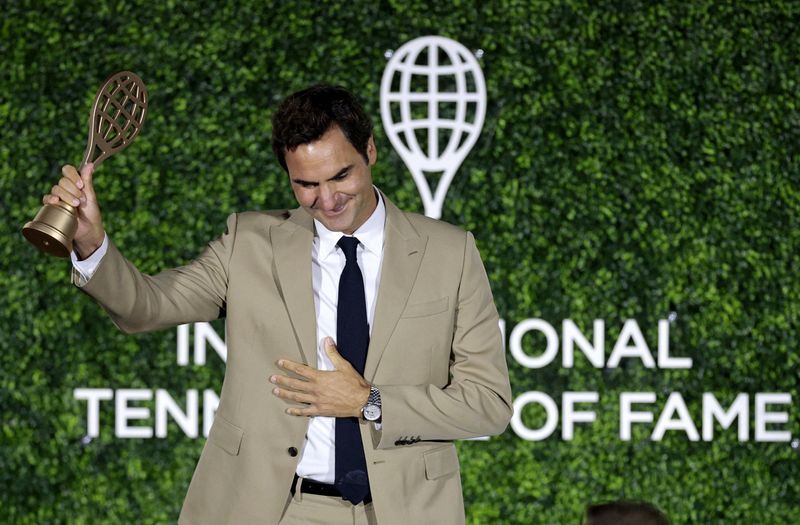
Roger Federer's induction into the International Tennis Hall of Fame in Newport, Rhode Island on Saturday marked a poignant milestone for the 20-time Grand Slam champion, who took the stage visibly moved as he reflected on a career that reshaped professional tennis. The Swiss legend, who retired in 2022, described his ongoing relationship with the sport as a love letter still being written, underscoring that his departure from competitive play represents merely a chapter's end rather than a final farewell to the game that consumed four decades of his life.
Federer's Hall of Fame induction alongside broadcaster and journalist Mary Carillo provided him with a platform to articulate what tennis has meant beyond trophies and rankings. In remarks that brought him to tears, he articulated a philosophy fundamentally at odds with conventional measures of sporting success, declaring that fame was never his driving force. Instead, he emphasised the privilege of dedicating his life to an activity he loved alongside people who shared that passion with equal intensity. This perspective, shared by few athletes at his level, hints at the deliberate construction of a legacy that transcends wins and losses.
The numbers that define Federer's playing career remain staggering even in retrospect. His eight Wimbledon titles stand as a men's record that endured until Novak Djokovic's ninth championship in 2023. Over 310 weeks as world number one, he accumulated six Australian Open titles, five U.S. Open crowns, and a solitary French Open victory—the tournament that eluded his grasp during his prime years. These achievements accumulated across 103 ATP Tour titles, representing a consistency and dominance that few athletes across any sport have approached.
Yet Federer's significance extends well beyond the statistic sheet, a reality he articulated by referencing the more whimsical aspects of his career. His signature headbands, numbering over 5,000 during his playing years according to his own count, became as iconic as his measured court demeanor. The peculiar detail about wearing two pairs of socks simultaneously reflected the meticulous attention to comfort and ritual that characterised his preparations. These seemingly minor details accumulated into a coherent aesthetic that influenced how millions of people perceived what professional tennis could look like—elegant, thoughtful, and distinctly individual.
The tactical innovations Federer pioneered on court represented perhaps his most enduring contribution to tennis' evolution. His mastery of serve-and-volley strategies, his willingness to attack from positions traditionally associated with defensive play, and his experimental approach to returning serve through unconventional positioning redefined positional tennis. The SABR—a return technique that caught opponents off-guard by positioning himself unusually close to the net—became synonymous with his willingness to challenge conventions. These innovations revealed a philosophical commitment to pushing the sport's boundaries through creativity rather than simply out-muscling opponents.
Beyond the court's white lines, Federer emphasised that the most significant developments in his life occurred away from competitive play. His induction speech afforded him opportunity to publicly acknowledge the support systems that enabled his success, including coaches who refined his technique, medical professionals who maintained his body across four decades of competition, and crucially, his wife Mirka. Her presence and endorsement of his character as husband, father, and friend underscored that the public persona millions observed represented only a partial reflection of his human complexity.
Federer's reference to his origins as a thirteen-year-old ball boy watching tennis in his hometown of Basel added poignant context to his Newport induction. That childhood vantage point—literally working within the sport before he dominated it—shaped his perspective on belonging to something larger than individual achievement. His pride in Switzerland accompanying him into the Hall of Fame reflected an understanding that individual accomplishment extends outward to encompass one's nation, family, and community.
For Malaysian and Southeast Asian readers, Federer's career trajectory and philosophical approach to sporting excellence carries particular resonance. His emphasis on authentic self-expression within professional sport contrasts with the sometimes rigid expectations placed on Asian athletes to conform to specific templates of success. His willingness to experiment tactically and take calculated risks on court demonstrated that excellence need not emerge from a single prescribed pathway. Moreover, his sustained competitiveness across multiple decades showcased that longevity in sport need not require the sacrificial lifestyle often assumed necessary.
Looking forward, Federer articulated concerns about professional tennis that warrant attention from the sport's governance structures. His hope that competitive tennis retain elements of amateur spirit even as globalisation and professionalisation accelerate reflects anxiety that commerce might erode the camaraderie and genuine love for competition that sustains the sport's appeal. His caution about maintaining authenticity and questioning conventions becomes particularly relevant as younger generations of players navigate the demands of sponsorships, media expectations, and algorithmic visibility.
Federer's vision for tennis' future emphasised that his Hall of Fame induction should catalyse continued evolution rather than nostalgic retrospection. His exhortation to players to attempt previously unseen approaches and push the sport toward new heights reflected refusal to position his career as a high-water mark against which all successors should be measured. Instead, his speech implicitly endorsed the concept that each generation of athletes bears responsibility for advancing their sport's possibilities. This generosity of vision—welcoming innovation beyond his own contributions—distinguishes his perspective from athletes who regard their era as unsurpassable.
The emotional core of Federer's induction remarks centred on tennis as the intersection of his most cherished priorities: family, friendship, and personal growth. This formulation reframes sporting achievement as fundamentally relational rather than solipsistic. Tennis did not merely provide Federer with titles and rankings; it enabled the relationships and experiences that constitute his life's meaning. His assertion that induction does not represent goodbye but rather a transition in his engagement with the sport reflects maturity about career evolution that many athletes struggle to articulate.
As Federer moves into the next phase of his relationship with tennis—one presumably involving commentary, mentorship, or other forms of engagement beyond competitive play—his Hall of Fame induction crystallises a moment of collective reflection on what his career meant to professional sport. His emphasis on integrity, creativity, and sustained passion offers lessons that transcend tennis, particularly relevant for emerging athletes across Southeast Asia seeking to build legacies that extend beyond individual achievement toward broader cultural impact.

