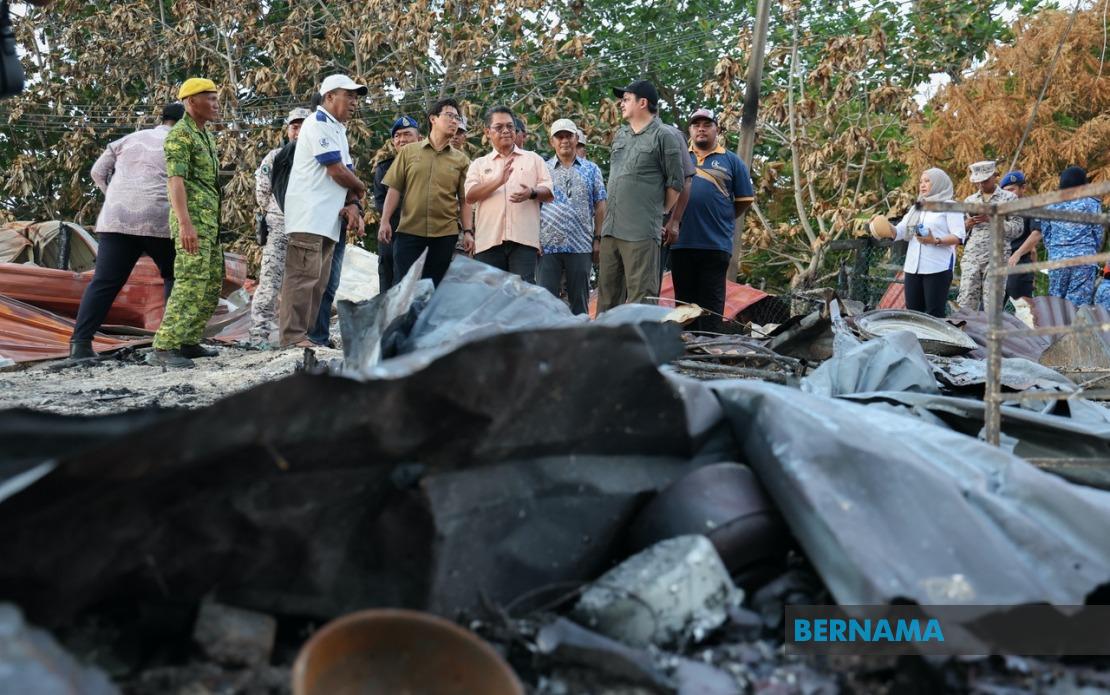
The Prime Minister's Department has moved swiftly to provide emergency relief following a destructive fire that swept through Pulau Nunuyan Laut in Sandakan yesterday morning, affecting dozens of families and leaving more than 100 people without shelter. The blaze, which broke out around 3 am at Kampung Nunuyan Laut, destroyed 28 houses in what authorities are treating as an urgent humanitarian crisis requiring coordinated government response across multiple agencies.
Initial assistance has been distributed to 29 heads of households impacted by the fire, with Datuk Mustapha Sakmud, Minister in the Prime Minister's Department overseeing Sabah and Sarawak affairs, confirming that the Implementation Coordination Unit has begun implementation of relief measures. Beyond immediate cash assistance, the department has recognised specific vulnerabilities within the affected population, arranging for wheelchairs to be provided to elderly residents who have lost their homes and require mobility support during this transitional period.
The government's approach extends beyond temporary relief to addressing systemic challenges that the disaster has exposed. Officials have identified critical infrastructure damage requiring urgent restoration, particularly the jetty serving as the primary transport link for schoolchildren accessing educational facilities. Disruption to children's schooling represents a secondary impact of the fire that authorities are determined to prevent, signalling an intention to treat reconstruction as a holistic process rather than merely replacing destroyed property.
Datuk Mustapha outlined a collaborative framework involving the Sandakan Municipal Council and various agencies tasked with conducting comprehensive needs assessment across the affected community. This approach recognises that fire victims rarely have uniform requirements; some may need temporary shelter, others require assistance locating employment, while families with school-aged children face education continuity challenges. By centralising coordination through the Implementation Coordination Unit, the government aims to identify and address these varied needs systematically rather than through ad-hoc responses.
A complicating factor in the relief and rehabilitation process is the land tenure situation affecting Pulau Nunuyan Laut residents. Sandakan Municipal Council president Datuk Walter Kenson revealed that the fire victims were occupying private land involving two separate land titles owned by different proprietors. This creates both immediate and long-term challenges: in the short term, private landowners may be reluctant to permit displaced families to remain on their property indefinitely, while permanent relocation solutions require careful negotiation and coordination with these private stakeholders.
The Rural Development Department has been assigned responsibility for determining optimal relocation strategies for affected families, with discussions planned involving both the private landowners and relevant government bodies. Rather than impose immediate relocation, authorities appear to be taking a measured approach that acknowledges property rights while prioritising resident welfare. Village reserve land has been identified as a potential relocation site, representing government-held property that could facilitate more permanent settlement solutions without ongoing negotiations with private parties.
Planned infrastructure development in any relocated site will encompass essential services that currently contribute to the vulnerability of island communities. Electricity supply, fresh water distribution systems, and maritime access via jetties represent basic amenities that appear to have been absent or inadequate in the original settlement. Building these services into relocation planning reflects lessons learned from the fire response, suggesting that authorities are considering not merely where displaced residents will live, but under what conditions their long-term welfare can be assured.
The fire at Pulau Nunuyan Laut highlights the particular vulnerability of maritime communities in Malaysian Sabah, where dispersed island settlements often lack formal infrastructure and may sit in regulatory grey zones regarding land ownership and settlement legality. The involvement of private landowners in this case is not unusual; many island communities in Sabah have developed on private land through informal arrangements that persist for years until triggered into crisis by disasters. This fire therefore serves as a case study in how government machinery responds when such informal settlements suddenly demand public attention and resources.
For Malaysian policymakers, the incident underscores the need for proactive surveying and registration of informal settlements, particularly in maritime areas where accurate population data is difficult to obtain and infrastructure planning consequently becomes reactive rather than preventive. Communities living on private land without formal title or lease arrangements represent a vulnerability that extends beyond individual disasters; fire, flood, or other calamities can render these situations suddenly urgent, forcing rapid government intervention under crisis conditions that may be more costly and less effective than planned development.
The coordination demonstrated in the Pulau Nunuyan response—involving the Prime Minister's Department, municipal council, Rural Development Department, and private stakeholders—represents a model that could be replicated across other vulnerable maritime communities throughout Sabah and Sarawak. Whether this model will ultimately deliver sustainable solutions or merely provide temporary relief will depend on whether government agencies follow through with promised infrastructure development and whether private landowners prove willing to support relocation initiatives.

