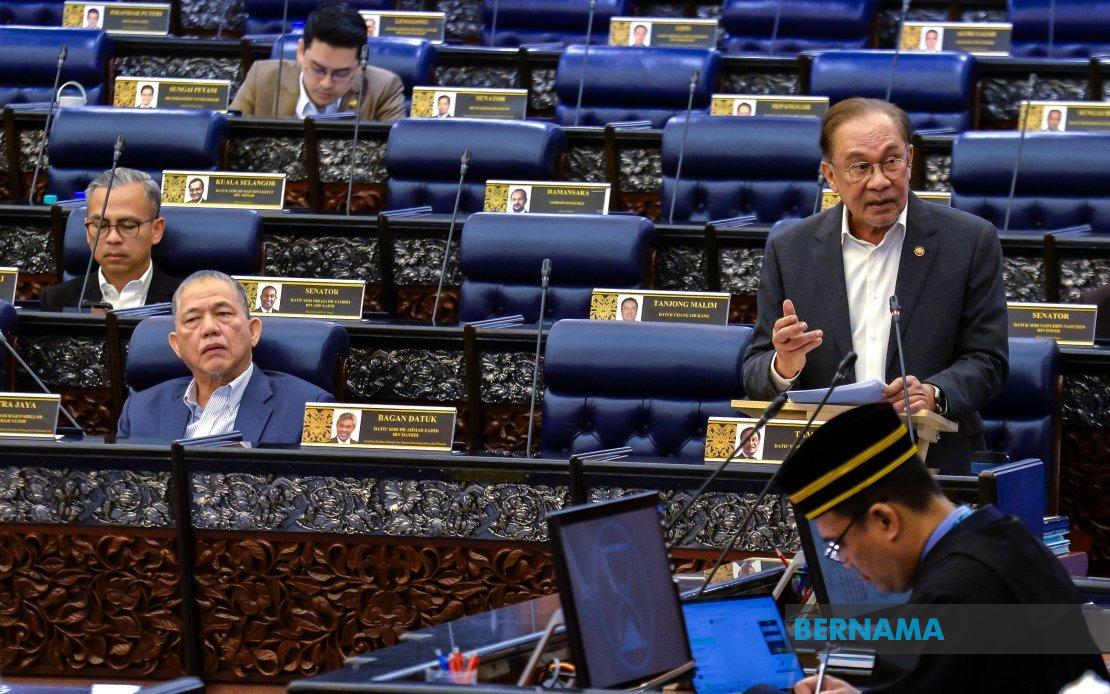
Prime Minister Datuk Seri Anwar Ibrahim has moved to counter persistent assertions of regional favouritism in federal resource distribution, declaring that the allocation framework prioritises developmental requirements and public welfare across states rather than simply returning tax revenue to its source. During parliamentary question time on June 30, the Prime Minister clarified a commonly misunderstood aspect of Malaysia's fiscal federalism, noting that nearly all states benefit from receiving federal funds in excess of their tax contributions to the national coffers, with only Selangor and Penang emerging as net contributors based on revenue generation metrics.
This distinction carries significant weight for understanding Malaysia's approach to national development. The federal system deliberately channels resources to areas with greatest need, recognising that poorer states with lower tax bases often face acute infrastructure deficits, higher poverty concentrations, and developmental bottlenecks requiring substantial public investment. Rather than perpetuating existing economic disparities through a strictly proportional tax-return mechanism, the government's methodology seeks to address regional imbalances and ensure equitable development across the nation's diverse landscape.
Anwar's comments arose during parliamentary debate when Datuk Seri Doris Sophia Brodi, the GPS representative from Sri Aman, raised questions about the adequacy and fairness of federal allocations to state governments. Her inquiry touched on perceptions that certain states faced unfair treatment in the distribution process and whether the MADANI administration had successfully reformed allocation mechanisms from previous governance periods. The question gave the Prime Minister opportunity to articulate the government's position comprehensively and dispel misconceptions circulating among state administrations and the public.
The Prime Minister outlined the specific policy drivers guiding allocation decisions, emphasising that each state's funding reflects carefully assessed priorities rather than formulaic calculation. Critical infrastructure projects including flood mitigation and disaster management systems receive substantial focus, particularly relevant given Malaysia's vulnerability to seasonal flooding and climate-related challenges. Development corridors like the Pan Borneo highway upgrading initiative demonstrate how allocations support major regional connectivity projects designed to unlock economic potential and improve inter-state movement.
Beyond highway infrastructure, federal funding addresses water supply systems and drainage networks that directly impact public health and urban habitability. These technical systems require continuous capital investment but often lack sufficient revenue generation to sustain themselves through state-level sources alone. Education infrastructure development, encompassing school construction and facility upgrades, forms another allocation priority, as investment in human capital development yields economy-wide benefits extending beyond individual state boundaries. Poverty eradication programmes similarly demand targeted federal intervention in states where income levels and employment opportunities lag national averages.
Anwar drew specific attention to the comparative funding performance under the current MADANI administration relative to previous governments. He highlighted that Kedah, Terengganu, and Kelantan had received enhanced allocations during the current administration's tenure, suggesting directional change in distribution patterns. This comparative claim carries political significance, implying that resource allocation had shifted toward states that may have previously experienced funding constraints. The framing invites examination of how different administrations have weighted various state development priorities within the federal budget framework.
The Prime Minister's defence of the allocation system reflects broader tensions within Malaysia's federal structure. State governments increasingly scrutinise their fiscal position relative to federal revenue collection within their territories, particularly as economic development creates widening disparities between high-growth urban states and slower-growing regions. These tensions have periodified in public discourse and state-level political debates, with some representatives arguing for greater fiscal autonomy or more transparent allocation formulae.
The necessity for explicit clarification regarding allocation methodology suggests widespread public misunderstanding about how federal resource distribution functions. Many observers perceive an implicit quid pro quo between tax contribution and service receipt, though such a system would likely entrench regional inequality rather than ameliorate it. By publicly explaining that Selangor and Penang represent exceptions rather than the norm, Anwar acknowledged that two developed states do indeed receive lower allocations than their tax contributions, potentially validating concerns in those jurisdictions while simultaneously demonstrating that the broader system operates according to different principles.
For Malaysian readers and policymakers, this clarification carries implications extending beyond immediate budget debates. It reflects deliberate policy architecture designed to temper market-driven inequality through redistributive mechanisms. However, the continued need for such explanations suggests the messaging has not penetrated effectively into public consciousness. State administrations, particularly those governed by opposition parties, may find political advantage in interpreting allocations as inadequate regardless of official reasoning, creating persistent friction in centre-state relations.
The allocation methodology also intersects with Malaysia's development aspirations and regional equity objectives embedded in various national plans. Concentrating resources in higher-performing states risks reproducing uneven growth patterns, whereas strategic distribution aimed at capability-building in lagging regions supports broader inclusive development goals. Yet implementing such a system transparently and managing expectations across diverse stakeholder groups remains consistently challenging, as evidenced by ongoing parliamentary scrutiny and public discourse.

