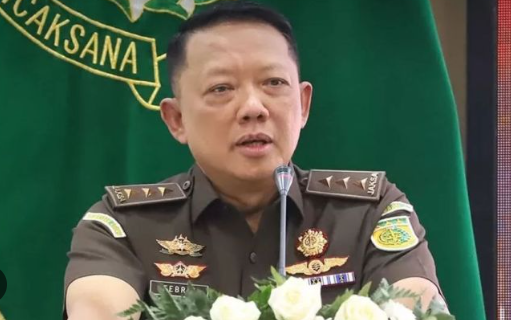
President Prabowo Subianto's commitment to eradicating corruption faces a crucial test with the investigation into Febrie Adriansyah, the nation's former deputy attorney general for special crimes, whose residence was raided last week after police seized US$26 million in cash and gold bars. The case has become emblematic of deeper structural vulnerabilities in Indonesia's approach to fighting graft, particularly when those accused occupy the highest echelons of the enforcement machinery itself. Prabowo had made aggressive anti-corruption rhetoric a centrepiece of his presidency, repeatedly exhorting officials to "clean themselves up" before enforcement bodies intervened—a message that now rings hollow as questions mount over whether the system can police its own.
The investigation's most contentious aspect centres not on the allegations themselves, but on the decision by police to transfer three related cases to the Attorney General's Office, where Febrie spent most of his distinguished career. This institutional handover has alarmed legal scholars and constitutional experts, who argue it muddies jurisdictional lines and creates perverse incentives. Febrie remains at large despite being named a suspect, while another individual in the case was arrested the following Friday. The police have not publicly justified why Febrie has avoided detention, a silence that fuels speculation about institutional protection and suggests the enforcement system may be shielding one of its most influential figures from the full rigour of investigation.
Former Constitutional Court Chief Justice Mahfud MD has directly challenged the legality of the transfer itself, arguing that Indonesia's criminal procedure code contains no provision allowing an active police investigation to be handed to prosecutors. His warning carries considerable weight: the transfer could become a vulnerability that legal counsel exploits in pretrial challenges, potentially unravelling the entire case on procedural grounds. This legal fragility reflects a broader institutional problem—the country's law-enforcement apparatus was never designed to investigate itself with genuine independence. When the accused is not a peripheral figure but rather someone who shaped prosecutorial strategy for years, the conflict of interest becomes structural rather than incidental.
The Attorney General's Office has assumed investigative responsibility for a case involving one of its former leaders, a situation that inherently compromises institutional credibility. Multiple lawmakers have responded by establishing a working group to monitor proceedings, while some have called for the creation of a dedicated independent team within the Attorney General's Office to handle the inquiry. Zaenur Rohman, an anti-corruption scholar at Gadjah Mada University, has characterised the transfer as "a political settlement aimed at easing tensions" between police and prosecutors—language that implies the decision reflects institutional negotiations rather than legal principle. He argues that Indonesia's Corruption Eradication Commission, positioned within the executive branch and designed to operate independently, would be institutionally better positioned to conduct such a sensitive investigation without the baggage of internal career connections.
Coordinating Minister Yusril Ihza Mahendra defended the transfer on procedural efficiency grounds, yet in doing so acknowledged the elephant in the room by referencing the Indonesian expression "oranges eating oranges"—a colloquial way of describing one institution protecting its own. His admission that Prabowo personally intervened to direct both the police chief and attorney general on handling the case further undermines any appearance of institutional independence. When the presidency becomes directly involved in steering the conduct of an investigation, the question of whether law-enforcement agencies are genuinely impartial becomes academic.
Febrie's prominence in Indonesian prosecutorial circles amplifies the sensitivity of the case. As head of the Attorney General's Office's Special Crimes Division, he oversaw investigations into some of the nation's most significant corruption matters, including inquiries into state-owned enterprises such as Pertamina and Timah, flag carriers like Garuda Indonesia, and even Prabowo's own flagship free-meals programme. This last connection adds an ironic dimension: Prabowo initiated an anti-corruption investigation into his signature social policy initiative, only to have that same programme become entangled in the Febrie case. His influence extended to investigating former Education Minister Nadiem Makarim, making him a figure whose institutional knowledge and prosecutorial relationships span the entire elite of Indonesian politics and business. Investigating such a figure inevitably exposes the interconnected loyalties that characterise the enforcement system.
The procedural irregularities extend beyond jurisdictional questions. While police transferred the cases to prosecutors, they retained involvement in evidence verification and material handovers, creating ambiguous accountability chains. Police have enlisted the FBI, US Secret Service, and both US and Singapore embassies to authenticate the seized currency and test gold bars, a process that suggests either genuine complexity or perhaps deliberate delay and obfuscation. As of Wednesday, Febrie's whereabouts remained undisclosed, though immigration authorities confirmed a 20-day travel ban at police request. His own statement, issued before resigning, acknowledged owning one of the raided houses but denied ownership of the seized assets—a claim that neither confirms nor dispels suspicion.
The case illuminates deeper fault lines in Indonesia's law-enforcement architecture. Police, the Attorney General's Office, and the Corruption Eradication Commission maintain overlapping mandates in corruption investigations, creating ongoing jurisdictional competition that successive presidents have attempted to manage through institutional balance rather than genuine consolidation. Recent legal changes in 2025 have shifted this calculus: a revised military law now permits active-duty military officers to serve in the Attorney General's Office without resigning from the armed forces, while new provisions allow prosecutors to request military protection. This militarisation of the prosecutorial apparatus represents a structural change whose full implications remain uncertain.
Aditya Perdana, a political science lecturer at the University of Indonesia, observed that "the events don't explicitly prove institutional conflict, but the sequence tells a story." The armed soldiers deployed around Febrie's residence during the raids, the subsequent appearance of police and Attorney General officials together denying any institutional rift, and the Attorney General's sudden halt to regional prosecutors' data collection on the free-meals programme—all suggest choreographed damage control rather than genuine institutional cooperation. Jacqui Baker, a Southeast Asian politics scholar at Murdoch University, contextualises Indonesia's approach within a longer pattern: successive presidents have deliberately avoided allowing any single law-enforcement institution to accumulate disproportionate power, instead playing agencies against one another to maintain executive control. Prabowo appears to be continuing this strategy, albeit with new institutional configurations that incorporate military structures more deeply into prosecutorial functions.
The Febrie investigation reveals uncomfortable truths about anti-corruption campaigns in Southeast Asia, particularly when enforcement institutions are asked to investigate themselves without external, independent oversight. Prabowo's aggressive rhetoric about corruption fighting rings authentic enough—his administration has pursued multiple high-profile cases involving state enterprises and officials. Yet when institutional self-interest collides with genuine accountability, the system's structural limitations become apparent. Until Indonesia establishes a genuinely independent mechanism for investigating law-enforcement officials themselves, cases like Febrie's will continue to undermine public confidence in anti-corruption efforts. The president's ability to direct investigative agencies, the Attorney General's Office's capacity to shield one of its own, and the absence of clear legal frameworks for cross-institutional accountability all point to a system that can pursue external targets aggressively but struggles to turn that lens inward with comparable rigour.

