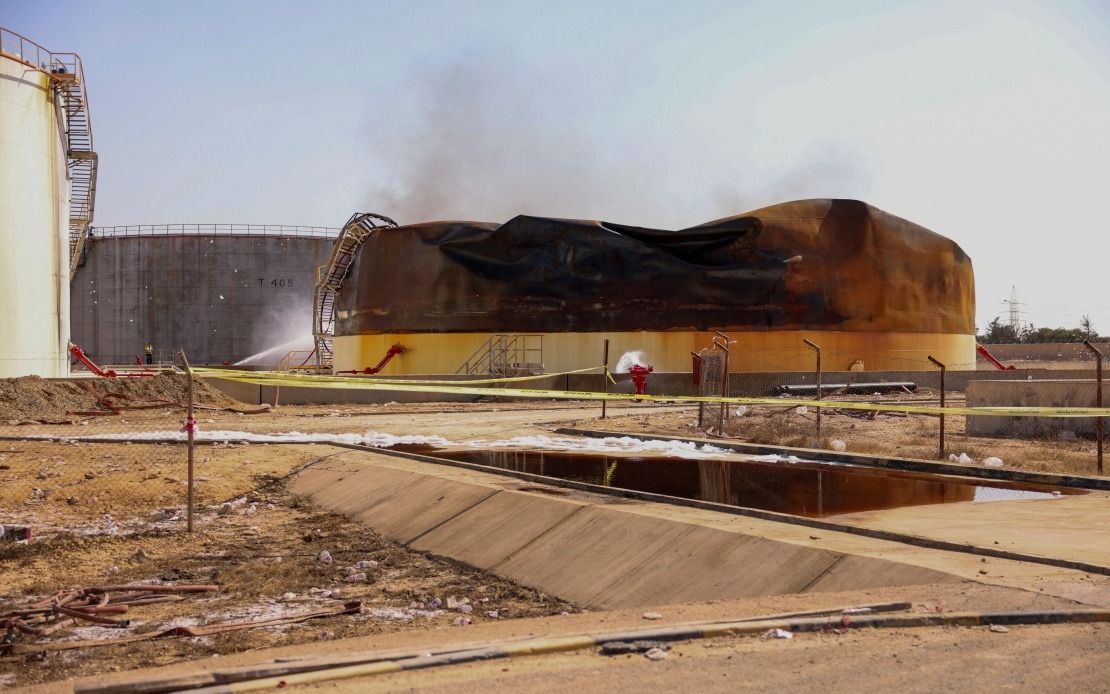
A blast occurring on Saturday near the Zawiya power plant in western Libya has severely compromised the nation's already fragile electricity supply network, with state-owned General Electricity Company of Libya (GECOL) confirming that several generation units have been forced offline. The incident represents another serious setback for a country grappling with chronic energy shortages and competing security threats across its vital infrastructure.
GECOL has mobilized technical teams to assess what triggered the explosion and establish the exact circumstances surrounding the incident. While investigations are underway to determine the technical factors that may have contributed to the blast, the company has provided limited details about the nature of the damage or the timeline for restoration. Initial assessments suggest that recovery efforts will require careful planning to gradually bring offline capacity back into operation without further straining the already depleted grid.
The broader context for this incident is deeply troubling. Just one week prior to the explosion, Zawiya faced a coordinated assault involving unmanned drone attacks that targeted multiple critical installations across the city. Those strikes struck oil storage facilities, crucial desalination plants that supply fresh water to the population, and additional power infrastructure. The frequency and precision of these attacks suggest a sophisticated capability and raise urgent questions about the adequacy of Libya's defensive systems and intelligence gathering operations.
The succession of attacks within such a compressed timeframe indicates that Zawiya has become a focal point of instability. For a region already struggling with governance challenges and economic fragility, the targeting of energy, water, and petroleum assets strikes at the heart of essential services that underpin urban survival and economic function. When these systems fail, the cascading effects ripple through hospitals, water treatment facilities, and everyday life for ordinary Libyans.
Authentication of responsibility remains elusive. No organization has publicly acknowledged perpetrating either the drone strikes or the explosion, leaving Libyan authorities without clarity on the adversary's identity or motivations. Such ambiguity complicates response strategies and raises the possibility of multiple actors with competing interests pursuing destabilization. Intelligence services have launched investigations aimed at tracing the origins of the unmanned aircraft and identifying those orchestrating the campaign, but progress has been limited.
The timing and pattern of attacks warrant serious scrutiny. Strikes concentrated on Zawiya suggest either localized factional disputes or attempts by external parties to weaken Libya's economic capacity. The inclusion of oil infrastructure in targeting calculus hints that energy control may factor into the perpetrators' strategic thinking, reflecting the centrality of petroleum revenues to Libyan state finances and political power structures. For regional observers, including Malaysian analysts tracking Middle Eastern and North African stability, such conflicts over resource infrastructure represent familiar flashpoints.
GECOL has committed to restoring power supply progressively, though no specific timeline has been announced for complete stabilization of the electricity grid. The company issued an apology to citizens for service disruptions while pledging sustained effort until normal operations resume. Such commitments reflect the acute political pressure that infrastructure failures generate in societies where essential services are already chronically insufficient. Restored electricity translates directly into relief for households, businesses, and public institutions that depend on uninterrupted power.
Libya's electricity sector already operates far below capacity even in periods of relative stability. Chronic underinvestment, aging infrastructure, civil conflict, and lack of maintenance have conspired to create a system operating at a fraction of design capacity. This explosion thus arrives at a moment when the margin for additional supply loss is virtually nonexistent. Neighborhoods already enduring rolling blackouts will face deeper deprivation in coming weeks as restoration efforts proceed.
The security dimension extends beyond immediate infrastructure protection. These attacks underscore the vulnerability of Libyan critical infrastructure to both conventional military threats and unconventional drone operations. The nation's capacity to defend key installations against organized adversaries equipped with modern weaponry appears demonstrably inadequate. This asymmetry invites further exploitation by actors perceiving weakness in Libya's defensive posture.
From a Southeast Asian perspective, Libya's experience offers cautionary lessons about the fragility of nations where central authority cannot monopolize the use of force or maintain territorial control. Malaysia and regional partners monitor such developments as potential precedents for state fragmentation and the rise of non-state actors wielding advanced technology. The proliferation of drone capabilities among sub-state groups presents challenges transcending Libya's specific circumstances.
The explosion and preceding attacks will likely force Libyan policymakers to reassess infrastructure hardening strategies and security protocols. However, financial constraints and competing demands for limited government resources mean comprehensive remediation may prove impossible without sustained international support. The fundamental question facing Libyan authorities involves whether they possess sufficient capacity and will to reverse the trajectory of institutional decay that enables such incidents.
As GECOL teams work to restore service, ordinary Libyans face deepening hardship from electricity shortages. The question of who orchestrated these attacks, and whether further strikes will follow, remains unanswered. The pattern suggests that Zawiya's critical infrastructure will remain under threat absent major shifts in the underlying conflicts driving such targeting decisions.

