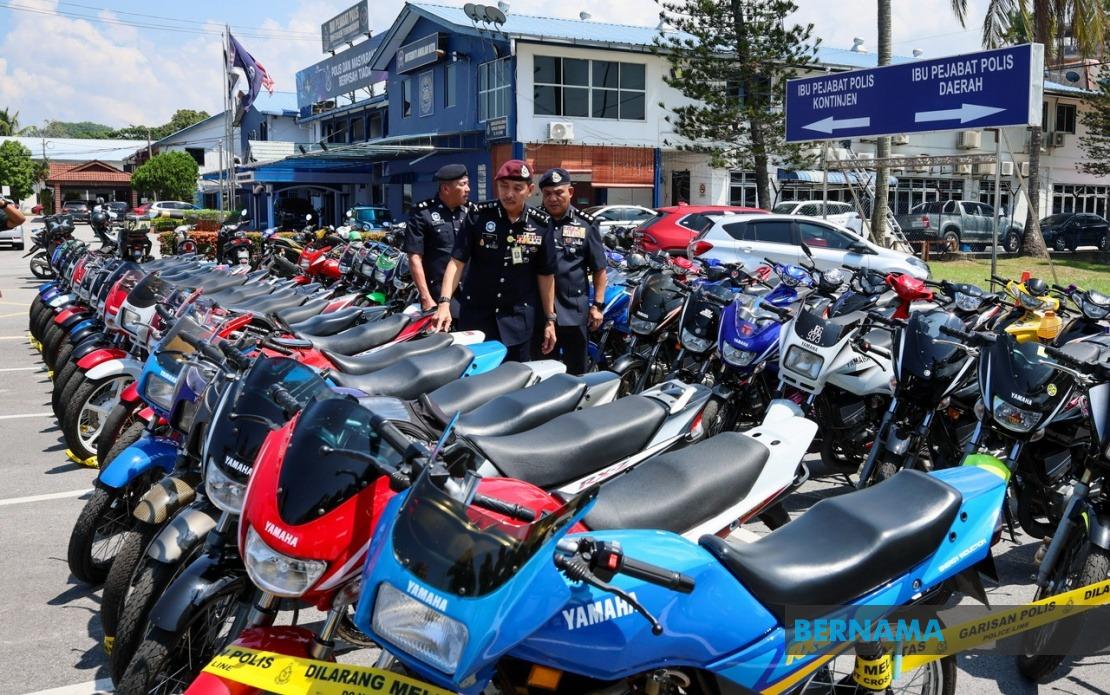
The largest edition of the RXZ Members motorcycle gathering on record has prompted an urgent call from road safety advocates for Malaysia to adopt a systematic approach to managing the event's inherent dangers. Shahrim Tamrin, a former board member of the Malaysian Institute of Road Safety Research (MIROS), has drawn attention to the deteriorating safety record over consecutive years, warning that piecemeal enforcement tactics are inadequate for an event that has ballooned to attract more than 200,000 riders from across the nation.
The RXZ Members 8.0 programme, which concluded recently at the Gong Badak Motor Racing Circuit in Kuala Nerus, revealed stark figures that underscore the severity of the problem. Over the four-day gathering spanning late July and early August, the Bukit Aman Traffic Investigation and Enforcement Department documented 46 motorcycle-related road accidents across Malaysia. Among these incidents, 11 proved fatal—representing nearly a quarter of all recorded accidents—whilst five were classified as serious and thirty as minor. The concentration of casualties during such a short timespan suggests systemic vulnerabilities in how the event is currently organised and supervised.
What distinguishes Tamrin's analysis is his identification of an alarming trajectory rather than a one-off crisis. The fatality figures from successive editions paint a picture of deterioration: two deaths in 2024, escalating to five in 2025, and then surging dramatically to eleven in 2026. This progression, he contends, indicates a structural problem that intensifies with each iteration of the event. As the RXZ Members programme has evolved from a niche motorcycle gathering when it first launched in 2017 into one of Southeast Asia's largest two-wheeled assemblies, the safety infrastructure has failed to scale proportionately with participation numbers. The mathematical reality is sobering: the event now attracts several hundred thousand participants, yet contemporary management approaches remain rooted in conventional policing methods designed for far smaller gatherings.
Tamrin has articulated a comprehensive blueprint for reform that extends well beyond visible police presence on roadways. His proposed framework encompasses participant forecasting to anticipate volume pressures, strategic mapping of arterial entry and exit corridors to mitigate bottlenecks, designated recovery zones where riders can pause without obstructing traffic flow, predetermined positioning of ambulance units, establishment of a dedicated emergency operations centre, coordinated communication protocols, and crucially, a pre-event vulnerability assessment conducted by specialists rather than administrators. Each component addresses a specific failure mode evident in the 2026 incident data. The absence of such orchestrated planning suggests authorities have treated the gathering as a law enforcement challenge rather than a large-scale logistical and public health operation.
Beyond immediate safety enhancements, Tamrin has advocated for an evidence-based feedback mechanism that would transform future editions. He proposes conducting a thorough post-event safety audit examining not merely aggregate figures but granular details: precise accident locations, temporal clustering, contributing factors, participant demographics, mechanical failures, and the measurable impact of any enforcement interventions deployed. Critically, he insists this analytical work be completed and publicly released prior to the subsequent year's event, enabling decision-makers to identify patterns and implement targeted improvements grounded in data rather than intuition. This approach would establish institutional learning, preventing the cyclical pattern whereby each tragedy prompts reactive measures that prove insufficient for the following iteration.
An ancillary concern that has received less policy attention involves environmental and community impacts. Local residents adjacent to the Gong Badak circuit have filed complaints about noise pollution and exhaust emissions generated by the massive concentration of motorcycles. Tamrin has urged enforcement agencies to strengthen compliance mechanisms regarding noise and emission standards, particularly for modified machines. This dimension reflects how the event's expansion has begun affecting constituencies beyond the participating riders themselves, creating political pressure for intervention across multiple regulatory domains.
A practical consideration that Tamrin has highlighted involves the peculiar status of Yamaha RXZ motorcycles themselves. Most machines in active use today are two to three decades old, having been manufactured during the 1990s and early 2000s. This vintage presents documentation and registration challenges. Many have undergone multiple ownership transfers, restoration work, or performance modifications over their lifespan, creating gaps in ownership records and compliance paperwork that complicate re-registration with the Road Transport Department (JPJ). Tamrin recommends streamlining the administrative pathway for roadworthy machines to obtain current registration whilst maintaining stringent safety standards. Specifically, he argues that motorcycles modified in ways that compromise structural integrity or braking capability should either be restored to original specifications or excluded from registration entirely. This distinction is crucial: facilitating legitimate re-registration of well-maintained older machines should not extend to approving unsafe modifications that increase accident risk.
The relationship between the JPJ and police is foundational to any sustainable improvement. Tamrin has recommended that these agencies collaborate with RXZ organisers and affiliated motorcycle clubs to establish training programmes for marshals and convoy leaders, equipping them with knowledge of safe group riding protocols, hazard recognition, and emergency response procedures. This subsidiary safety infrastructure—the human layer of management within the riding community itself—remains largely undeveloped despite its obvious potential to reduce incident rates.
A further innovation that Tamrin advocates involves adopting travel advisory systems comparable to those deployed by Malaysian highway concessionaires during festive holiday seasons. Such systems would provide real-time guidance to participants regarding congestion hotspots, optimal departure windows, alternative routing options, and designated rest facilities. Rather than assuming all 200,000 participants will somehow self-coordinate their movements, structured advisory mechanisms acknowledge the inherent chaos of such mass gatherings and attempt to distribute demand across temporal and spatial dimensions to reduce collision probabilities.
The underlying tension reflects Malaysia's broader challenge in managing civil society gatherings at scale. The RXZ Members programme has transformed from a modest motorcycle enthusiast meeting into a phenomenon that commands national attention and resources. Yet governance structures and enforcement capabilities have not evolved correspondingly. Tamrin's intervention is significant because it reframes the discourse from one of enforcement—attempting to police bad behaviour—toward one of proactive systems design that assumes human fallibility and designs safeguards accordingly. For Malaysian policymakers, the choice is straightforward: invest comprehensively in risk management now, or continue managing preventable tragedies through investigations and inquests conducted after the fact. The mounting casualty figures suggest the current trajectory is unsustainable.

