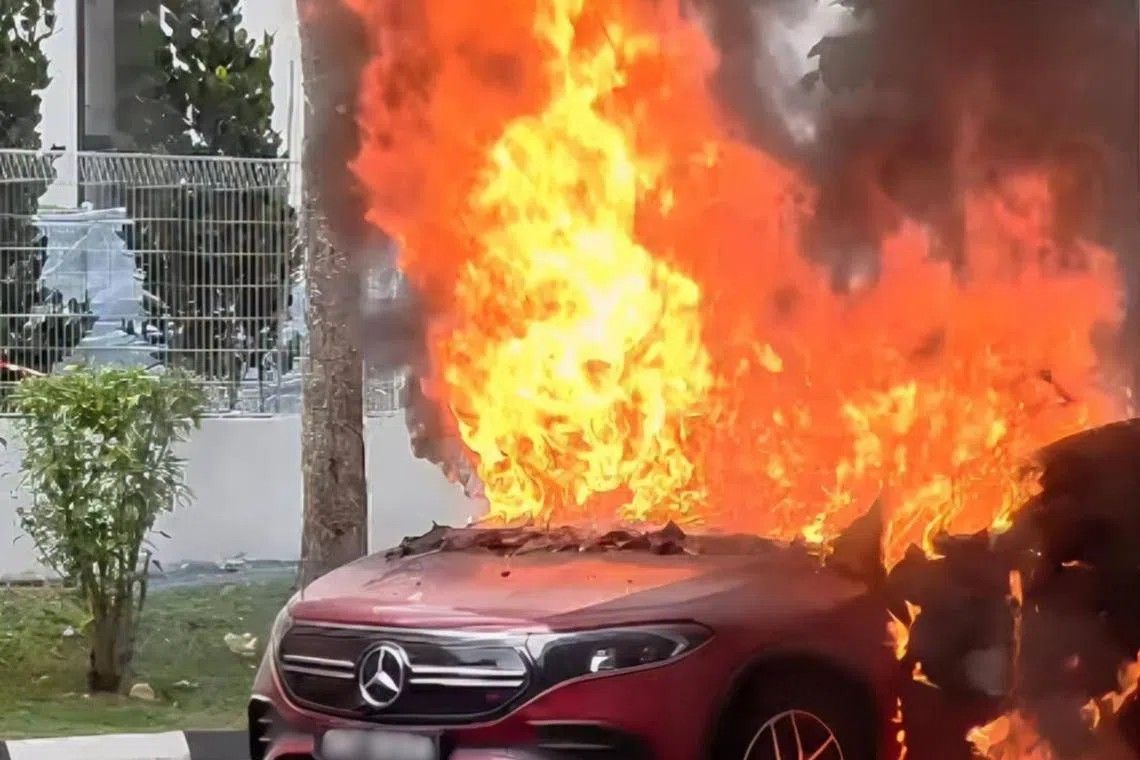
A morning commute turned terrifying on July 21 when an electric vehicle suddenly caught fire near the entrance of a multi-storey carpark at Block 548 Woodlands Drive 44 in Singapore's Woodlands district. The Singapore Civil Defence Force responded to the emergency at approximately 10.10am, dispatching firefighters to battle an intense blaze that had consumed the vehicle's interior and threatened nearby residents and vehicles. While no injuries were reported, the incident underscores growing concerns about electric vehicle safety infrastructure and emergency preparedness across residential housing estates in Singapore and the broader Southeast Asian region, where EV adoption is accelerating without corresponding advances in battery fire containment protocols.
The driver, who was exiting the carpark when the fire began, provided crucial details about the incident's progression when interviewed by Shin Min Daily News. She described noticing a distinctive burning odour while driving and immediately pulling the vehicle to safety upon detecting smoke billowing from the interior. The fire's origin point proved particularly significant: the blaze originated in the cavity situated between the driver's seat and front passenger's seat—an area that houses the vehicle's battery pack. This location is critical because battery fires, especially those involving lithium-ion cells common in modern EVs, present extraordinary extinguishing challenges that standard fire suppression methods often cannot adequately address.
The driver's attempts to contain the situation through conventional means ultimately failed. She sought assistance from security personnel stationed near the carpark, and together they attempted to suppress the flames using standard fire extinguishers. However, the emergency equipment proved wholly inadequate against the intense heat generated by the battery fire. Realising the escalating danger and concerned that the accumulating thermal energy could trigger a catastrophic explosion, the driver and security staff prudently evacuated the immediate vicinity and contacted emergency services. This decision likely prevented serious injuries or fatalities, though it also highlighted the vulnerability of standard carpark safety protocols when confronted with EV-specific hazards.
Photographic documentation of the aftermath reveals the severity of the thermal event. The vehicle's interior lies almost entirely charred, with virtually no recognisable upholstery, trim, or interior fittings surviving the intense heat. The dashboard—normally robust plastic and metal components—appears severely warped and deformed, its structural integrity compromised beyond recognition. The supports and framework that typically conceal the vehicle's structural skeleton now stand exposed, testament to the extraordinary temperatures achieved during the combustion event. Such visual evidence suggests that the battery fire sustained temperatures far exceeding those generated by conventional combustion engine fires, a distinction that carries profound implications for emergency response planning in residential areas.
The SCDF's response demonstrated the capabilities of professional firefighting units equipped and trained for vehicular emergencies. A single water jet proved sufficient to extinguish the fire, though authorities noted that the incident is under active investigation to determine the precise trigger mechanism. This investigative focus is essential, as understanding whether the fire resulted from manufacturing defects, design vulnerabilities, maintenance failures, owner misuse, or battery degradation will shape future prevention strategies. The potential causes range from internal battery cell failures and thermal runaway conditions to external damage from accidents or impact with carpark infrastructure.
For Malaysian readers and Southeast Asian policymakers, this incident carries significant resonance given the region's rapid embrace of electric vehicles as a component of climate action commitments and urban air quality improvement strategies. Malaysia has promoted EV adoption through various incentive schemes and infrastructure investments, with charging networks expanding across Kuala Lumpur, Selangor, and other developed regions. However, battery safety standards, emergency response protocols, and residential carpark infrastructure modifications have not necessarily kept pace with vehicle deployment rates. Carpark operators and housing authorities across Malaysia may lack specific training for battery fire suppression, and building codes may not account for the unique thermal and chemical hazards posed by EV battery fires.
The incident occurred at a high-rise residential complex, the most common living arrangement for urban populations throughout Southeast Asia. Multi-storey carparks in these developments present confined spaces where fire and smoke can rapidly spread through ventilation systems, potentially affecting multiple residential units and creating evacuation challenges. Singapore's incident, occurring in a developed jurisdiction with sophisticated emergency services, still resulted in standard fire extinguishers proving useless. This raises urgent questions about whether Malaysian HDB-equivalent facilities, some managed with fewer resources, possess adequate contingency planning for EV battery emergencies.
Emergency response agencies across Southeast Asia are only beginning to develop specialised training protocols for EV fires. Unlike conventional vehicle fires that respond to water and foam-based suppression techniques, battery fires often require thermal management strategies, chemical suppression agents, or prolonged cooling periods. The SCDF's deployment of water jets proved effective in this instance, though some fire services have experimented with alternative approaches including dry powder application and foam systems designed specifically for lithium-ion battery fires. Without standardised regional guidance, responses may vary substantially between jurisdictions.
The vehicle was removed from the carpark at approximately 12.15pm, roughly two hours after emergency services arrived. This recovery timeline reflects the need for extended cooling and monitoring periods, as battery fires can spontaneously reignite after initial suppression. Such removal procedures complicate carpark operations and may impact access for other residents, factors that housing authorities and property management companies across Malaysia will increasingly confront as EV ownership penetrates the vehicle fleet.
Singapore's development density and concentration of high-rise residential housing create unique vulnerabilities around EV fire incidents. Malaysia's rapid urbanisation in Kuala Lumpur, Petaling Jaya, Shah Alam, and other metropolitan areas is following similar patterns. As EV adoption accelerates across the region, driven by government incentives, improved charging infrastructure, and declining battery costs, residential buildings will house greater concentrations of electric vehicles. This creates a compounding risk profile unless building codes, carpark design specifications, and emergency response capabilities are upgraded proactively.
The investigation into the fire's cause remains ongoing, with SCDF officials pursuing technical analysis of the damaged vehicle and its battery system. Results from this investigation will likely be shared with regional automotive safety authorities and emergency management agencies. However, the incident already demonstrates that reactive responses—arriving after fires begin—are insufficient safeguards. Proactive measures including enhanced carpark ventilation systems, improved early detection technologies, dedicated charging infrastructure with isolation capabilities, and operator training programs must precede widespread EV adoption in residential settings.
For Malaysia's automotive industry, charging operators, and housing sector stakeholders, this Singapore incident serves as an instructive case study. The growing intersection of urbanisation, electric vehicle proliferation, and residential density demands that Southeast Asian jurisdictions develop comprehensive, harmonised approaches to EV safety before incidents proliferate. Policymakers should consider establishing regional standards for carpark EV charging infrastructure, requiring building code modifications for high-rise residential developments with EV parking areas, and mandating that emergency services develop EV-specific fire response protocols. The incident also highlights the importance of driver awareness—this motorist's quick recognition of abnormal symptoms and decision to evacuate undoubtedly prevented more serious consequences. As EV adoption accelerates across Malaysia and the region, education campaigns teaching drivers to recognise warning signs of battery malfunction will become increasingly critical for public safety.

