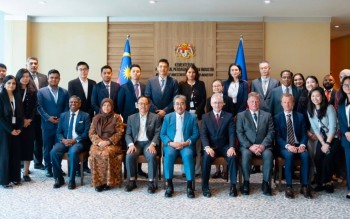
A high-level European business delegation concluded a three-day visit to Kuala Lumpur this week, holding substantive discussions with multiple Malaysian government agencies on economic reform, environmental sustainability, and bilateral trade expansion. The EU-ASEAN Business Council (EU-ABC) led the engagement, bringing together more than 25 European companies and over 70 representatives to chart a course for deeper economic cooperation between Malaysia and Europe across critical sectors.
Chris Humphrey, executive director of EU-ABC, characterised the visit as a success, emphasising that direct engagement with Malaysian policymakers offered valuable clarity on the government's reform trajectory and regulatory environment. The delegation's multi-ministry itinerary reflected the breadth of European commercial interests in Malaysia, spanning finance, natural resources, energy, healthcare, agriculture and digital transformation. Humphrey highlighted the uniformly constructive tone of discussions, noting that Malaysian officials demonstrated genuine enthusiasm for attracting European investment and deepening institutional partnerships.
At the Economy Ministry, the delegation received detailed briefings on Malaysia's ongoing reform initiatives and expressed strong support for the government's commitment to the green transition. European business leaders signalled particular interest in circular economy development and digitalisation pathways, recognising these as areas where Malaysian and European companies can collaborate profitably. Similarly, discussions at the Finance Ministry canvassed broader questions of investment climate, taxation frameworks, and innovative financing mechanisms—all critical considerations for corporate capital allocation decisions.
The Malaysian financial regulator, Bank Negara Malaysia, also featured prominently on the agenda, underscoring European banks' and investors' need for clarity on monetary policy and financial stability considerations. Key government figures including Investment, Trade and Industry Minister Datuk Seri Johari Abdul Ghani and Economy Minister Akmal Nasrullah Mohd Nasir met the delegation to reaffirm Malaysia's openness to foreign direct investment and outline sectoral priorities. These high-level interactions signal that both sides regard the commercial relationship as strategically significant.
Environmental and sustainability concerns occupied substantial portions of the discussions, reflecting the European Union's own aggressive climate commitments and the growing importance of ESG (environmental, social and governance) criteria in European corporate decision-making. Meetings with the Natural Resources and Environmental Sustainability Ministry and the Energy Transition and Water Transformation office addressed how Malaysia and Europe can collaborate on renewable energy deployment, energy efficiency improvements, and sustainable resource management. For Malaysian readers, this signals that the country's green transition agenda is increasingly central to how international investors evaluate long-term opportunities.
Customs modernisation emerged as a significant focus area, with European businesses seeking expedited clearance procedures and digital enhancements to Malaysia's import-export systems. Beyond efficiency gains, the delegation emphasised the importance of working with the Malaysian Customs Department to combat illicit trade, particularly in tobacco products—an issue where Malaysia faces sustained enforcement challenges. This dimension of the visit underscores how bilateral business engagement can address broader regulatory and public health concerns simultaneously.
Healthcare cooperation also featured prominently, with European pharmaceutical and medical device companies exploring opportunities to support Malaysia's evolving healthcare infrastructure. The EU-ABC representatives stressed European willingness to discuss innovative financing models for healthcare expansion, pharmaceutical availability, and preventive wellness initiatives. For a Southeast Asian nation managing rising healthcare demand amid budget constraints, such partnerships offer practical pathways to improve service delivery without overwhelming public expenditure.
Central to the entire engagement was the Malaysia-EU free trade agreement, currently in its fifth negotiation round. Both parties have demonstrated sufficient political commitment to target finalisation by 2027, with the next negotiating session scheduled for September 21-25 in Brussels. Humphrey expressed confidence that momentum would accelerate following the September round, with a sixth round anticipated before year-end. This timeline matters significantly for Malaysian exporters and investors, as an FTA would reduce tariff barriers, simplify regulatory compliance, and enhance market access for Malaysian products across the EU's 27 member states.
The strategic value of Malaysia as a European investment destination reflects multiple structural advantages. The country's geographic position as a gateway to Southeast Asia, well-developed infrastructure, educated workforce, abundant natural resources, and availability of land create a compelling investment proposition. Europe's existing economic footprint in Malaysia is substantial: bilateral goods trade reached €48.9 billion in 2025, with Malaysia exporting €30.3 billion to EU markets while importing €18.6 billion of EU goods. European direct investment stock in Malaysia exceeded €33.1 billion in 2024, positioning Malaysia among the EU's top investment destinations in Southeast Asia.
For Malaysia's policymakers and business community, these developments carry important implications. The visit demonstrates that the government's reform narrative is resonating with international investors and that Malaysia's green transition commitment is credible in the eyes of demanding European corporations. The forthcoming FTA negotiations represent an opportunity to lock in preferential market access for Malaysian exports while positioning the country as a hub for European regional operations. As European companies navigate supply chain diversification away from China and seek production bases in geopolitically stable, well-connected locations, Malaysia stands to capture meaningful investment flows.
The delegation's focus on customs efficiency and digital transformation also suggests areas where Malaysian policy improvements could yield immediate commercial returns. Streamlining import-export procedures would enhance Malaysia's competitiveness against rival ASEAN destinations such as Vietnam and Thailand, both of which have invested heavily in logistics modernisation. Similarly, combating illicit trade demonstrates how public-private partnerships can address enforcement challenges that undermine legitimate commerce and government revenues.
Looking ahead, the success of the EU-ABC visit may catalyse additional European engagement with Malaysian counterparts across other sectors. The uniformly positive reception suggests that government officials view European investment as complementary to domestic development priorities rather than competitive or threatening. As negotiations on the free trade agreement intensify over the coming months, maintaining this constructive momentum will be crucial. For Malaysia's regional standing, deepening economic ties with Europe—alongside existing relationships with China, India, Japan, and the United States—reinforces the country's position as a genuinely non-aligned, open economy attracting capital from multiple sources.

